• Seeks input from business leaders to spur export-led growth
• Orders review of super tax exemption for exporters
• Insists reducing energy costs remains govt priority
• Regulatory ‘guillotine’ being pursued to cut compliance burden
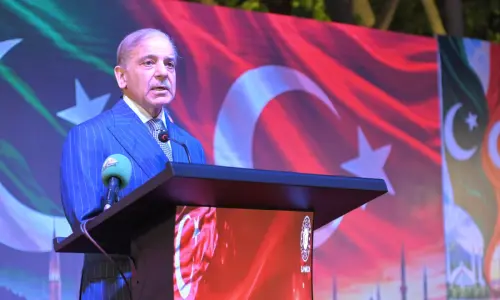
ISLAMABAD: Prime Minister Shehbaz Sharif on Tuesday said the government had recovered Rs800 billion through enforcement measures in the past year without imposing new taxes, as he sought fresh proposals from leading businessmen and industrialists to accelerate export-led growth.
During a more than two-and-a-half-hour meeting at the Prime Minister’s House, PM Shehbaz also directed the relevant authorities to review extending the super tax exemption for exporters and promised continued consultation with the business community on tax, trade and investment issues.
The prime minister expressed gratitude to business leaders for their proposals, which were incorporated into the last federal budget. “The PM also hosted a dinner reception in their honour after the meeting,” an official close to the prime minister told Dawn.
“You people helped prepare such a balanced budget ... for this I must thank you,” the source quoted the prime minister as telling the participants.
PM Shehbaz vowed to continue consultations with the business and industrial community, stressing that such interactions would be held regularly.
Pakistan Business Council Chairman Ziad Bashir, who was one of the participants, said the prime minister spoke briefly and spent most of the meeting listening to suggestions and problems raised by businessmen and industrialists.
He said the premier had directed cabinet members to maintain a close liaison with the business community for prompt resolution of their issues.
According to the Prime Minister’s Office, the premier said any economic growth achieved by the country would have to be export-led. “Whatever growth we have to achieve, it has to be export-led growth,” he said.
He said the purpose of the meeting was to seek the business community’s views, early in the fiscal year, on challenges to increasing exports and possible ways of overcoming them.
“Today’s meeting is because I need your opinions on how to increase our exports, as well as what challenges we will face and how to address them,” he told the participants.
The prime minister said special tax relief had already been extended to exporters in the budget. He also directed the authorities to review the possibility of extending the super tax exemption for exporters.
He said reducing energy costs remained one of the government’s priorities as part of efforts to improve the business environment.
PM Shehbaz also expressed his resolve to make the recently established Trade Facilitation Board an effective institution for promoting trade and sought proposals from the business community to improve its scope and performance.
He said work was under way on a “regulatory guillotine” aimed at removing unnecessary regulations, simplifying rules and reducing compliance costs for businesses.
The prime minister said the Special Investment Facilitation Council was also providing investors with a one-window platform.
Enforcement drive
PM Shehbaz said overdue structural reforms had been undertaken with the support and consultation of the private sector.
“As a result, we made overdue structural reforms. It’s a long journey, but through enforcement we recovered Rs800bn in one year. No new taxes were imposed,” he said.
According to the PMO, the government had pursued cases pending in courts for the past 10 years, particularly those involving indirect sales tax paid by consumers. The prime minister claimed that such improvement in enforcement had not been witnessed before in the country’s history.
He recalled that before the budget, several rounds of consultations had been held with the business community, involving the finance and commerce ministers, their secretaries and other officials.
PM Shehbaz said recommendations made by business leaders during those discussions had helped the government introduce structural changes.
He said the process represented a “long journey” undertaken through collective effort and promised that the government would continue seeking guidance from the private sector.
The premier said it was for this reason that the International Monetary Fund, for the first time, extended relevant allowance, and that the IMF managing director, during an interaction with the prime minister, had agreed to offer a tax waiver.
He said Pakistan’s macroeconomic conditions had improved but acknowledged that more work was required at the microeconomic level to ensure that the benefits reached citizens.
He said progress had also been made in digitising the Federal Board of Revenue (FBR) and directed officials to take immediate steps to address issues raised by businesses.
The meeting was also informed of measures to improve export infrastructure and facilitate small and medium enterprises (SMEs), including efforts to improve their access to financing and increase their participation in exports.
Business leaders discussed both traditional export sectors and emerging areas such as telecommunications, digital infrastructure and artificial intelligence.
Industrialist Aamir Ibrahim said participants called for greater focus on AI infrastructure, including data centres and “AI factories”, to strengthen the country’s digital economy.
Other participants welcomed regular consultation between the government and industry and called for prompt resolution of taxation and other business-related problems.
Published in Dawn, September 9th, 2026