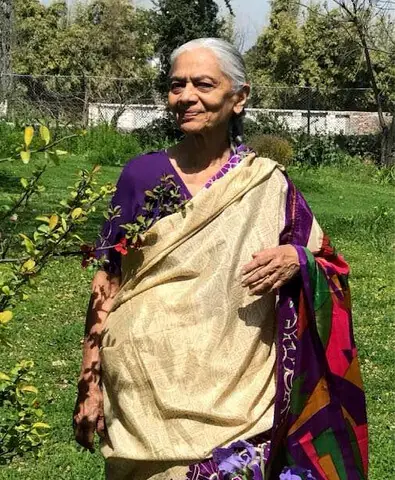
ISLAMABAD: After a lifetime dedicated to teaching arts and classical dance, celebrated classical dancer Indu Mitha, 97, passed away in Dublin, surrounded by a legacy that stretches far beyond geography.
Born Indu Chatterjee in Lahore in 1929, she belonged to a Bengali Brahmin family that had converted to Christianity.
At the time of Partition, her family moved to Delhi, where she earned a Master’s degree in Philosophy from Delhi University and also learnt Bharatanatyam, a classical dance with roots in Tamil Nadu.
In 1951, she moved back to Pakistan after marrying Captain Aboobaker Osman Mitha, who later became a major general in the Pakistan Army. Here, she travelled across the country with her husband, and wherever she found herself, she performed and taught classical dance.
From Lahore Grammar School, where she taught dance, to her own Mazmoon-i-Shauq academy, she taught her craft to anyone who cared to learn.
Indu adapted themes that resonated with her audience and worked with Urdu poetry and music. She brought ‘Bharatanatyam’ out of temples where it originated and beyond the musical and linguistic traditions that had defined this ancient dance. She even reimagined this classical dance form to include secular and feminist ideas.
Indu mentored thousands of young artists over the course of her eventful life and stood out as “the voice of the artist” in a country where art is often undervalued. She showed up for the arts and championed key causes, but she was also discerning in who she chose to mentor and support.
Indu was also the subject of ‘How She Moves’, a documentary by her students that celebrated classical dance and music. Similarly, ‘Theatre Wallay’ in Islamabad shared some of her stories in ‘This Stained Dawn’, a 2015 theatre production bringing together stories of Partition.
In the generosity of spirit that was her hallmark, Indu shared her memories and stories of her father, Professor Chatterjee, a professor of philosophy at Government College Lahore, for this production.
In 2020, the Government of Pakistan awarded her the Presidential Pride of Performance for her contribution to the arts.
Fizza Hasan, director of Theatre Wallay, said Indu Mitha embodied the true spirit of an artist who never allowed age or circumstance diminish her engagement with the arts.
She said: “At a time when the arts and cultural spaces are increasingly fragile, Indu refused to let them fade away. She kept showing up, as an artist, a mentor, a storyteller and an audience member. Her life reminded younger artists that art is not something one simply does; it is a way of remaining engaged with the world and with other people.”
Arjumand Faisel, a gallerist, said Indu’s presence was a gift of nature. “She radiated warmth and positive energy, stimulated the mind, filled the heart with joy, and brought a quiet sense of peace to the soul.”
Her legacy lives on through her daughter Tehreema Mitha, who posted about the demise of her mother in a Facebook post on August 31. A dancer and choreographer herself, Tehreema described her mother as a beloved wife, mother, nani and guru who gave her love — and her joy of dance — unconditionally to so many.
Published in Dawn, September 2nd, 2026