PSX closes lower as geopolitical uncertainty weighs
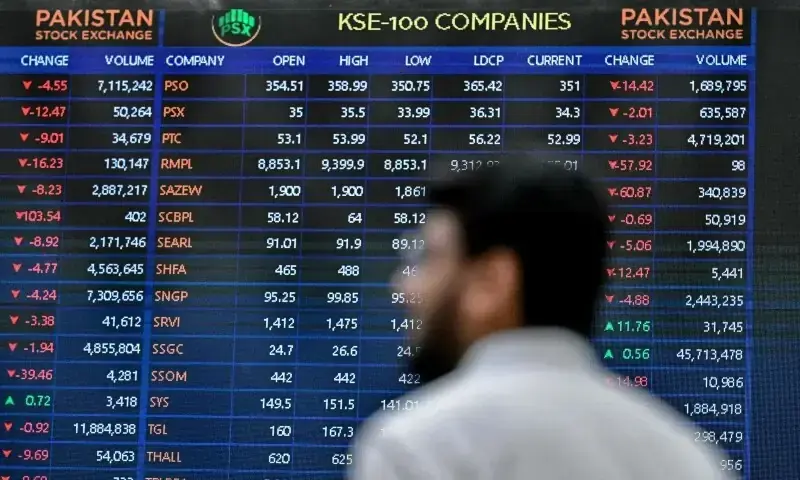


KARACHI: The Pakistan Stock Exchange (PSX) closed lower during the outgoing short week as uncertainty over a possible US-Iran agreement and the reopening of the Strait of Hormuz kept investors cautious, while elevated oil prices continued to weigh on sentiment.
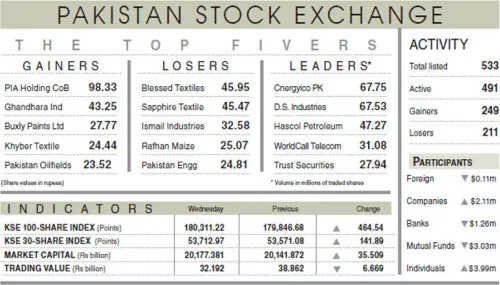
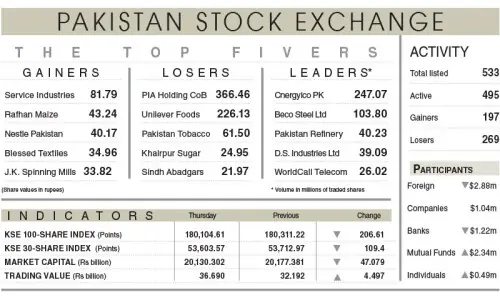
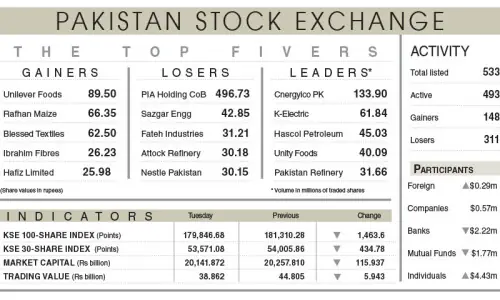
According to Arif Habib Ltd (AHL), the KSE-100 index fell 0.73 per cent, or 1,325 points, week-on-week to close at 180,104.
Topline Securities Ltd noted that the index largely traded sideways amid limited progress in US-Iran negotiations and a lack of fresh market triggers.
AKD Securities Ltd said Brent crude crossed $90 per barrel during the week, compared with $84 last week, before easing to around $86. The elevated oil prices added to concerns over external-sector pressures and kept investors wary.
Elevated oil prices amid US-Iran tensions keep investors cautious in short week
Despite the subdued market performance, trading activity improved. Average daily volume rose 14pc week-on-week to 853.3 million shares, while average traded value increased 13pc to $137m.
The main market support came from exploration and production (E&P), refinery, leather and tanneries, and miscellaneous sectors. E&Ps contributed 297 points to the index, refineries 159 points, leather and tanneries 76 points, miscellaneous companies 63 points and fertiliser 17 points.
The major drags were power, technology, cement, investment banks and insurance, which contributed negative 445, 236, 234, 172 and 59 points, respectively.
Among individual stocks, Hub Power was the biggest negative contributor, taking 435 points off the index, followed by Lucky Cement, Engro Holdings, Systems Ltd and United Bank, which dragged it down by 188, 173, 159 and 122 points, respectively. Habib Bank was the largest positive contributor at 280 points, followed by Pakistan Petroleum, Pakistan Oilfield, Cnergyico PK and Service Industries.
Foreign flows remained mixed. Individuals were the largest net buyers of equities, with net purchases of $16.3 million, while companies were the largest net sellers, with net sales of $5.2 million. Banks and insurance companies were the major sellers, recording net sales of $11.2m and $6.3m, respectively.
Automobile sales provided a positive domestic indicator. July sales rose nearly 80pc year-on-year to 19,818 units, although they fell 13pc month-on-month, thanks to a strong annual increase, robust demand, and a low base in the same period last year.
Workers’ remittances also strengthened, rising 13pc year-on-year and 5pc month-on-month to $3.6bn in July, compared with $3.2bn a year earlier. Gross inflows under the Roshan Digital Account reached $13.647bn by July, with $2.118bn repatriated and $8.603bn utilised locally.
According to the Ministry of Finance’s economic report, Pakistan’s fiscal position also improved. The fiscal deficit for FY26 stood at Rs3.313 trillion, or 2.6pc of GDP, its lowest level since FY18. The primary surplus reached a record 2.9pc of GDP. The FBR tax collection rose 11pc year-on-year to Rs13.01tr, while mark-up payments declined 22pc to Rs6.948tr.
Central government debt, however, rose 7.4pc year-on-year to Rs83.4tr by June, compared with Rs77.9tr a year earlier. The rupee strengthened marginally, gaining 0.04pc week-on-week to close at Rs277.7 against the dollar.
Oil and gas production showed mixed trends. Oil output declined 3.4pc week-on-week to 682,000 barrels per day, mainly because of lower flows from Nashpa, while gas production increased 4pc to 2,939 million cubic feet per day following the revival of Uch gas production.
Petrol prices fell Rs2.64 per litre to Rs324.98, while high-speed diesel rose Rs3 to Rs382.79, following a corresponding increase in the petroleum development levy.
Other key developments included plans to open a new gateway for global oil suppliers, indications that the Federal Board of Revenue could withdraw super tax, satisfactory cotton crop prospects and Punjab rice production exceeding its target.
Analysts expect geopolitical developments and corporate results to remain key market drivers as the earnings season gathers pace. The market is likely to improve on stronger economic indicators, easing geopolitical tensions and favourable June-quarter results. A potential US-Iran agreement could also bring international oil prices closer to pre-conflict levels.
The KSE-100 index is currently trading at a forward price-to-earnings ratio of about 8.1 times, with a dividend yield of 6.2pc.
Published in Dawn, August 15th, 2026