Leh Nullah rises to dangerous level after heavy rain
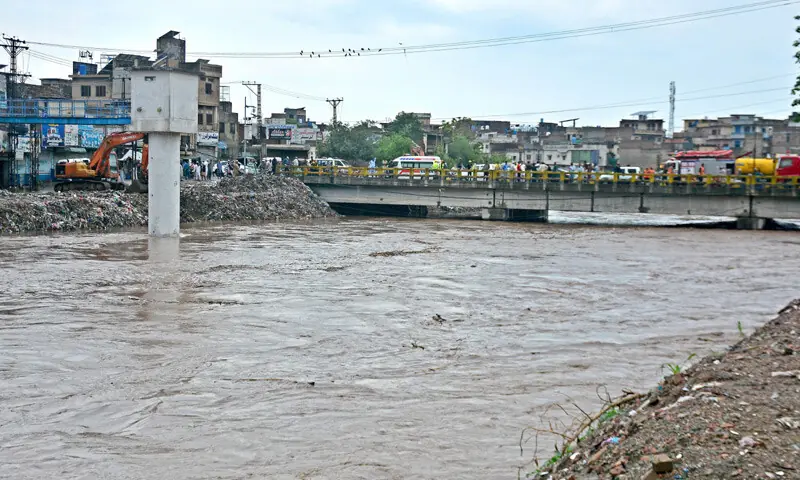

RAWALPINDI: Heavy rain lashed the twin cities of Rawalpindi and Islamabad on Wednesday morning, raising the water level in Leh Nullah and inundating houses in low lying areas in surrounding.
The Met Office had warned a day earlier that monsoon currents were penetrating the country and might continue during the following 24 hours. The monsoon currents were likely to strengthen further from August 13, with rain expected until August 15.
The water level in Leh Nullah rose to 18 feet at Kattarian Bridge and 17.5 feet at Gawalmandi, while residential areas along the nullah came under water, forcing residents to leave their houses until the water receded.
The 111 Brigade of the army arrived to deal with any emergency. Rescue 1122 was ready with boats to rescue people living in low-lying areas. However, the rain later stopped.
Water enters houses located in low-lying areas
The Water and Sanitation Agency (Wasa), district administration and Rescue 1122 remained on high alert and prepared to shift residents of low-lying areas to safer places.
The Meteorological Department recorded 143 millimetres (mm) of rainfall at Golra, 70mm at Zero Point, 73mm at Saidpur, 47mm at Bokra and 24mm at the Airport in Islamabad, while 76mm was recorded at New Kattarian, 65mm at Shamsabad, 62mm at Chaklala, 54mm at Gawalmandi and 51mm at Katcheri and Pirwadhai in Rawalpindi.
The Met official said weak monsoon currents from the Arabian Sea were penetrating the upper parts of the country. A shallow westerly wave was also present over the upper and western parts.
“Rain-wind/thundershower (with isolated heavy falls) is expected in Kashmir, Gilgit-Baltistan, Khyber Pakhtunkhwa, Islamabad, Pothohar region and northeast/south Punjab, while hot and humid weather will prevail elsewhere in the country,” he said.
The five-hour-long shower, varying from light to heavy, lashed the twin cities, bringing the mercury down to 30 degrees Celsius and almost blocking all major roads in the city and cantonment areas. However, the water drained out in the afternoon.
The roads and streets presented the look of small pools, posing great difficulty for commuters. At many places in the city and cantonment areas, traffic signals went out of order, leading to traffic chaos. Power supply was suspended in low-lying areas for fear of damage to human lives.
The strong spell of rain exposed the tall claims of the local administration in city areas and the Rawalpindi and Chaklala Cantonment Boards that they had cleared obstructions in nullahs and drains for the smooth flow of water.
The sewerage systems in city and cantonment areas and those adjacent to Leh Nullah choked, causing water to enter houses and shops.
Water entered the basement of the Outpatient Department of Holy Family Hospital, where the gynaecology and paediatrics departments have been established, creating a mess in the hospital.
As much as Rs3 billion has been spent on the construction of the new Holy Family Hospital building, and the incident exposed the quality of construction work by the Communication and Works Department.
The hospital drainage system was recently laid by the Water and Sanitation Agency, but it failed to cope with the rain. “Wasa dug up the area to lay sewerage lines and failed to fill it before the monsoon, and it created a mess,” said a senior doctor at HFH.
When contacted, HFH Medical Superintendent Dr Ijaz Butt said rainwater entered the basement during the early morning rain, but the staff managed to clear it by 8:30am before the formal opening of the OPD.
Meanwhile, rainwater entered Dhoke Khabba, Nadeem Colony, Gawalmandi, Arya Mohallah, Sadiqabad, Satellite Town and adjoining areas, where people spent the day draining water from their houses.
On the other hand, a Water and Sanitation Agency (Wasa) official claimed that heavy rainfall in the catchment areas of Leh Nullah in Islamabad was the main reason for the rise in its water level.
“The intensity of rain was very high, as 60mm of rain fell in one hour, which raised the water level,” he said.
He said Leh Nullah had not risen to the dangerous level of 30 feet. “Due to rainwater, many shrubs as well as waste accumulated near Gawalmandi Bridge, and we will remove them from the nullah on Thursday using heavy machinery,” he said.
Published in Dawn, August 13th, 2026