There is something unsettling about places that continue to exist only in memory. They linger somewhere between reality and imagination, carrying fragments of lives that can no longer be revisited.
Zahabia Khozema’s ‘A Memory Catcher Visited My Town’ is built around this fragile space between remembering and forgetting. Inspired by the recollections of a boy who grew up in an industrial town in central Punjab, this exhibition at Vasl Gallery becomes less a record of a disappearing place and more a meditation on belonging, loss and the landscapes we carry within us.
The artist’s statement introduces a stone-crusher, a goat-grazer and a coal-miner awaiting the arrival of a “memory catcher.” It unfolds almost like folklore, yet beneath its poetic language lies a sobering reality. The town gradually disappears under the pressures of capitalist expansion, economic violence and climate change. Rather than documenting this transformation literally, Khozema explores what remains when homes, communities and identities begin to dissolve.
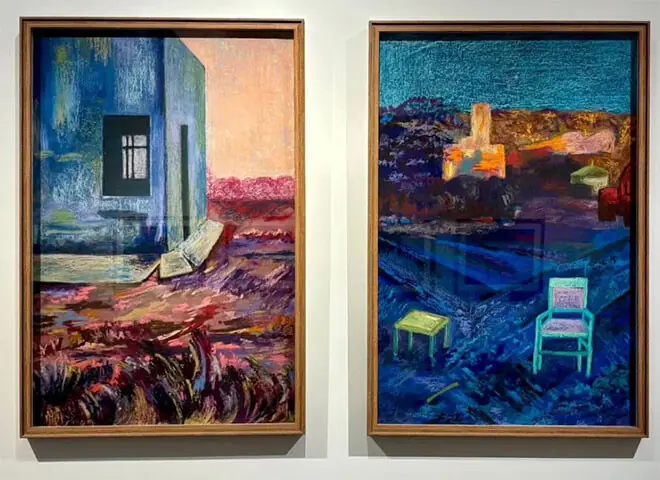
This sense of abandonment is particularly evident in How Many Times Did You Pass by This House?, where an empty dwelling stands as more than an architectural form. Stripped of human presence, it suggests that buildings, much like people, retain the memories of those who once inhabited them.
Through luminous colours and dreamlike settings, Zahabia Khozema explores how memory preserves places long after they have disappeared from the physical world
Similarly, Let Us Meet Here Again, with its solitary chair placed within an expansive landscape, transforms an ordinary object into a poignant symbol of absence. The chair inspires conversations that never took place, people who never returned and places that continue to wait long after they have been forgotten.
The paintings rarely feel tied to a specific geography. Rivers, abandoned houses, flowering trees and open landscapes drift between dream and recollection, occupying a liminal territory where certainty gives way to sensation. Rather than reconstructing a town with documentary precision, Khozema paints the emotional architecture of remembrance. The viewer is left navigating spaces that feel familiar without ever being fully identifiable, as though assembled from scattered fragments of childhood.
Perhaps the exhibition’s most compelling quality is its use of colour. A body of work addressing displacement, environmental decline and erasure might be expected to rely on subdued tones, yet Khozema embraces intensely saturated blues, luminous pinks, violets and fiery oranges. In When the Mountains Called for Us, broad, expressive passages of warm colour, interrupted by seemingly unfinished forms and abrupt gestures, lend the work an almost dreamlike quality.
The looseness of the composition depicts the fragmented way memory often survives. Likewise, What Was Behind This is dominated by glowing reds and magentas, interrupted only by delicate passages of cool blue, suggesting that warmth and melancholy can exist within the same remembered moment.
Materiality further strengthens this atmosphere. Working with oil pastel and oil sticks, Khozema builds dense, tactile surfaces that reward prolonged looking. Thick deposits of pigment, energetic scribbles and layered marks prevent the paintings from becoming overly polished.
While deeply personal, the exhibition also gestures towards wider political realities. The vanished town is not presented as the inevitable consequence of time but as the result of systems that value extraction over communities and development over continuity. Climate change further deepens this vulnerability, reminding us that landscapes and livelihoods often disappear together.
Although the exhibition draws upon themes of capitalist erasure, economic violence and environmental decline, these ideas remain understated within the paintings themselves. Rather than confronting the viewer directly, Khozema allows them to emerge gradually through atmosphere and memory, inviting viewers to feel their emotional weight before recognising their broader social implications.
‘A Memory Catcher Visited My Town’ ultimately becomes an act of resistance. By preserving the emotional geography of a place, Khozema suggests that remembering itself can become a way of resisting disappearance. The exhibition stays long after one leaves the gallery, not simply because it reminds of what has been lost, but because it asks what remains when an entire town survives only in the memories of those who once called it home.
‘A Memory Catcher Visited My Town’ was on display at Vasl Gallery in Karachi from July 28-August 7, 2026
The writer is a Karachi-based visual artist currently pursuing an MPhil in Visual Arts at the National College of Arts (NCA), Lahore
Published in Dawn, EOS, August 9th, 2026