The group exhibition ‘The Invisible Collapse’, held at Karachi’s Canvas Gallery, brings together four artists whose practices emerge from distinctly different lived realities, yet converge around a common concern: the experience of marginalisation.
Whether shaped by disability, gender, geography, political violence or ethnicity, the works of Attiya Shaukat, Rabia Farooqui, Maisam Hussain and Syed Hussain explore what it means to belong to a society that simultaneously excludes. The exhibition unfolds through deeply personal narratives, revealing the invisible fractures that quietly shape contemporary Pakistan.
Attiya has spent more than two decades navigating life in a wheelchair, after a fall just before presenting her Bachelor of Fine Arts (BFA) thesis at the National College of Arts (NCA), Lahore in 2004 left her paralysed from the waist down. Rather than allowing disability to define her, she has transformed it into a language of resilience, self-examination and artistic inquiry. Her artist’s statement speaks of continually searching for inner strength and embracing experimentation as an essential part of her practice.
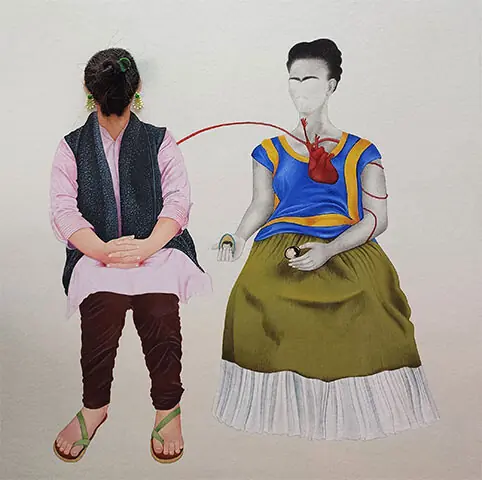
Frida Kahlo appears as an important artistic companion in Let the Dice Roll I and II, where stitched thread intersects with portraits of the Mexican artist, whose own physical suffering has long become part of art history. In To Be or Not To Be I, Kahlo’s face is stripped of every feature except her unmistakable unibrow, while her exposed heart extends through branching veins towards Attiya’s own seated figure. The artist herself is portrayed with her face completely obscured by her hair, suggesting both concealment and protection.
Four artists confront disability, political violence, emotional vulnerability and prejudice in an exhibition that explores the hidden fractures running through Pakistan
The paired work, Queen of Bones I, shifts the viewpoint to the back of her head, allowing the damaged vertebrae that caused her paralysis to dominate the composition. Attiya transforms the injured spine into both subject and symbol, reclaiming ownership over a body that has become central to her artistic vocabulary.
Where Attiya’s work turns inward, Rabia examines the subtle dynamics of instinct, vulnerability and power. Trained in miniature painting at the Indus Valley School of Art and Architecture (IVS), the artist employs gouache on wasli to construct carefully orchestrated narratives that deliberately resist easy interpretation. Her anonymous figures refuse portraiture in the conventional sense. By withholding identity, Rabia redirects attention towards relationships, gestures and emotional undercurrents.
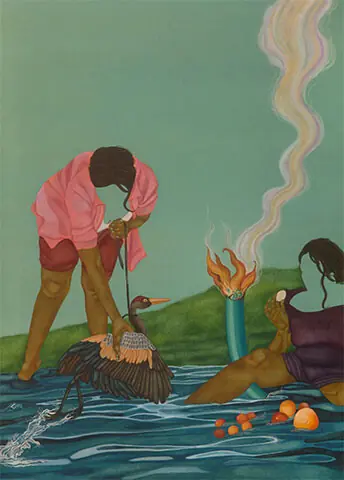
Motifs of fire, water, birds and eggs become metaphors for contemporary political and emotional landscapes. Fire represents crises that have become disturbingly familiar, while turbulent water suggests disasters whose violence barely registers in public consciousness. Particularly compelling is the diptych comprised of the artworks Don’t Stop Me and Protection, where cranes, women and cats coexist in an uneasy balance of care and threat. In Forced Release, a woman struggles to lift a crane from water while its eggs drift helplessly nearby. The imagery recalls both maternal instinct and forced displacement, allowing multiple readings without prescribing a single narrative.
For Maisam, memory is inseparable from conflict. Born in Parachinar, Khyber Pakhtunkhwa (KP), his childhood unfolded amid bomb blasts, gunfire and recurring violence. His paintings recall growing up in an environment where explosions, shattered buildings and dust-filled air became ordinary experiences rather than extraordinary events.
A sculptor by training and currently teaching at the NCA, Maisam works with unconventional materials closely associated with warfare. Every work in this exhibition is executed using gunpowder and graphite, transforming the very substance of violence into a medium of artistic expression. Rather than depicting war literally, Maisam allows its physical residue to become the image itself, collapsing the distance between medium and message. His restrained monochromatic surfaces convey trauma more effectively than overt representation could.
Syed approaches marginalisation through the lens of identity. As a member of Pakistan’s Hazara community, whose distinct physical features have made them frequent targets of discrimination and violence, he explores visibility itself as both burden and necessity.
His Document Series consists of exquisitely rendered portraits of Hazara children, painted on wasli. Instead of naming the children, however, each portrait is identified only by a number. The decision is quietly devastating. These are individuals whose humanity is unmistakably conveyed through delicate observation and remarkable technical precision, yet bureaucratic numbering strips away personal identity. The contrast raises uncomfortable questions about documentation, surveillance, anonymity and the reduction of human lives into statistics.
Although each artist speaks from a different social location, ‘The Invisible Collapse’ succeeds because it avoids reducing marginalisation to a single narrative. Disability, emotional vulnerability, political violence and ethnic persecution remain distinct experiences, yet the exhibition reveals their shared foundation: the struggle to be recognised fully within society.
By transforming personal histories into visual testimony, the four artists ask us not simply to witness suffering but to question our own habits of looking away. In doing so, The Invisible Collapse becomes less an exhibition about victims than about resilience, memory and the urgent need to recover our capacity to see.
‘The Invisible Collapse’ was on display at Canvas Gallery in Karachi from July 14-23, 2026
Rumana Husain is a writer, artist and educator. She is the author of two coffee-table books on Karachi, and has authored and illustrated 90 children’s books
Published in Dawn, EOS, August 2nd, 2026