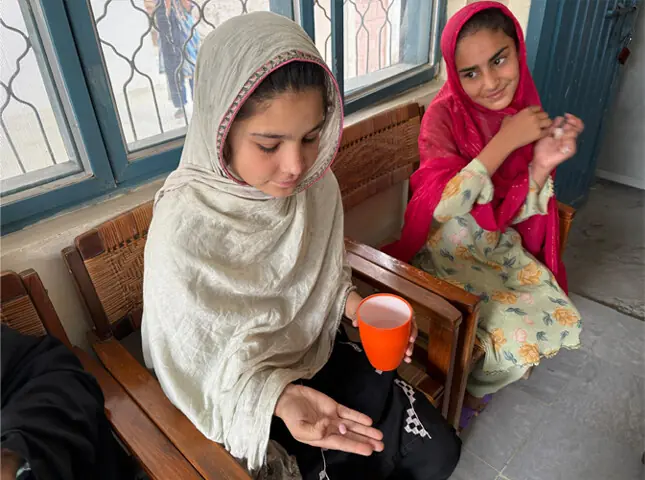
In Swat, 15-year-old Hania has spent the last 10 months learning about nutrition, balanced diets and almost everything she needs to know about anaemia.
She can tell you which foods inhibit iron absorption — tea, coffee and milk. She knows that Vitamin C helps. She has made fruit plates in class, designed posters and role-played conversations with imaginary mothers, fathers and brothers. She takes her weekly iron-folic acid (WIFA) tablet every Tuesday in school, in front of her teacher, with a cup of water ready for her.
What happens on Wednesday is another story.
At home, her father says he hasn’t given permission. Her brothers have heard a rumour on social media that the supplements are a conspiracy. Her grandmother warns that having them could affect her fertility.
But there is so much more Hania has learnt from her teacher about seasonal fruits that are locally available and rich in iron. Faced with opposition, Hania chooses silence. The problem is not Hania’s knowledge. It is that nutrition programmes assume she has the power to act on it.
A pilot nutrition programme in schools found that adolescent girls quickly learned about healthy diets and iron supplements. What it also revealed was that family and household routines — not classrooms — often determine whether those lessons sustain
THE PROBLEMS OF NUTRITIONAL DEFICIENCY
Adolescent nutrition interventions in Pakistan are designed as if the girl is a change agent. She isn’t. The household, not the school, is the actual unit of behaviour change. Until programmes are redesigned around that reality, results will keep evaporating at the front door.
The scale of what’s at stake is not in dispute.
According to the 2019 Global Nutrition Report, 41 percent of women of reproductive age in Pakistan suffer from anaemia — among the highest rates in the world for the 14-18 age group. The 2025 State of Food Security and Nutrition in the World report puts the affordability problem in starker terms: more than 60 percent of Pakistanis — that is over 150 million people — cannot afford a healthy diet.
The consequences accumulate quietly: stunted growth, poor academic performance, elevated risks during pregnancy and a maternal mortality rate of 186 deaths per 100,000 live births. For adolescent girls in public schools, the condition is both pervasive and largely invisible.
FROM CLASSROOM TO HOUSEHOLD
A social protection programme for adolescent girls’ nutrition, called SOPRAN, piloted interventions across seven districts — Islamabad, Faisalabad, Swat, Skardu, Quetta, Kotli and Shaheed Benazirabad — involving over 100,000 girls. It was led by the Benazir Income Support Programme (BISP) and implemented by GIZ Pakistan, Ottawa-headquartered Nutrition International and the World Food Programme among others.
According to the programme’s findings, anaemia awareness among adolescent girls rose 48 percentage points over the 10 months of its implementation. Awareness of WIFA supplements increased from 12 percent to 81 percent. There was a 27 percent drop in cases of anaemia symptoms among girls. The findings showed that three-quarters of girls in the targeted area were now meeting the minimum dietary diversity threshold, consuming at least five of the nine food groups.
But the data also reveals something uncomfortable: when the school gate closes, the programme’s influence shrinks to whatever an adolescent girl can negotiate against household economics, gendered authority, social rumours and deeply ingrained food routines.
An adolescent girl in a public school in Pakistan is not an individual recipient of an intervention, but is embedded in overlapping circles of influence. Typically, a father decides what can be bought and the mother decides what is cooked. Grandparents encourage what they recognise and reject what they don’t. Teachers — when they’re well-trained — notice hesitation and help reassure girls in the face of unfamiliar information.
According to the data, teachers were the linchpin, bridging the initial trust gap through reassurance and instructional consistency. Structured protocols ensured nutrition education sessions were delivered regularly and WIFA supplements were distributed on schedule. Make-up doses were tracked. Girls also reinforced each other’s progress through peer observation. Over 90 percent of girls could recall key nutrition messages. Around 86 percent shared what they had learned with their mothers.
CARRYING IT HOME ALONE
But the household was largely left to the girls themselves. And they tried.
Anum from Quetta watched a classmate transform from being visibly pale to visibly stronger. She used that observation as evidence when seeking her own father’s permission. Tahira in Skardu persuaded peers through her own account of improved energy. Maliha in Swat quietly began influencing what was cooked at home, one conversation at a time.
These acts are significant, but also fragile. Girls attempted change through suggestion, through patience, through incremental advocacy in kitchens and at dinner tables. Whether those efforts translated into lasting practice remains, by the program’s own admission, uncertain.
What is not uncertain is where the resistance is concentrated. Fathers were the least engaged decision-makers, yet often held the final say over WIFA supplementation. Only 44 percent of girls shared nutrition learnings with their fathers.
In Quetta and Skardu, more than half of fathers and mothers did not actively support and encourage their daughters’ supplementation. Misinformation about fertility, side-effects and the suspiciousness of anything free remained very much present at the dinner table.
THE LIMITS OF INFORMATION
Adolescent girls’ nutrition practices are shaped by constraints that sit outside their control.
Household income determines what can be purchased. Food choices follow habit, taste, affordability and convenience. Some girls skip meals when they wake up late, when household routines make breakfast difficult or when money for their favourite canteen snack is not available.
Others know exactly what healthier options exist and have no power to put them on the table. Knowledge, while necessary, is nowhere near sufficient.
Schools remain the most scalable platform for reaching adolescent girls in Pakistan, and SOPRAN’s results within that platform are a genuine proof of concept. But scaling up cannot mean simply running the same school programme in more districts. It means redesigning the programme with the household as the unit of change. This starts with structured, gendered engagement with household decision-makers, particularly fathers and male family members, before launching the programme and not as an afterthought.
It also requires upstream misinformation management: myth-busting content integrated into community-level outreach, grievance mechanisms that allow families to raise concerns and receive credible responses and the activation of trusted local authorities, including doctors and religious leaders.
On the programme design itself, the evaluation points towards institutionalising recurring nutrition modules, strengthening teacher advocacy skills and producing peer testimonial materials that families can see and trust.
The girls themselves are not the limiting factor.
Kiran in Faisalabad imagines herself moving through her community door-to-door, talking to families about nutrition. Bakhtawar in Quetta frames it as an obligation. “It is the duty of a person to inform other people,” she says. She believes in persuasion through personal action. The intention is there, and the confidence too, in many cases.
What is missing is the infrastructure behind them. If girls are expected to carry change into their households, then credibility, protection and an enabling environment must travel with them. Until the household is treated as the intervention, girls like Hania will keep knowing what they must, but without the authority to act on it.
The writers are part of the Analytics team at the Centre for Economic Research in Pakistan (CERP), which conducted the evaluation of the SOPRAN pilot project
Published in Dawn, EOS, July 26th, 2026