Govt to unveil strategy to curb population growth

• Targets halving growth rate by 2035
• PM calls rising population one of country’s biggest national challenges
• Welcomes Chinese firm’s investment to modernise Pakistan’s grain storage infrastructure
ISLAMABAD: The federal government will soon convene a meeting with the provinces, the administrations of Gilgit-Baltistan (GB) and Azad Jammu and Kashmir (AJK), and other stakeholders to formulate a comprehensive strategy to reduce the country’s population growth rate from the current 2.55 per cent to 1.25pc by 2035.
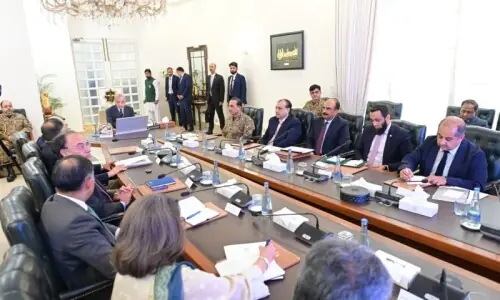
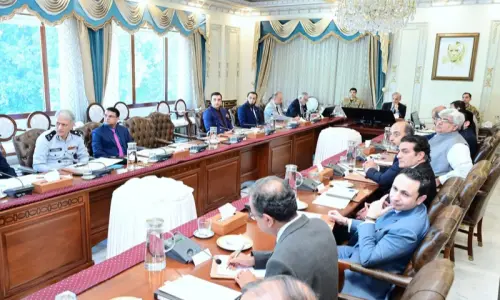
The decision was shared during a meeting on population welfare chaired by Prime Minister Shehbaz Sharif on Thursday.
Describing the rapidly growing population as one of the country’s biggest challenges, the prime minister said measures for population control and welfare must be treated as a national responsibility.
He stressed the need to align population planning with national development, economic stability and human resource development, and called for enhanced coordination among the provinces and effective public awareness campaigns to curb population growth.
Calling population stabilisation essential for sustainable national development, the prime minister directed the authorities to convene a meeting of the National Population Council (NPC) at the earliest.
According to a press release issued by the Prime Minister’s Office, the meeting will bring together the chief ministers of all four provinces and Gilgit-Baltistan, the prime minister of Azad Jammu and Kashmir, and representatives of relevant institutions and stakeholders to formulate a comprehensive national strategy.
During the meeting, officials briefed the prime minister on demographic trends, population welfare initiatives and preparations for the NPC meeting.
The meeting was informed that the operating procedures for the National Population Council Secretariat had been finalised, while the National Population Stabilisation Plan 2026-2035 was being prepared. The plan aims to provide a unified national framework to reduce the population growth rate from 2.55pc to 1.25pc by 2035.
Under the proposed framework, priority will be given to healthcare, education, youth development, increased female labour force participation, vocational training and social safety nets. Work has also begun to align federal social protection programmes with population welfare objectives.
Federal ministers Ahsan Iqbal, Ahad Khan Cheema, Syed Mustafa Kamal and Attaullah Tarar, along with senior government officials, attended the meeting.
FAMSUN delegation
Meanwhile, PM Shehbaz welcomed a Chinese investment initiative aimed at modernising Pakistan’s grain storage infrastructure, saying stronger business-to-business partnerships between Pakistan and China would further deepen the longstanding strategic relationship between the two countries.
The prime minister made the remarks during a meeting with a delegation led by Jack Chen, Chief Executive Officer of Chinese agribusiness company, FAMSUN.
He said Pakistan and China enjoyed exemplary bilateral relations, with economic cooperation continuing to expand.
Welcoming FAMSUN’s proposal to modernise Pakistan’s grain storage facilities, the prime minister said the project would help introduce modern agricultural technologies and promote commercial activity. He directed the authorities to ensure that skills development and training for Pakistan’s workforce were incorporated into the proposed projects to strengthen local capacity.
The FAMSUN CEO thanked the prime minister and the government for their hospitality and recalled his meeting with Mr Sharif during the latter’s recent visit to China, which led to the company’s visit to Pakistan to explore practical cooperation in the field of food security.
According to the briefing, FAMSUN plans to support Pakistan through improved grain storage infrastructure, technology transfer and training. The company will establish a demonstration centre for green silos in Pakistan, while existing storage facilities will be upgraded into modern green silo centres.
Officials also informed the meeting that a memorandum of understanding (MoU) had already been signed between FAMSUN and the Green Pakistan Initiative.
Published in Dawn, July 24th, 2026