0
0

KARACHI: A human being emerges from a dirty, stinking sanitation manhole that he had to go into to clear a blockage. Coming up for air several times, he also brings out with him the filth that was causing the problem. The job done, he cleans up himself, only to go down another hellhole the next day because it is his job.
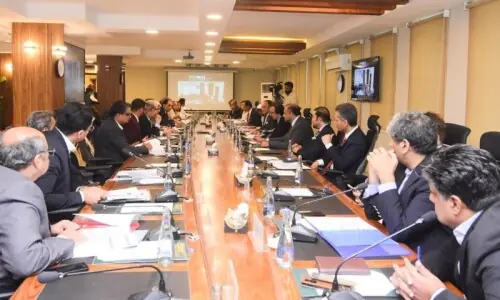
The documentary by Mobeen Ansari, screened during an Urban Resource Centre (URC) consultation on the ‘Rights of Sanitation Workers’ on Thursday, follows the daily routine of one poor sanitation worker, Pervez Masih, who cleans sewer pipes by climbing into them in order to earn money to feed his children. There are several more like him. Some made the news recently when after going down similar hellholes, they did not return alive.
“Due to the nature of their work, the life expectancy of sanitation workers is 45 years,” pointed out Zahid Farooq of the URC. “The cruel and inhumane exploitation of sanitation workers at the hands of our callous society is a very serious issue,” he added.
Industrial engineer and social activist Naeem Sadiq asked many pertinent questions. “Are we so busy in our own lives that we don’t notice the indignity inflicted on sanitation workers by us, their fellow human beings? Do respectable societies make people climb into gutters to clean their filth? Should there not be a law against such lowly and unhealthy work?”
Documentary on sanitation workers’ plight screened; rights activists say KWSC continues with inhumane manual work despite having machinery
He said the Karachi Water and Sewerage Corporation (KWSC) has proper machinery and some 130 vehicles for this kind of work worth Rs900 million. He also informed that the KWSC has a Rs54 billion budget.
“If the health and safety of a worker is compromised then the employer is to be held responsible for it. But here the KWSC bosses are not held accountable for the deaths of sanitation workers because the poor workers are taken on as contractual employees. They are hired as daily-wagers by contractors. And if they lose their lives on the job, their families receive Rs100,000 as compensation,” Mr Sadiq regretted.
“Can we carry out a survey on why these people are forced to take on this kind of outdated work? Can we train them to do something else so that they and their children after them don’t ever need to do such work?” He asked.
Lawyer Sara Malkani also said that sanitation workers in Pakistan are suffering an indignity inflicted upon them by society. “It is an issue of basic dignity. And we filed a petition in November 2025, which is pending in the Sindh High Court,” she added.
She also said that the KWSC has admitted having machines to clean sewer pipes. “But the utility also says that there are circumstances where the gutters require manual cleaning, though it is quite vague about what such circumstances are. So they have machines for the job, which they are not using. They also don’t directly employ sanitation workers while leaving it to private contractors,” she said.
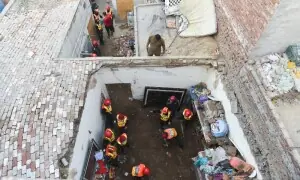
Bringing up the recent deaths of sanitation workers in Usmanabad and Surjani Town, she said that the hazardous practice of climbing down filthy, stinking sewers must be prohibited by all. “There is public-interest litigation needed here,” she said, adding that, sadly, such discriminatory practices are reserved for low-caste religious minorities.
“But the practice violates Pakistan’s Constitution. Therefore, it should be completely prohibited,” she stressed.
Published in Dawn, July 3rd, 2026