‘Inhumane and avoidable’: activists call for end to manual sanitation work
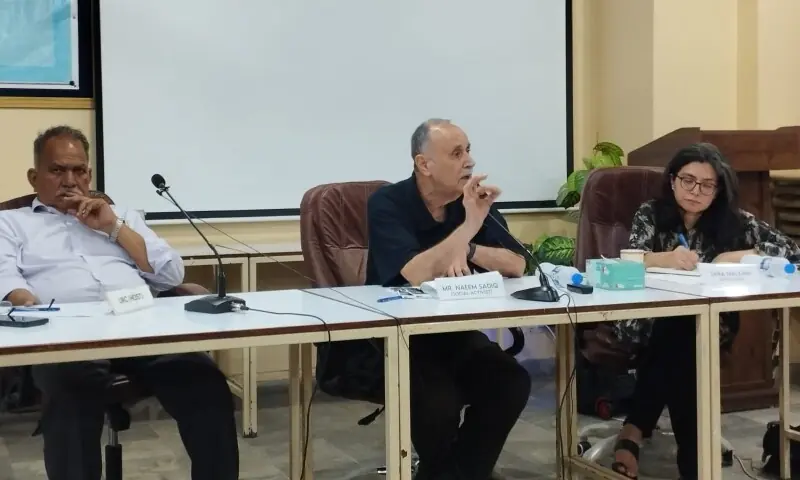
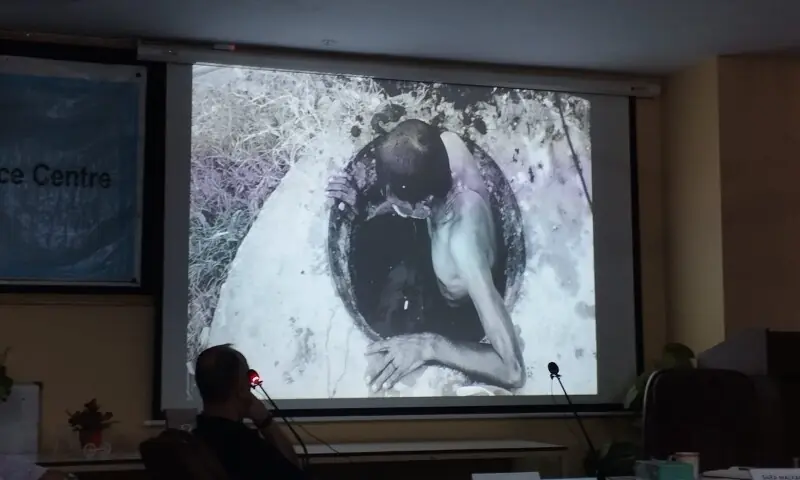
KARACHI: Civil society members gathered on Thursday at Karachi’s Urban Resource Centre (URC) to discuss the perils of manual sanitation work across Pakistan, stressing the need to preserve workers’ dignity and calling for an end to the “inhumane and avoidable” practice.
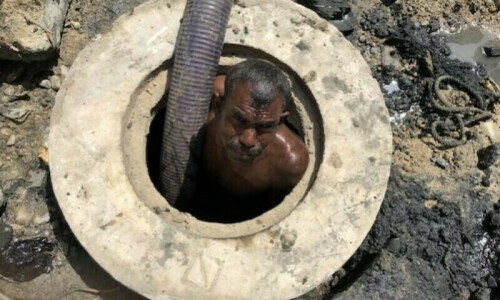
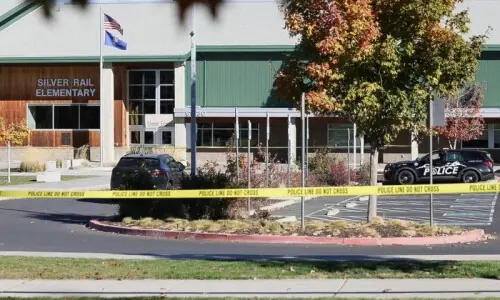
As the discussion began, speakers Advocate Sara Malkani, social activist Naeem Sadiq and URC’s Zahid Farooq recalled an incident in Karachi’s Usmanabad in September 2025, when three sanitation workers — 22-year-old Vishal, 19-year-old Shahir and 42-year-old George — lost their lives after asphyxiating in a manhole while cleaning it.
The three, who belonged to the same family, had been hired to clean the manhole for a wage of Rs15,000.
On behalf of a group of human rights activists, Malkani filed a constitutional petition in the Sindh High Court (SHC) in November 2025, asking the court to declare the practice of manual gutter cleaning a violation of human dignity and therefore unconstitutional.
Malkani said the petition also contended that the court should direct legislative and regulatory bodies to enact legislation to prohibit the “inhumane practice”.
She added that the petition names the Karachi Water and Sewerage Corporation (KWSC), the Sindh government and local government bodies as respondents.
Malkani maintained that the practice was entirely avoidable, as technology for cleaning gutters already exists.
She recalled that in its response to the SHC, KWSC had also admitted that machinery existed; however, it submitted that “due to some circumstances, people have to go inside gutters.”
She added that the utility did not specify those circumstances in its response to the petition.
KWSC Employees’ Union Secretary General Mohsin Raza, who was also present at the dialogue and spoke to Dawn, explained that while machinery existed within KWSC, most of it required manual operation.
“We do not have a standardised system; some manholes are 4 feet deep, while others may be up to 24 feet deep, so in many cases staff still have to enter the manholes,” he said, adding that at present the machinery also required manual operation.
Malkani further recalled that the water utility had also stated that the deceased workers were contracted through a private firm. She contended that ultimate responsibility for gutter cleaning rests with municipal bodies, whether the work is carried out by government employees or private contractors.
‘Dirty and undesirable’
Speaking at the panel, Malkani also highlighted the discriminatory nature of sanitation work in the country, particularly along religious lines.
“The practice also continues because sanitation workers have not been given any status in society,” she remarked.
A 2025 Amnesty International report describes sanitation work as stigmatised due to its association with a “caste system” in South Asia.
In the Pakistani context, this is transposed onto religious identities, leaving those engaged in such work labelled as “undesirable” by wider society.
Meanwhile, Sadiq said the dehumanisation of sanitation workers was a result of society’s apathy towards them.
“It is a problem that we expect our brothers and fellow citizens to clean up after us,” he said.
“Will we continue to disregard these people the way we have for many decades? Would a civilised society force its people to enter manholes?”
He questioned how it could sit with one’s conscience to “debate how much compensation sanitation workers should receive for their untimely deaths” instead of ensuring safety standards, recalling the compensation offered to the three deceased workers in Usmanabad.
He said that if such an incident were to occur in another country, the leadership of the responsible authorities would be held accountable.
The activist urged the audience to mobilise on the issue and demand an end to the practice of manual gutter cleaning.
According to the National Commission for Human Rights, Pakistan (NCHR), sanitation workers in the country work in hazardous conditions without adequate occupational safety standards or legal protections.
In its 2025 report, Amnesty recommended that manual cleaning of gutters be replaced with machinery, and that workers be trained to operate the equipment.
It also called for constitutional amendments to provide protection against caste-based discrimination, in order to address issues faced by communities associated with sanitation work.