SINDH BUDGET 2026-27: Sindh Assembly passes Rs3.562tr deficit budget for financial year 2026-27


 0
0
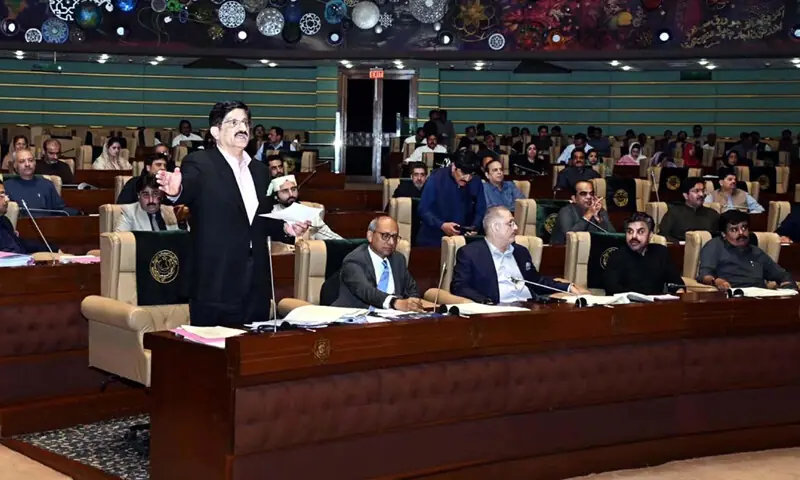

• Thanks to its numerical strength in the house, PPP rejects all cut motions of opposition parties
• CM Murad calls budget a document of prudent financial discipline
• 143 opposition, treasury MPAs take part in budget debate over seven days
• House approves supplementary grants worth Rs165bn
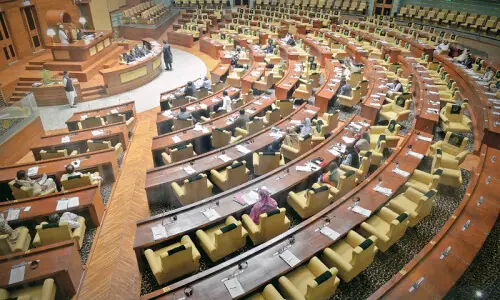
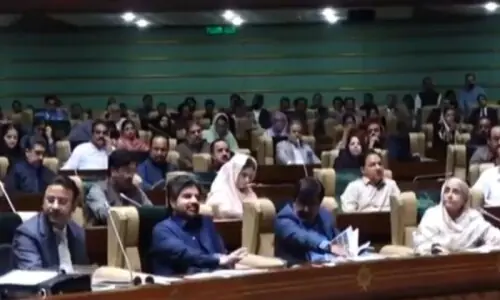
KARACHI: The Sindh Assembly on Sunday passed the Rs3.562 trillion provincial budget 2026-27 with a majority vote, rejecting all cut-motions moved by opposition members belonging to the Muttahida Qaumi Movement-Pakistan, Pakistan Tehreek-i-Insaf and Jamaat-i-Islami.
The assembly also approved the Sindh Finance Bill, under which no new taxes were imposed with Chief Minister Syed Murad Ali Shah saying that existing taxes were rationalised and streamlined.
The house rejected with a majority vote the proposed amendment to the Sindh Finance Bill submitted by Muttahida Qaumi Movement-Pakistan’s Sabir Qaimkhani, seeking an eight per cent super tax on annual agricultural income of Rs50 million or more.
The Bill revises rates across various taxes and widens the tax net, introducing an 8pc super tax on agricultural income exceeding Rs500mn while exempting income below that threshold.
The house also approved supplementary grants worth Rs165bn for the next year with the Leader of Opposition citing Rs273bn in “additional expenditure” through supplementary budget.
A total of 143 lawmakers from the both sides of the aisle took part in the budget debate that lasted for seven days.
CM defends budget
Earlier, winding up budget debate, the chief minister defended Rs3.562tr budget for 2026-27, calling it a document of “prudent financial discipline” and an ambitious roadmap to position Sindh as a regional hub for trade, finance, renewable energy and investment.
He said the province maintained fiscal discipline despite a Rs344bn deficit, reduced federal fiscal space and over Rs95bn in additional expenditures last year.
“Even so, we completed nearly 100 major projects, achieved wheat self-sufficiency for the first time, expanded social protection and continued investing in public services,” he said.
Announcing an Annual Development Programme of Rs720bn for the next fiscal year, he said that Rs206bn had been earmarked for Karachi.
“More than 1,800 schemes are to be completed province-wide,” he added.
The chief minister said that the plans included developing Keti Bandar as a logistics hub through public-private partnership, establishing a Sindh International Financial Centre, a province-wide green energy network, and an agricultural finance system for small farmers.
He said that education and health budgets had been increased while administrative expenses cut by over Rs62bn, with resources redirected to development and welfare.
The CM mentioned the Sindh People’s Housing Scheme for flood affectees as the world’s largest scheme, with one million houses completed and 600,000 under construction.
“The World Bank had approved nearly $1.7 billion for Sindh in just two-and-a-half months,” he added.
CM Murad also highlighted Thar Coal project, expansion of free cardiac care at NICVD, and growing renewable energy capacity.
Responding to the opposition, the chief minister rejected claims he termed “misleading”, including figures on federal transfers and Karachi’s past development spending.
He said official records showed projects worth about Rs33bn during a former city nazim’s tenure, not Rs300 billion.
The chief minister also criticised unfulfilled federal Karachi packages and said current federal support was limited to a few roads.
He also urged the lawmakers to avoid divisive politics and respect all contributions to Pakistan’s creation.
‘Collection of claims’
Opposition Leader Ali Khurshidi said that the provincial budget was a “collection of government claims and announcements” that ignored ordinary citizens, warning that it was taking public trust into deficit.
“Most of our voters are middle or lower class. Does this budget reflect the Quaid-i-Azam’s vision? How will it affect a labourer, a farmer, a mother, a sister?” he asked while concluding the budget debate from opposition side.
He criticised the PPP’s reliance on what he called “electables”.
“Remove the Bajaranis from Kashmore, the Mahars and Shaikhs from Shikarpur, and the Pakistan Peoples Party can’t win,” he said adding that the PPP could not win in Ghotki, Sanghar, Umerkot, Matiari and Tando Allahyar without specific people given tickets.
He said that if they (“electables”) contested as independent, they could not win and the provincial government’s majority would end immediately.
The opposition leader questioned Rs273bn in supplementary grants, including Rs970mn for an IT Park at Bahauddin Zakariya University, Multan.
He said that the home department alone spent Rs10bn extra.
He alleged a big portion of the Rs700bn development budget was going to commissions. “Government officers consider it their right,” he said.
He referred to the province’s grievances such as water rights, gas production and the stalled Hyderabad-Sukkur Motorway and urged PPP Chairman Bilawal Bhutto-Zardari to “put the resignations of the president, governor and members on the table”.
Mr Khursheedi demanded a public inquiry into the Sindh Public Service Commission after “11,000 youth fail while officers’ children pass”, a published Gul Plaza report, pension relief, a 20 per cent raise for lower-grade staff, parity with Punjab Police salaries, and an early completion of the forensic lab.
He also raised KMC employees’ pay, private schools’ fees and uniforms, and alleged BISP irregularities. “Wherever you lift a stone, corruption emerges. If Sindh improves, Pakistan will improve,” he said.
Later the house was prorogued.
Published in Dawn, June 29th, 2026