Technical issue at Sukkur Barrage chokes flows into right bank canals
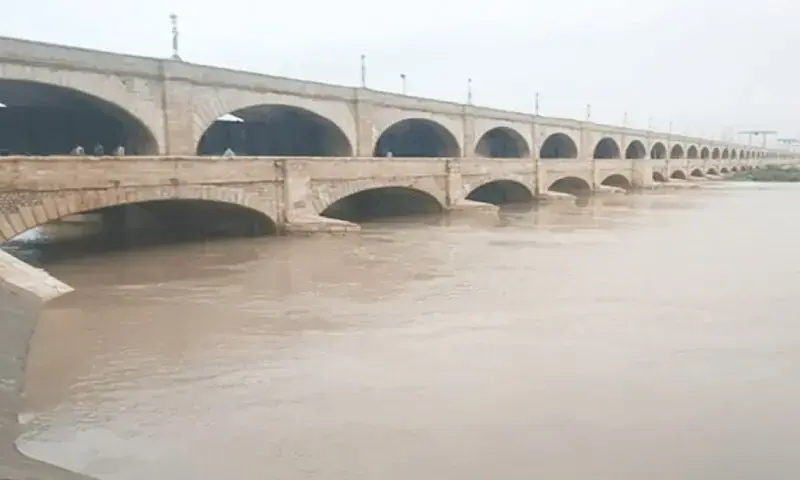
HYDERABAD: A technical issue at Sukkur Barrage has deprived the right bank canals of Sukkur Barrage of their due share in water at a time when the Kharif season is at its peak.
Even improved flows of up to 203,000 cusecs, released by the Indus River System Authority in the second and third weeks of June, could not be utilised due to the issue — belated removal of cofferdam.
Cofferdam, a watertight structure, is built to avoid river flows accumulating in and around the project activity area. It was supposed to be removed much before June 30 as per the timeline. But it could not be removed fully till the evening of June 28.
This cofferdam was built as part of the barrage improvement programme for the replacement of Sukkur barrage’s gates. The replacement process has been underway for the last two years and would continue in the next year.
Officials struggle to remove cofferdam by Tuesday in order to increase pond level for normal flows
Chief Engineer of Sukkur Barrage’s Left Bank Canals Ghulam Mujtaba Dhamrah and Project Monitoring Office (PMO) official Abdul Fatah Memon, however, remained optimistic on Sunday that it would be removed by the given date. They anticipate that the pond level would be increased to feed the right side irrigation channels of the barrage satisfactorily.
They conceded that the cofferdam’s removal was delayed by one week for some technical reasons. “Removal will enable the barrage management to increase the pond level to 200ft on July 1, enabling it to feed right bank canals as required,” Mr Memon told Dawn over phone.
Shortage persists despite improved flows
While the improved flows benefited Kotri Barrage canals, Sukkur barrage’s non-perennial canals remained deprived of adequate river flows at a time when they are needed the most.
Reduction in flows of right bank canals means water shortage for Balochistan, too, as the province gets its share from one of these canals.
According to one estimate, against a share of 2,200 cusecs, Balochistan is still getting 1,000 cusecs through Garang Regulator of Kirthar Canal of Sukkur Barrage, indicating over 50pc shortage.
River flows indicate that another dip in the river system is seen at Tarbela. It would again reduce flows into canals of Sindh’s barrages in the next few days.
Pond level
Officials said that when Irsa released 200,000 cusecs on June 13 and enhanced the volume up to 203,000 cusecs on June 21, the Sukkur barrage authorities started increasing pond level from 196ft on June 13 to 198.2ft on June 23. But this started affecting the cofferdam work. “The authorities then reduced the pond level to ensure safety of cofferdam. A level of 198ft is now being maintained,” said a source. He added the 200,000 cusecs flows actually benefited Kotri Barrage, where water shortage percentage has dropped considerably.
While Kotri Barrage canals have been witnessing satisfactory flows despite a recent period of severe shortage, the miseries of the farmers depending on Sukkur Barrage’s right bank canals seem not to be coming to end any sooner.
The Sukkur Barrage is reporting a 23pc shortage while its North Western Canal (NWC) is witnessing a 47pc, Rice Canal 23pc and Dadu Canal a 57pc shortage.
Irsa had to increase flows at Chashma downstream after the Sindh chief minister sought prime minister’s intervention to seek water for Sindh’s barrages and called for deferring of the filling of dams till water needs of Sindh are met.
Lawmakers’ protest in the National Assembly’s budget session forced Irsa to release more water for Sindh.
A 20,000 cusecs dip
After ensuring better flows (200,000 cusecs) downstream Chashma barrage on June 13, Irsa again effected a reduction in the flows due to a dip of around 20,000 cusecs in the system.
Tarbela dam hit 1437.18ft level on June 26 with an inflow of 139,100 cusecs. The dam had attained a level of 1,450ft or a little over it last month.
On June 7 and 8, it had a storage level of 1,455.05ft before recording a dip. Finally, it attained the level of 1437.18ft on June 26. Tarbela’s maximum conservation level is 1,550ft.
The dip necessitated Irsa to start storing flows because a storage level below 1,432ft could threaten closure of Wapda’s powerhouses. “This is the main system constraint that is confronting the authorities concerned,” said a water sector source.
Link canals also get less flows
Tarbela Dam remains the primary source of irrigation and drinking water supplies to Sindh. Water is also stored in Mangla Dam, but Sindh rarely receives supplies from this source.
“The improvement in flows will be hit again in the next days due to the dip that has passed from Tarbela Dam,” said an official. He said that reduction in flows of Chashma-Jhelum and Taunsa-Panjnad link canals was also witnessed. “These canals are receiving 1,000 and 2,810 cusecs, respectively, today (June 28), against the June 13 flows of 16,500 and 10,181 cusecs, respectively,” he said.
Published in Dawn, June 29th, 2026