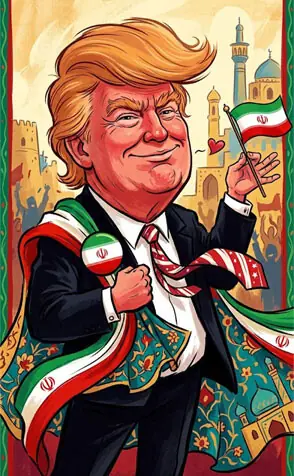
POLITICS is full of surprises, but few developments in recent history have been as dramatic as the transformation of United States President Donald Trump’s position on Iran. Only months ago, Washington’s rhetoric revolved around maximum pressure, overwhelming force, and the language of unconditional surrender.
Iran was portrayed as an adversary that could be subdued through military power and economic strangulation. Today, the same president is defending a peace agreement with Iran, advocating re-construction, supporting the return of frozen Iranian assets, criticising aspects of Israeli military conduct in Lebanon, and warning against actions that could derail the ceasefire he now champions. The question is obvious: what changed?
At the outset of the conflict, many in Washington appeared convinced that overwhelming military pressure would quickly force Tehran into submission. As the confrontation unfolded, it became increasingly clear that military victories do not automatically translate into strategic success. Trump himself provided clues to this transformation during his remarks at the G7 Summit. Defending the agreement, he openly acknowledged that continuing the war would have imposed catastrophic economic costs on the world economy.
The second factor was geopolitical reality. While Israel’s strategic focus is naturally centred on its immediate neighbourhood, the US, however is a global superpower whose interests span continents. As the conflict expanded, American policymakers increasingly recognised that unlimited support for military escalation carried substantial diplomatic costs. Relations with Gulf states and important global partners risked deterioration. This broader perspective became increasingly evident in Trump’s remarks as time passed by.
The third factor was the realisation that economic warfare and military operations have limits. Trump repeatedly emphasised that the objective of preventing nuclear proliferation had been achieved. For decades, American officials often defended Israeli military actions without publicly questioning the underlying strategy. Recent comments suggest growing frustration within the US administration with Israel.
The fourth factor was military sustain-ability. Wars consume resources at extra-ordinary rates. Trump highlighted the staggering financial cost of continued operations, noting that hundreds of millions of dollars were being spent within days. Even the world’s strongest military cannot wage unlimited campaigns without facing consequences.
Perhaps the most significant trans-formation, however, occurred at the level of strategic vision. As the conflict unfolded, Washington increasingly realised that its interests and Israel’s interests were not always identical. At some point, Washington appears to have concluded that continued escalation served neither American interests nor global stability. This helps explain why Trump increasingly praised diplomatic efforts involving regional actors, including Pakistan and Qatar. In doing so, he signalled a broader shift away from confrontation and towards managed coexistence.
None of this means that Trump has become soft on Iran. The only difference is that Washington now appears to view diplomacy as the preferred mechanism and military action as the last resort rather than the first. That is a major trans-
formation. Whether critics describe it as pragmatism, realism, or strategic necessity, the shift is undeniable. The president who once spoke primarily of bombs, now speaks of reconstruction.
The administration that once emphasised pressure, now speaks of investment and economic recovery. The government that once focused exclusively on confrontation, now emphasises stability, trade and regional normalisation.
The truth is that Trump did not simply negotiate a deal with Iran; he seems to have redefined US approach to conflict.
Qamar Bashir
Islamabad
Published in Dawn, June 24th, 2026