They don’t really care
THE budgets for FY26-27 are mostly out and the story they tell is the same as before: they don’t really care about us.
Even when Pakistan has just gone through one of the worst inflationary periods of its history and everyone knows that fixed income groups have been hurt the most, both on the expenditure — through increases in prices of goods and services — and income side — through limited income-increase opportunities due to slow growth and greater direct and indirect taxation — there has been little to no relief for ordinary, working-class Pakistanis. The prime minister just thanked them for having borne the brunt of the crises … as the poet said: ‘faqat wada-i-hoor’.
Look at the education budget. The UN recommends a minimum of four per cent of GDP to be spent on education every year. We used to spend a little below 2pc of GDP on education, over the last couple of years; it has dipped below 1pc of GDP. Yet every leader insists that education is a top priority for their government and every leader agrees that the future of the country depends on the youth of this country being educated and trained.
The composition of this 1pc that is being spent on education is also very interesting. At the federal level, where many universities have been facing severe financial problems, the recurrent budget for higher education — the money given to the Higher Education Commission to be distributed to the universities — has been kept the same as last year. There has not even been adjustment for inflation — this while salaries have been increased by 7pc. Over the years, there has been an increase in the number of universities as well, so the envelope has been getting smaller in many ways. But there have again been no adjustments. The government imperative is that universities should prepare the young for globally competitive markets. But a lot of universities do not even have resources for making salary and pension payments. Yet education remains a top priority!
Over the last couple of years, spending on education has dipped to below 1pc of GDP.
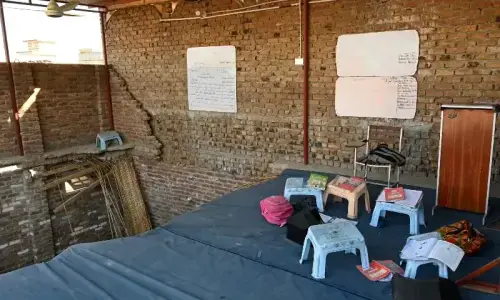
At the school level, while the amount for the 424 or so primary and secondary schools and colleges of Islamabad has not been changed by much, Rs20 billion have been set aside for setting up Daanish schools under federal funding. So, the 1pc being spent on education includes all sorts of vanity projects too. These include various laptop distribution schemes at the federal and provincial levels as well as setting up institutes meant to resemble ‘centres of excellence’. But millions of children remain out of school or are enrolled in government schools that do not have proper infrastructure, furniture or even the requisite number of teachers.
Federal and provincial governments used to provide textbooks and teacher guides to children a few years back, but when inflation hit and prices of paper and printing went up, instead of increasing budgets to cater to the increase, the government changed rules and said that students don’t really need books every year and should use them for three years. The second ploy was to say all books are being put online so students could have direct access. But we know textbooks don’t last three years when children use them and we know most children who come to government schools do not have access to the internet. Yet, education remains a top priority!
Some provinces have slightly raised their education budgets. Punjab has just announced, quite proudly, that it has enhanced the education budget by 15pc compared to last year. This is, of course, in nominal terms. If inflation is factored in, the real increase might only be 5pc or so. And with a 7pc increase in salaries, with most of the education budget going towards teacher and administrator wages, the actual budget for schools or materials or textbooks etc. has not increased. In fact, the budget for many things might have to be trimmed a little since Punjab has a number of vanity projects.
The story is not different for other areas where public provisioning should matter as well. We, as a nation, spend even less on the health sector, compared to education, even though we are one of two countries in the world that has not been able to eliminate polio. We are not able to inoculate all of our children against preventable diseases, some 40pc of our children are malnourished and we continue to have high and fairly stagnant infant and maternal mortality rates. Diseases like tuberculosis and hepatitis take a heavy toll and now diabetes, hypertension and cardiac disease have become leading killers in the adult population.
One reason we have high malnutrition rates is that most of the population in Pakistan does not have access to safe drinking water. We do not have good sewage disposal systems in place. We do not have good and comprehensive waste disposal systems in place. Yet, none of these are priorities for this government or the governments that have been in power for many years. Would it be impossible to have a five-year plan to ensure the provision of safe drinking water to all citizens of the country? But underpasses and roads get priority.
What has gotten more money in the budget? Security concerns have led to increases in allocation for these areas — more resources for the military as well as for law-enforcement agencies. While security is important, if human development indicators continue to be as they are or deteriorate further — and they will deteriorate if we spend peanuts on health, education, water, sanitation and other public services — what will security amount to? What will this country look like if children continue to be malnourished and the youth continue to be neither educated nor skilled?
Our governance system is broken — and broken badly. It does not care about the very people who are supposed to be the ultimate stakeholders of interest: Pakistani citizens. It serves sectional interests quite well. But that does not bode well for the future of a 250 million-strong polity.
The writer is a senior research fellow at the Institute of Development and Economic Alternatives and an associate professor of economics at Lums.
Published in Dawn, June 19th, 2026