The exhibition ‘All That Was Left Behind’ at VM Art Gallery brought together two artists whose works deal with traces of the past and impermanence, through very different approaches.
Throughout the history of painting, artists have used colour not simply as embellishment but as a way to construct emotion, atmosphere and psychological depth. From the dreamlike landscapes of Peter Doig to the emotional intensity of Mark Rothko’s colour fields, colour has often carried meaning beyond representation. In ‘All That Was Left Behind’, colour becomes the strongest link between the practices of Zahabia Khozema and Nain Tara, shaping mood, memory and emotional experience across their works.
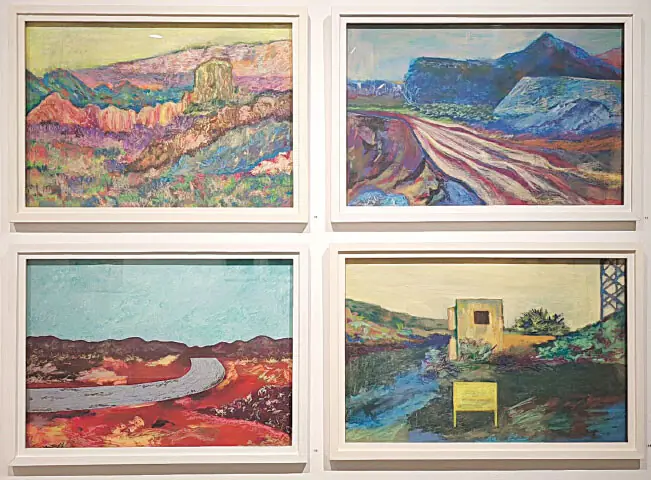
Khozema’s works take a more narrative turn. Drawing from memories of an industrial town in central Punjab, her paintings reconstruct fragments of a fading place by narrating the story of a boy and his connection to the town. Landscapes and traces of the industrial town appear throughout the works, but they do not function as documentary images.
Instead, they resemble remembered scenes, suspended somewhere between reality and imagination. Her energetic use of colour gives the paintings an almost dreamlike quality. Blues, oranges and greens collide across the canvas in triadic contrasts, creating works that feel strangely alive even with the absence of any human figures throughout her works.
Through varying visual vocabularies, two artists used colour to capture and preserve emotional landscapes at an exhibition in Karachi
This is particularly visible in I Will Return After Dusk, where colour intensifies this lack of human figures and the partially desolate nature of the landscapes. Khozema’s use of drawing as a method becomes important here. The drawn line carries a sense of immediacy and intimacy, allowing the works to retain traces of the artist’s hand. In many ways, the drawings blur the line between private memory and public image.
The art critic John Berger once wrote, “A drawing is essentially a private work, related only to the artist’s own needs.” That private quality remains present in Khozema’s practice even when the works are placed within the public space of the gallery. At the same time, the vividness of her palette highlights the bleakness of the histories she references. The industrial town at the centre of her practice is shaped by environmental change, labour and gradual disappearance, yet the paintings refuse to collapse into despair. Instead, colour becomes a way of preserving emotional intensity, even as places begin to fade.
In contrast, Tara’s works lean towards abstraction. Her colour palette is comparatively softer and closer to the tones of the natural world. Greens, muted yellows and pale blues flow freely across surfaces, creating works that feel atmospheric and meditative. Unlike Khozema’s paintings, Tara’s works do not rely on identifiable imagery. They ask the viewer to spend time with texture, surface and movement, rather than to view in passing.
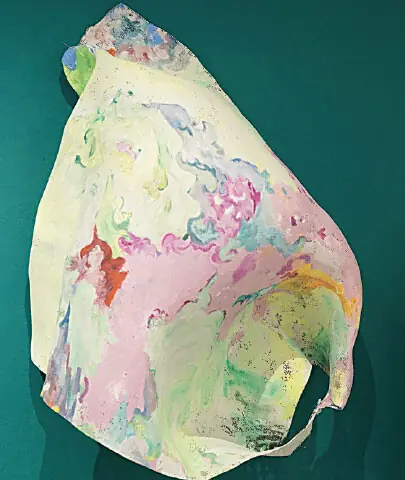
This slower engagement becomes central to the experience of her work. The paintings reveal themselves gradually through layered surfaces and shifting forms. Two works made on mesh move beyond the rigidity of the square canvas altogether, allowing the material to bend and extend into space. In doing so, Tara breaks away from conventional painterly boundaries and introduces the idea of repair, as both process and metaphor.
For the artist, repair is not simply physical but also emotional, cultural and political. This understanding enters the work through layering, tension and material interaction, with surfaces carrying traces of care, exhaustion, fragility and continuity simultaneously.
However, while the textures and materiality successfully draw the viewer in, these ideas do not always fully translate through the works themselves, making some of the paintings feel equivocal in their narrative direction. The abstraction creates openness for interpretation, but at times also distances the viewer from the emotional and conceptual concerns informing the practice.
Together, the two artists approach memory from different directions. Khozema reconstructs it through narrative and place, while Tara approaches it through abstraction and material tension. Yet, both rely on colour to hold their works together emotionally.
‘All That Was Left Behind’ succeeds in showing how colour can preserve atmosphere even when memory itself remains incomplete. The exhibition leaves the viewer with questions that remain unresolved, but perhaps that is where the beauty of this exhibition lies. Some stories are not meant to arrive at fixed conclusions.
‘All That Was Left Behind’ was on display at VM Art Gallery, Karachi from April 18-May 13, 2026
The writer is a university student with an interest in urban history, culture and public spaces. He can be contacted at pakistaniumer04@gmail.com
Published in Dawn, June 21st, 2026