Pakistan assails 17 Indian projects on Indus waterways, calls them ‘tools for hydro-hegemony’


 1
1
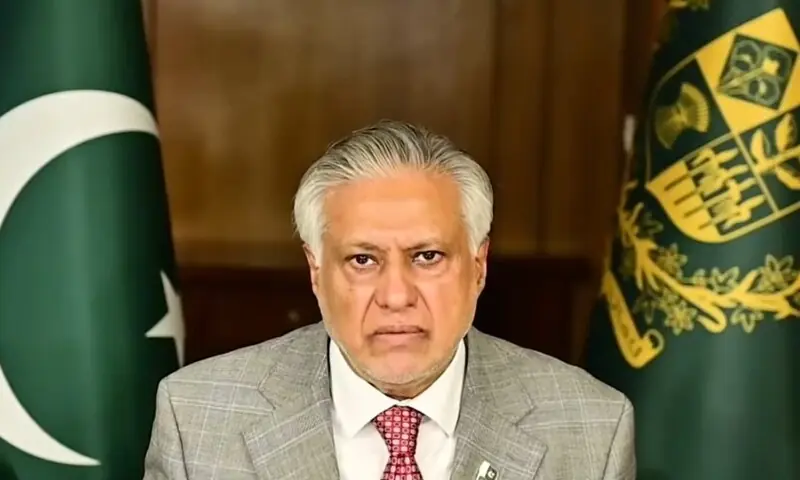

Deputy Prime Minister and Foreign Minister Ishaq Dar said on Thursday that at least 17 projects by India on waterways part of the Indus River System would give New Delhi the “tools for hydro-hegemony”.
Dar’s statement has come at a time when water and the Indus Waters Treaty remain a contentious issue between India and Pakistan, following New Delhi’s unilateral abeyance of the accord last year — a move that followed a brief military conflict between the two sides in May 2025.
More recently, Indian Water Minister CR Patil said his country was working to ensure “not a single drop of water” would flow into Pakistan. Meanwhile, Pakistan has maintained that any attempt to change the flow of cross-border waterways would be considered an “act of war”.
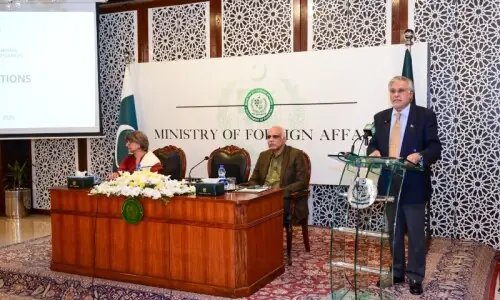
It was against this backdrop that Dar’s keynote address, touching upon the matter, was played at a seminar titled “Transboundary Water Resources: A Weaponised Global Common”. The seminar was jointly organised by Pakistan’s embassy in Brussels and the Centre for European Policy Studies.
Dar began his address by highlighting that shared resources required cooperative management through agreed frameworks.
“Otherwise, competing interests can turn them into sources of conflict and weaponisation,” he said.
The deputy prime minister quoted the United Nations’ former secretary general, Kofi Annan, as saying, “Fierce national competition over water resources has prompted fears that water issues contain the seeds of violent conflict, but the water crises we face are more often crises of management and governance rather than absolute scarcity. Shared waters can be a pathway to peace and regional integration rather than a catalyst for war.”
He said, “The very fact that we need to have this discussion in this day and age is, in itself, dismaying”.
“It serves as a reminder that peaceful coexistence cannot be taken for granted, must be sustained through respect for the treaties, agreements, and multilateral frameworks that enable states to manage differences through cooperation rather than confrontation,” he added.
Dar stated that Pakistan had consistently upheld the values enshrined in the United Nations Charter and remained committed to its principles, as well as relevant UN resolutions.
“It was in this spirit that Pakistan signed the Indus Waters Treaty with India in 1960, establishing a framework for the utilisation of the six rivers of the Indus River System.
“The treaty envisages the peaceful resolution of disputes within its own framework. It is a testament to the enduring quality of the treaty that it survived three major conflicts and several other challenges over the decades,” he said.
The deputy prime minister then recalled that Pakistan had previously voiced concerns over certain actions by India under the treaty as well.
“Consistent with the treaty’s provisions, we sought settlement through international mechanisms and respected decisions that even fell short of our expectations,” he said. “At no stage was the outright unilateral abrogation of the treaty considered a viable course of action by the other side.”
He then asserted that responsible states acted within established legal frameworks rather than abandoning them.
“And yet, today, we find ourselves confronted with precisely such a challenge,” he said, adding that “our concerns are not merely based on Indian statements”.
“India has followed up its belligerent statements with illegal actions,” the deputy prime minister stated, mentioning variious initiatives and projects by India. Those included the Sawalkot, Kirthai, Kwar hydroelectric projects on Chenab River in occupied Kashmir; expansion of Baglihar and Salal hydroelectric projects also built on Chenab in occupied Kashmir and diversion projects on Indus, Chenab and Ravi rivers.
“In total, at least 17 such projects that will drastically alter the river system as a whole, giving India the tools for ‘hydro-hegemony’ that it so desires,” Dar said.
He said, “River systems are not merely waterways — they are lifelines. They carry profound historical significance and serve as immediate sources of sustenance and survival.”
India’s stated policy to intentionally deprive 240 million people of their rightful access to water represented a “catastrophe in the making of unparalleled magnitude”, he said.
Dar stressed that water must never be viewed as an instrument of coercion, as it was “a shared resource, a common responsibility and ultimately a prerequisite for human dignity and sustainable development”.
“The future of transboundary water governance must therefore be anchored in cooperation and respect for international law,” he said.
The deputy prime minister added that this issue should not be viewed as one confined to South Asia, pointing out that Europe offered compelling examples of how faithfully implementing transboundary water agreements enabled states to share water resources cooperatively and promote regional stability and prosperity.
“The sanctity of treaties is the bedrock of the international order,” he said. “Respect fot treaty obligations is therefore not merely a regional concern but a global imperative.”
He affirmed that “Pakistan remains committed to resolving all issues through dialogue, diplomacy and the mechanism provided under international law.”
“Our position is guided not by confrontation, but by the conviction that lasting solutions can only emerge through cooperation and respect for mutually agreed obligations.”
Dar said that Pakistan was already disproportionately affected by climate change, pointing out that it remained among the most climate vulnerable countries in the world despite contributing less than one per cent of global greenhouse gas emissions.
He called for enhanced international cooperation and collaboration on water-related issues, expressing the hope that the seminar’s discussions would underscore the importance of cooperation in the management of transboundary water resources, while using the Indus Waters Treaty as a case study and examining other regions and river systems that may offer valuable lessons and insights.
“Let us reaffirm today that shared waters should unite nations rather than divide them, and that cooperation — not coercion — must remain the guiding principle of trans-boundary water governance,” he said.
A treaty under strain
The Indus Waters Treaty, brokered by the World Bank in 1960, regulates the distribution of the Indus river system between India and Pakistan. It allocates the eastern rivers — Ravi, Beas and Sutlej — to India, while the western rivers — Indus, Jhelum and Chenab — are largely allocated to Pakistan.
The agreement has long been considered one of the most durable frameworks of cooperation between the two countries, surviving wars and repeated crises. However, it has come under strain since India announced in 2025 that it was placing its treaty obligations in abeyance.
The announcement followed an attack on tourists in occupied Kashmir’s Pahalgam that killed 26 tourists — an incident New Delhi blamed on Islamabad without evidence. For its part, Pakistan strongly denied the allegations and called for a neutral investigation.
In June 2025, the Permanent Court of Arbitration (PCA) — an organisation that provides a framework for international disputes — had issued a Supplemental Award of Competence, stating that India could not unilaterally hold the treaty in abeyance.
India has maintained that it will keep the treaty in abeyance until Pakistan ends alleged support for cross-border terrorism — an accusation that Islamabad denies.
Last month, Pakistan hailed another supplemental award by the Permanent Court of Arbitration that it said affirmed Islamabad’s position of the Indus Waters Treaty placing “substantive limits on India’s water-control capability” on Indus River system’s western rivers.
The decision pertained to maximum pondage — a technical term for the maximum volume of water that could be stored in a reservoir — in Indus Waters Treaty proceedings arising from design disputes concerning the Ratle Hydroelectric Plant and the Kishenganga Hydroelectric Project in occupied Kashmir.
While the decision was not publicly shared by the PCA, an official statement by the Pakistan government said it addressed a core treaty concern that “India cannot justify increased pondage through imagined capacity, artificial load curves, unrealistic peaking assumptions, or bare assertions of compliance with paragraph 15 release limits”.
Indian news outlet CNBC TV18 recently reported that India would begin work on a proposed “Link-3 Project”, located on Chenab in Himachal Pradesh, on August 1. The project aims to divert surplus water from the Chenab river to the Beas basin and is estimated to cost 26.2 billion Indian rupees, as per Indian news agency ANI.
When asked about these reports during a weekly briefing on June 4, Foreign Office spokesperson Tahir Andrabi denounced India’s plans to build a river-linking project to divert water from Chenab to the Beas river as a “grave violation” of the Indus Waters Treaty and other international laws.
“Yes, we have seen this report as well as the public tendered document issued by the government of India that India has invited bids for the Chenab-Beas Link Tunnel project with the intention of transferring 1.9m acre feet of water annually from Chenab into the Beas system.
“Such an inter-basin diversion of water of the Chenab into the Beas system constitutes a grave violation of not just the IWT but also of the laws of treaty, particularly the Vienna Convention on the Law of Treaties, as well as the broader framework of international water law, including the principles reflected in the 1977 UN convention on watercourses,” he said.
The FO spokesperson also highlighted India’s planned “silt flushing” of the Salal Dam in occupied Kashmir’s Reasi district.
“This is a deeply concerning development. It would provide water control capability that is not permissible under either the Indus Waters Treaty or the 1978 Salal agreement,” he pointed out.