0
0

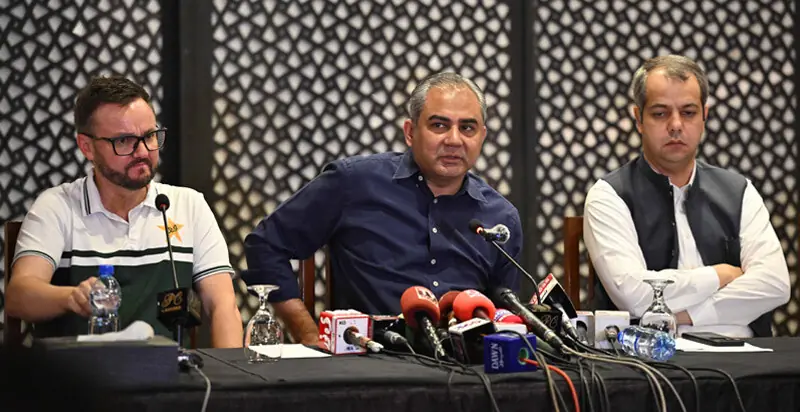
LAHORE: The Pakistan Cricket Board (PCB) on Monday introduced a sweeping overhaul of its central contracts system, replacing the traditional grading structure with a format-based framework designed to reward specialisation and strengthen Test cricket, while also dismissing speculation surrounding possible coaching appointments for former captains Younis Khan and Mohammad Hafeez.
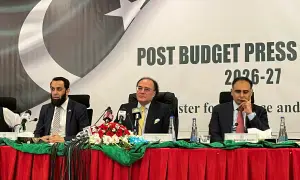
PCB chairman Mohsin Naqvi announced the reforms at a press conference held at a local hotel, where he was accompanied by white-ball head coach Mike Hesson, director high performance Aaqib Javed, chief medical officer Dr Javed Mughal and chief operating officer Sumair Ahmed Syed.
The new framework, which will take effect from the next contracting cycle beginning in July, abandons the long-standing ‘A’-to-’D’ category system and introduces five distinct “tracks” aligned with players’ primary formats.
Mohsin also used the occasion to reject reports that Younis was being considered for the role of Pakistan Test team head coach.
“Three or four days ago, television channels were reporting that Younis Khan would be appointed head coach of the Test team. I came to know about it through the media as there is no such proposal under consideration,” he said.
The PCB chief, however, confirmed that the board remained in contact with several former players, including Younis and Hafeez, and valued their input on cricketing matters.
“We are in touch with many former players and welcome their suggestions for the betterment of Pakistan cricket,” he said. “I am willing to meet anyone who can contribute positively to Pakistan cricket.”
Mohsin added that reports linking former players to coaching positions often emerged despite no discussions taking place.
“When Sarfaraz Ahmed is already serving as head coach, such reports appear in the media and there is little I can do about it,” he remarked.
Earlier in the day, Mohsin met all 49 players attending Pakistan’s ongoing red-ball and white-ball camps in Lahore and briefed them on the new contracts model.
Under the revised structure, players will be grouped according to format specialisation rather than broad pay categories.
Track ‘AB’ will comprise cricketers who represent Pakistan in both Tests and One-day Internationals (ODIs), effectively serving as the board’s highest commitment tier. Track ‘A’ has been designated for specialist Test players, while Track ‘BC’ will cater to cricketers active across the two white-ball formats.
Track ‘C’ has been reserved for T20 specialists and offers the greatest flexibility for participation in franchise leagues around the world. Track ‘D’, meanwhile, will function as a development category aimed at emerging players progressing through the National Cricket Academy and the wider high-performance system.
According to the PCB, the framework is intended to reflect the increasingly specialised nature of modern cricket while addressing the challenge of preserving the status of Test cricket in an era dominated by lucrative T20 competitions.
One of the most notable features of the policy is a provision allowing specialist Test cricketers to participate in overseas first-class competitions. The PCB said the move was designed to improve the quality of Pakistan’s red-ball cricket by exposing players to demanding first-class environments abroad.
At the same time, franchise T20 leagues will remain off-limits to players categorised as dedicated Test specialists.
The board said players would be assessed only against others within their own tracks rather than against cricketers operating in different formats. Each senior track will also contain two internal tiers, allowing players to move up or down on the basis of performance without changing their format designation.
Mohsin said the new model had been developed to eliminate many of the controversies that traditionally accompanied central contract announcements.
“The contracts players used to get always resulted in debates about why players were placed in a particular category,” he observed.
He revealed that data analytics would form the backbone of the evaluation process.
“The framework is based 85 per cent on data and 15 per cent on selectors’ assessment,” he said, adding that the aim was to ensure fairness and transparency.
The PCB chairman identified fitness, domestic cricket participation and performance as the three key pillars of selection.
Aaqib admitted that both the board and players had been dissatisfied with aspects of the previous system and said the reforms sought to reduce the influence of subjective judgement.
“Pakistan has fallen behind in Test cricket,” he said. “These reforms are designed to encourage players to focus on the longer format rather than solely pursuing financial opportunities through T20 leagues.”
He added that player evaluation would extend beyond traditional statistics such as centuries and half-centuries and would increasingly focus on overall impact in helping teams win matches.
Hesson backed the initiative, saying cricket boards around the world were grappling with the challenge of balancing financial incentives with the need to preserve Test cricket.
“How do you financially reward players while encouraging them to focus on Test cricket?” he asked. “The PCB has produced a framework that addresses all aspects of the issue.”
Calling the document “impressive”, Hesson said it demonstrated a genuine commitment to red-ball cricket while also recognising the realities of T20 specialisation.
The reforms also place renewed emphasis on domestic cricket. Mohsin said active participation in domestic competitions would now be mandatory for central contract eligibility.
“It is easy to issue statements that playing domestic cricket is mandatory to play for Pakistan, but implementing such policies is difficult,” he said. “We are now making it compulsory.”
Meanwhile, Dr Mughal acknowledged that current fitness levels within the player pool remained below desired standards and said new benchmarks had been established. He added that while media access to fitness testing had been discontinued because of privacy concerns, the board would continue sharing key fitness indicators.
Asked whether he would hold officials accountable if Pakistan’s performances failed to improve, Mohsin accepted responsibility.
“It is my responsibility to deliver results,” he said. “Our performances in bilateral series have been satisfactory, but we have struggled in major tournaments. We need to improve our performances in tournaments.”
Aaqib, however, cautioned against expecting immediate success, saying no reform could guarantee victories in the short term.
Published in Dawn, June 16th, 2026