For much of the four years, Pakistan’s fiscal budgets have been defined by one overriding objective: stabilisation. Under the International Monetary Fund (IMF) programme, the government seems to have no choice other than to focus on fiscal consolidation, external sector stability and revenue mobilisation. But after a long stretch of austerity, there finally appears to be a signal that the stabilisation phase is finally behind us and the economy is ready to transition into the growth phase.
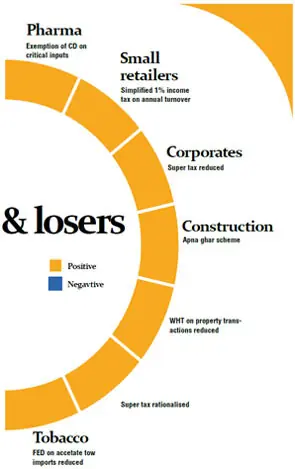
From a capital markets perspective, the budget is relatively uneventful with no major changes to the taxation of equities or investment income. However, the reduction in super tax for most sectors is set to provide a meaningful boost to corporate profitability in the listed and unlisted space. While the benefit excludes sectors such as banks, fertilisers and oil exploration companies, the impact can still be significant for companies operating in other sectors. Based on the State Bank of Pakistan’s unconsolidated financial data of non-financial listed companies, 216 listed companies can be expected to benefit from a reduction in super taxes (excluding the ones that are not profitable).
While the relief measures for households and businesses have attracted much attention, the government’s continued preference for the real estate sector can’t be overlooked. By reducing withholding tax on property purchases from 2.5 per cent to 1.25pc and property sales from 5.5pc to 2.75pc, policy makers are eyeing a GDP growth rate of more than 4pc, reinforcing the government’s idea that construction remains one of the quickest ways to stimulate growth and employment across a range of allied sectors such as cement, steel, glass, etc.
This strategy closely resembles the incentives extended to the real estate sector following the Covid-19 pandemic, which were accompanied by the launch of the Naya Pakistan Housing scheme. While the programme’s target was barely achieved, the incentives definitely contributed to a construction boom, with cement industry utilisation reaching nearly 83pc.
For the equity market, the budget is positive as it avoids surprise tax measures and provides targeted support through lower taxes, reduced transaction costs, and duties
The surge in activity was also reflected in the equity market, where the cement sector index rallied by 61pc as compared to the total return of the KSE-100 index of 36pc in FY21. Given the current budget’s similar tone and the incentives being offered to the real estate sector, it would not be surprising to see a renewed pickup in construction activity and a rerating of related sectors.
However, the 2023 economic crisis also highlights the risks associated with construction-led growth. Key inputs used by construction-related industries remain heavily import-dependent: for cement manufacturers, it is coal; for steel players, it is billets and steel scrap. Therefore, while the sector can provide a short-term boost to growth and employment, its long-term sustainability will depend on whether the economic benefits will outweigh the external sector costs.
Beyond real estate, the government has also attempted to support pharmaceutical companies by abolishing customs duties on key raw materials used in the local manufacture of medicines that treat cancer and other diseases.
Based on SBP data, 216 listed companies can be expected to benefit from a reduction in super taxes
Moreover, while acknowledging the investment and economic activity that have been generated, and following the entry of new automobile assemblers in the country, the government has decided to continue incentives for electric vehicles for one more year and to impose higher duties on imported luxury vehicles, while the sector still waits for the new auto policy.
Indeed, no relief comes without a cost, so the question arises as to how the government intends to pay for this transition. This year’s budget is built around an ambitious assumption that an economy transitioning from stabilisation to growth can support tax relief and deliver an 18pc increase in the collection of the Federal Board of Revenue.
While the relief measures are visible and immediate, the corresponding measures appear comparatively modest. However, one mode of revenue worth mentioning in this year’s budget is the anticipated transfer of around Rs1 trillion from the provinces under Article 164, a provision that effectively allows the federal government to claw back a portion of provincial allocation.
Nonetheless, for the equity market, the budget is likely to be viewed positively, given that it avoids surprise tax measures that had unsettled investors in previous years and instead provides targeted support to sectors through lower taxes, transaction costs, and duties.
The writer is an analyst at Karachi School of Business and Leadership’s InsightLab
Published in Dawn, The Business and Finance Weekly, June 15th, 2026