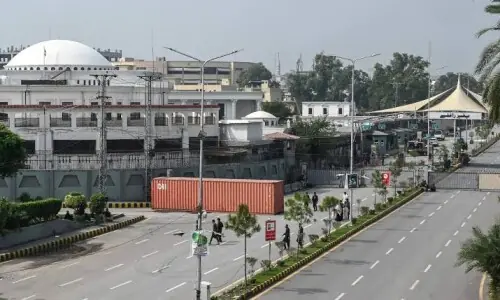
KARACHI’S mayor, Murtaza Wahab, has taken a bold decision that can improve Karachi physically, environmentally and socially. He has decided to remove walls and railings around parks and make them part of the larger urban environment that connects roads, trees, plants and people. At present, many parks in Karachi exist as isolated spaces enclosed by walls that separate them from the city around them. These barriers make green spaces appear smaller and discourage public use. Their removal can visually expand parks and make them feel part of the city rather than isolated compounds. Public spaces become meaningful only when people can see them, access them easily, and feel that they belong to them. Many of these parks and open spaces also contain institutions and structures of historical importance. Consideration will have to be given to how this heritage can be integrated into these spaces.
However, careful planning is needed. The issue is not simply about increasing green spaces but also ensuring proper maintenance and management. Karachi’s parks are generally poorly maintained, which affects public spaces. Improving conditions requires administrative capacity and commitment from those responsible for implementation. The people managing these spaces need training and support in maintenance, landscape management and public use. Municipal institutions can play an important role by establishing systems and training programmes for park management. Without such measures, open spaces may continue to deteriorate and contribute further to the decline of the environment.
Driving or walking through Karachi often feels suffocating because of the excessive use of walls around buildings, parks and vacant spaces, along with large billboards covering pedestrian bridges and flyovers. These structures block views, reduce natural light, and make the city appear more congested than it is. The removal of billboards from pedestrian bridges can make the city appear wider and friendlier. Moreover, billboards obstruct visibility and can isolate people using pedestrian bridges, leading to concerns regarding harassment, even cases of attempted rape. The visual opening up of the city can go further if walls around municipally old buildings are replaced with vertical railings. Such a step would make these buildings and their surrounding spaces part of the larger urban landscape. In Lahore, this has been done very effectively along the Mall Road.
Karachi possesses one of its most important natural assets in the form of its coastline. However, Karachiites benefit very little from it. Large sections of the coast continue to be occupied by real estate development. Much of this process goes against court observations which have repeatedly stated that beaches should remain accessible to the citizens. Yet little has been done to implement such observations.
At present, many parks in the city exist as isolated spaces.
Along Abdul Sattar Edhi Avenue, which forms the edge of Clifton Bay, there is a wall running along the road. If this wall were reduced by around 15 centimtres in height, people, including the elderly, could sit comfortably and observe the sea. It would also allow people travelling along the road to maintain visual contact with the beach. These interventions can significantly improve the relationship between citizens and the sea.
Many parts of Karachi’s beaches have been informally or illegally privatised, restricting public access to spaces that should remain open to everyone. In areas such as Hawke’s Bay and Sandspit, visitors are often told by touts that access to the beach can only be provided if payment is made or a hut is rented. At the same time, large private structures continue to appear along parts of the coastline, in violation of planning regulations and environmental con-cerns.
There is also an increasing tendency among politicians and planners to construct large monuments and symbolic projects that occupy spaces previously used for public purposes, especially by children and young people. People’s Square is one such example. Parks and the coastline must not become dominated by structures that overpower the natural landscape.
It is important that the sea should be viewed as a public resource and not as reclaimable land or a source of indiscriminate sea life for commercial purposes. It should be viewed as a public resource belonging to the people of the city. The recent decision to open up parks is important because it raises larger questions regarding the relationship between people and the city they live in. If such initiatives are carried forward with proper planning and management, they can improve not only Karachi’s physical condition but also the relationship between citizens and their urban environment.
The writer is an architect.
Published in Dawn, June 14th, 2026