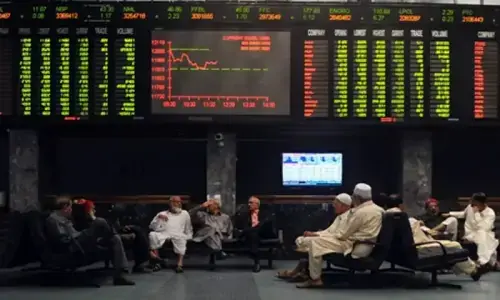
KARACHI: The Pakistan Stock Exchange (PSX) remained in positive territory during the outgoing week, with the benchmark KSE-100 index crossing the 172,000-point mark as investors responded favourably to easing geopolitical tensions, lower oil prices and encouraging economic indicators ahead of the federal budget.
The budget was presented after market hours on the final trading day of the week, keeping activity measured as investors awaited details of the government’s fiscal plans.
According to Topline Securities, the KSE-100 index gained 1.13 per cent week-on-week, adding 1,921 points to close at 172,400. The rally was supported by improving risk appetite amid hopes of progress in US-Iran negotiations and a decline in global oil prices.
Among major economic developments, according to Arif Habib Ltd (AHL), workers’ remittances reached a record monthly high of $4.3 billion in May, up 15pc year-on-year and 20pc month-on-month. Cumulative remittances during the first 11 months of FY26 rose 9pc to $38.1bn.
Remittances hit record high as lower oil prices support investor sentiment
Meanwhile, auto sales continued to show strength. Data released by the Pakistan Automotive Manufacturers Association (PAMA) showed sales of cars, light commercial vehicles, vans, jeeps and electric vehicles increased 19pc year-on-year to 17,660 units in May. However, sales fell 20pc from April levels, largely due to subdued economic activity during the Eid holidays. Total vehicle sales in 11MFY26 climbed 45pc to 183,600 units.
Foreign corporate investors remained net sellers during the week, offloading equities worth $19.42 million. In contrast, individual investors emerged as the largest buyers, with net purchases of $19.4m.
Average daily trading volume rose 24.5pc week-on-week to 776 million shares, while average daily traded value increased 6.1pc to around $104m, reflecting sustained investor participation.
On the monetary front, the government raised Rs1.96 trillion through a treasury-bill auction against a target of Rs2tr. Cut-off yields declined marginally on one-month and six-month papers, while yields on three-month and 12-month tenors edged higher.
Pakistan’s liquid foreign exchange reserves increased by $35.7m during the week to $22.7bn. State Bank reserves rose by $24.8m to $17.2bn, providing import cover of nearly 2.8 months. The rupee remained largely stable, closing at Rs278.32 against the dollar compared to Rs278.41 a week earlier.
Central government debt stood at Rs81.9tr in April, up 1.7pc from the previous month and 9.3pc higher than a year earlier.
In the energy sector, the government reduced the price of petrol by Rs4 to Rs377.78 per litre, while the price of high-speed diesel remained unchanged at Rs380.78 per litre. The adjustment reflected changes in ex-refinery prices and petroleum levy rates.
Oil and gas production recorded a modest decline during the first week of June. Gas output fell 1.6pc week-on-week to 3,021 million cubic feet per day driven by lower output from Qadirpur, Kandhkot, Sui, and Shewa fields, likely attributable to disruptions from the SNGPL pipeline rupture. While oil production slipped 1pc to 68,821 barrels per day, partly due to lower output from Makori East, Maramzai, KPD, and Sharf fields.
Sector-wise, banks made the largest positive contribution to the index, adding 670 points, followed by cement (511 points), power generation (189 points), investment banks (145 points) and property companies (109 points). Fertiliser, technology, refinery, fast-moving consumer goods and auto parts sectors weighed on market performance.
Among individual stocks, Meezan Bank, Lucky Cement, Hub Power, United Bank and Engro Holdings contributed the most to index gains. Conversely, MCB Bank, Pakistan Petroleum, Pakistan Telecommunication Company, Oil and Gas Development Company and Fauji Fertiliser were the major laggards.
Analysts at AHL said market direction in the coming week would largely depend on investors’ assessment of the federal budget and its implications for corporate earnings and economic growth. The State Bank’s monetary policy announcement and developments in US-Iran negotiations are also expected to influence sentiment.
The KSE-100 index is currently trading at a price-to-earnings ratio of 8.0 times, while offering a dividend yield of around 6.3pc.
Published in Dawn, June 14th, 2026