CM Murad approaches PM Shehbaz for restoration of curtailed water supplies

HYDERABAD: Sindh Chief Minister Syed Murad Ali Shah has urged Prime Minister Mian Mohammad Shehbaz Sharif to halt the filling of dams until the monsoon season to prevent a severe crisis in the province.
In a letter sent on Thursday, he warned that vital water supplies were being diverted away from Sindh, causing major shortages during the crucial early Kharif sowing season. He called on the PM to direct the Indus River System Authority (Irsa) to guarantee Sindh’s water shares under the 1991 Water Apportionment Accord.
CM Murad strongly criticised the continued release of water into the controversial Taunsa-Panjnad and Chashma-Jhelum link canals, which divert water from the main Indus River system to Punjab’s tributaries.
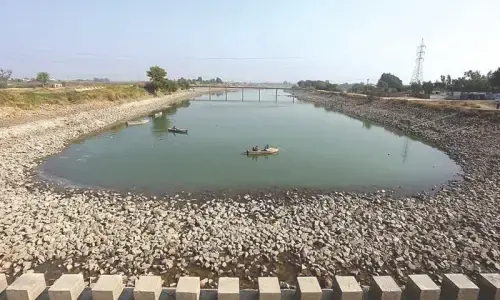
According to the chief minister, Sindh is facing a 41 per cent shortfall in its allocated water supply. On June 6, the province’s water utilisation stood at 57,867 cusecs against its accord allocation of 98,700 cusecs. By contrast, Punjab faced just a 10 per cent shortfall, drawing 97,970 cusecs against an allocation of 109,100 cusecs.
Writes to premier over filling of dams in Punjab while water crisis in Sindh deepening
The shortages come despite a significant 40 per cent improvement in overall water availability compared to last year. Total inflows into the Indus River system currently stand at 216,894 cusecs, up from 154,407 cusecs during the same period last year.
River inflows (in cusecs): Indus (at Tarbela): 110,000 (78,800 last year), Kabul (at Nowshera): 43,200 (24,700 last year), Jhelum (at Mangla): 35,410 (30,000 last year) and Chenab (at Marala): 28,284 (20,907 last year).
National reservoirs also show a 16 per cent increase in storage, totalling 4.07 million acre-feet (MAF) compared to 3.504 MAF last year. Current storage levels include 1.173 MAF at Tarbela, 2.667 MAF at Mangla, and 0.23 MAF at Chashma.
Mr Shah pointed out the paradox that despite higher inflows and healthier reservoirs, Sindh’s canal withdrawals have dropped by 33 per cent from 86,293 cusecs last year to 57,867 cusecs this year.
Meanwhile, diversions to the Chashma-Jhelum and Taunsa-Panjnad link canals have risen by 16 per cent, from 23,586 cusecs to 27,316 cusecs.
“There is a growing concern that operational priorities are focused on storage maximisation in reservoirs and canal diversions, rather than ensuring equitable distribution,” Mr Shah wrote.
He warned that the low water levels at Sindh’s barrages were now threatening supplies to both Sindh and neighbouring Balochistan, adding that Sindh continues to support Balochistan despite its own acute shortages.
Published in Dawn, June 12th, 2026