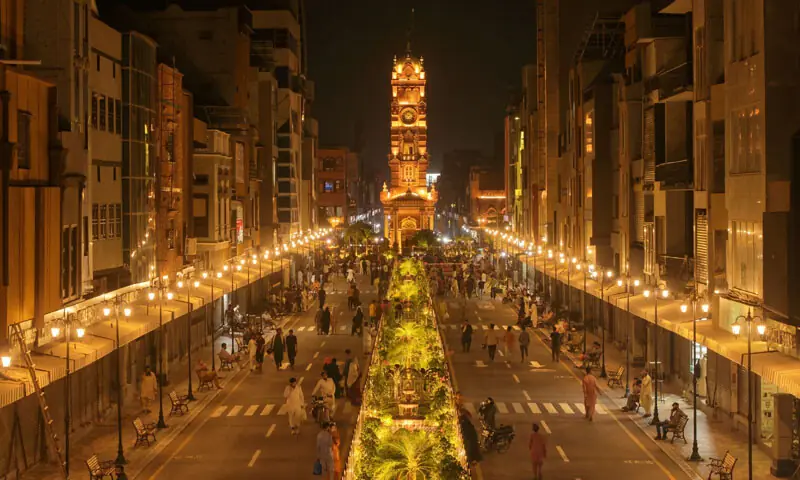
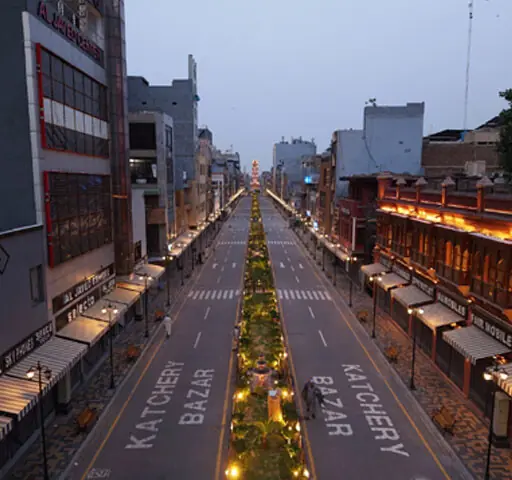
Stand at the entrance to Faisalabad’s Kutchery Bazaar and you could be forgiven for thinking you had stumbled on to a film set.
Decorative lamp-posts cast amber pools of light across newly paved walkways. Freshly painted façades glow in warm floodlights. Faisalabad’s famous Clock Tower — a colonial landmark at the hub of eight radiating bazaars and locally known as ghanta ghar — presides over it all, looking considerably more photogenic than before.
The transformation, completed in May this year, has been a social media sensation. Videos shared by Gen Z visitors routinely rack up hundreds of thousands of views. The government has invested approximately Rs360 million in the beautification of Kutchery Bazaar and the Clock Tower alone, with plans to extend the project to Jhang Bazaar, Aminpur Bazaar and the remaining five bazaars in the city in subsequent phases. By any superficial measure, it is a success.
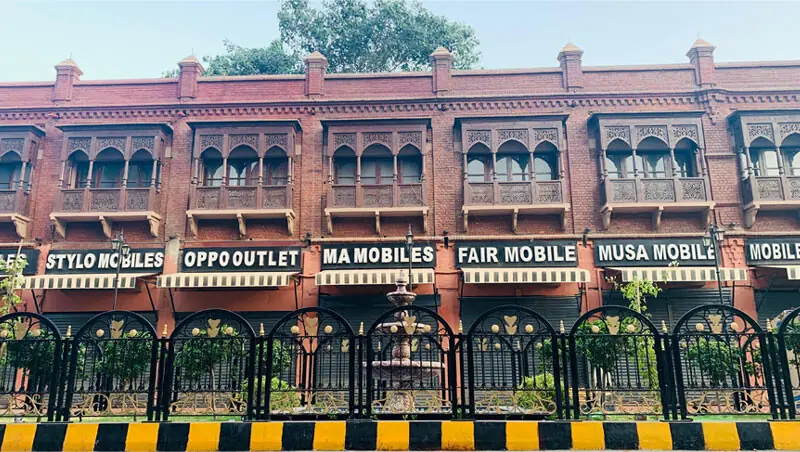
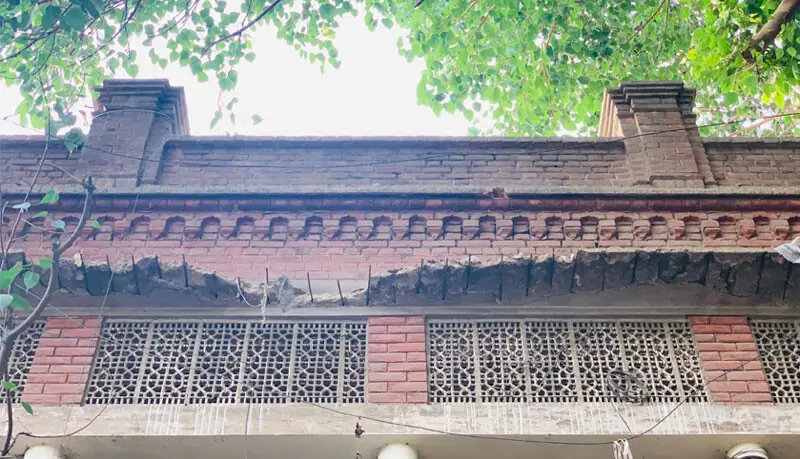
But step off the main thoroughfare. Duck through a side entrance. Look upward at the Zail Ghar — one of the bazaar’s most storied colonial buildings, a striking two-storey red-brick structure known for its turrets and minaret-like architectural features — and the picture changes.
The front façade has been freshly painted; old windows have been replaced with decorative wooden-style balconies. Yet the rear of the building tells another story entirely. Its structural framework is deteriorating and the staircases are damaged. Its verandas, rooms and roof remain in a state of advanced dilapidation. Only the face visible to the camera has been treated. The rest has been left to quietly collapse.
Fresh paint, decorative balconies and glowing floodlights have transformed Faisalabad’s historic core. But behind the Instagram-friendly makeover lie crumbling buildings, neglected landmarks and a growing debate over whether the city is actually preserving its heritage…
A WITNESS TO HISTORY
The Zail Ghar was constructed in 1918, when the city was still known as Lyallpur — named after Sir James Broadwood Lyall, the lieutenant governor of Punjab who oversaw its planned development.
Local journalist Zikerullah Hasani explains that its upper-floor rooms once accommodated zaildars — rural administrators who travelled to the city to deposit land revenue and water taxes, while the ground floor served as stables for their horses. The adjacent open space was a parking ground for bullock carts and horse carriages.
After Partition, the building cycled through many lives: a ‘Circuit House’ (accommodation for visiting government servants and dignitaries), a revenue court, government offices, and a hostel for medical students. By 1985, the district council had converted it into a press chamber, allotting offices to newspapers and news agencies. The horse stables were converted to shops and rented out. Today, it remains the property of the district council — though its crumbling domes and cracked towers suggest that ownership has not translated into stewardship.
The Zail Ghar is not alone in its predicament.
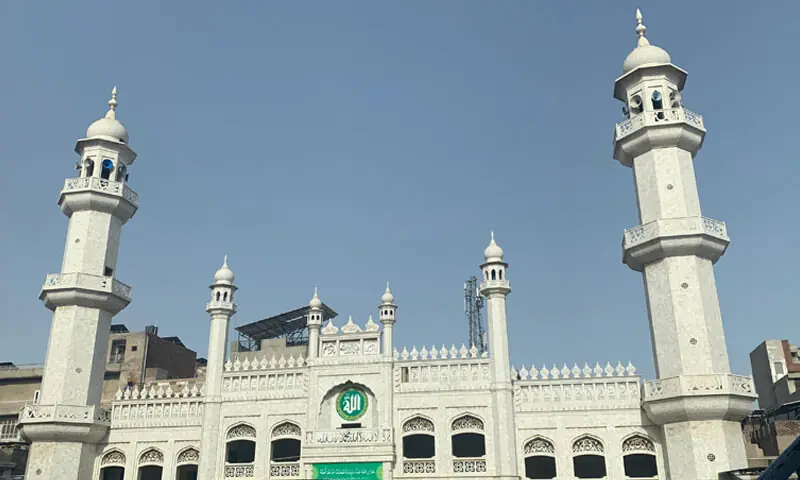
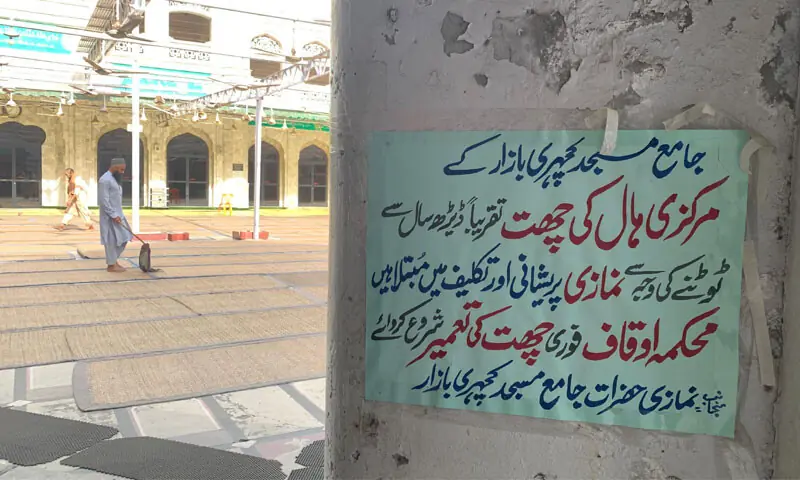
The main hall of the historic Jamia Mosque in Kutchery Bazaar, built in 1903, has remained closed for a year and a half because of a deteriorating roof. Parts of its rare glasswork ceiling have already broken and been lost. The building of the Central Cooperative Bank Limited Lyallpur — constructed in 1921 and once a landmark of the bazaar — has already vanished entirely, demolished through official neglect, with a multi-storey commercial structure now rising on its site.
BEAUTY WITHOUT BONES
Dr Tohid Ahmad Chattha, a lecturer in the history department at Government College University Faisalabad, puts the problem plainly: not a single archaeologist or heritage conservation expert was hired for the restoration and façade work carried out under the beautification plan.
This is not the first time, notes Dr Chattha, that Faisalabad’s buildings have suffered in the name of improvement.
“A portion of the Zail Ghar itself was demolished to accommodate a commercial structure,” he tells Eos. In 2015, several significant historical buildings were whitewashed in a so-called restoration exercise, permanently altering their original appearance. “Old maps and photographs of the city show the Clock Tower once surrounded by dense, mature trees — most of which were gradually felled and replaced with concrete,” he points out.
Prof Sajida Haider Vandal, heritage conservation expert and also the driving force behind the Trust for History of Art and Architecture in Pakistan, welcomes the government’s willingness to allocate significant funds to cultural heritage — calling it perhaps the first time in Pakistan’s history that such a budget has been set aside for this purpose. But the allocation of funds, she stresses, is only meaningful if the work is carried out under the supervision of trained conservation experts, following international standards.
“If restoration work is being assigned to ordinary contractors and historic buildings are being altered rather than restored to their original form, such work cannot genuinely be called conservation,” says Prof Vandal.
A MARKET DIVIDED
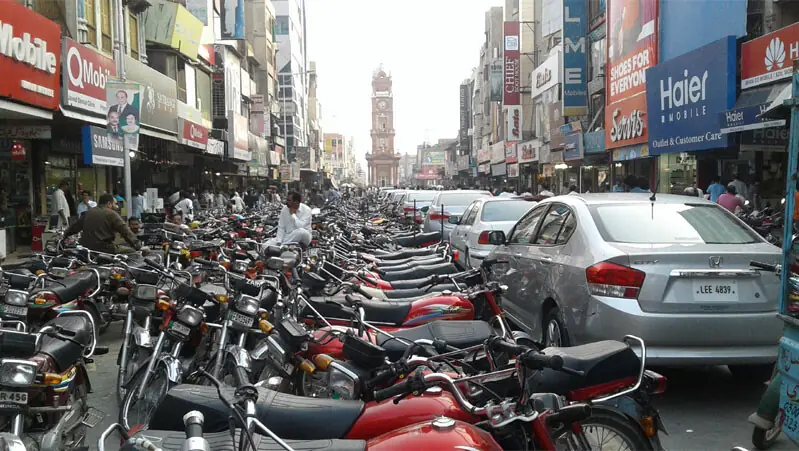
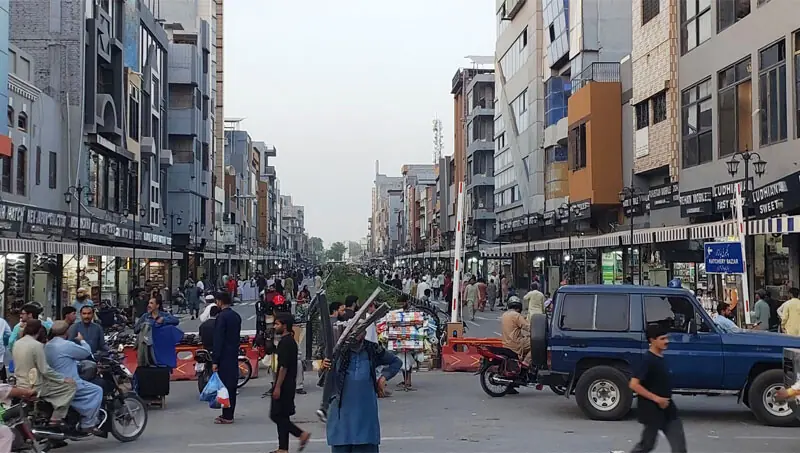
Not everyone on the ground is admiring the scenery. For the shopkeepers of Kutchery Bazaar, the transformation has brought disruption alongside decoration. The construction of a central green belt has effectively divided the market into two sections, forcing customers to take long detours to move from one side to the other.
Vehicle access has been restricted, but no adequate parking has been provided in the surrounding streets — a problem that has plagued the Clock Tower bazaars for decades and which a decade-long “parking plaza” project has failed to resolve.
Muhammad Irshad, who owns a cloth shop there, is direct about the failures. “The main issue in the Clock Tower bazaars has always been parking,” he says. Before aesthetics, before fountains, before ornamental lighting, the administration should have improved traffic flow and created proper parking infrastructure, he tells Eos.
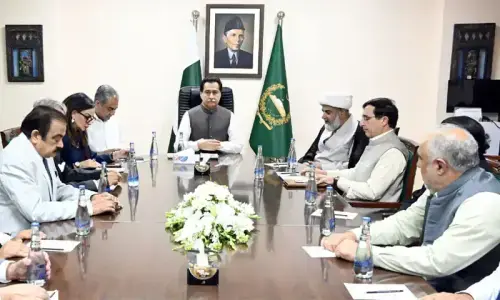
Faisalabad’s assistant commissioner, Adil Umar, acknowledges the severity of the parking problem and tells Eos that approval has been granted for five parking structures, with designs finalised for two. He also admits that the central green belt experiment had been a mistake — confirming that no similar belts would be built in the remaining bazaars. “Such green belts do not exist in international markets anywhere in the world,” he accepts. “Because of the central green belt, both traders and visitors are facing difficulties.”
Absent from every list
Perhaps the most striking fact about Faisalabad’s heritage crisis is a bureaucratic one.
Despite the city’s rich and distinctive colonial-era architecture — built to a unique radial urban plan that remains one of the more unusual city layouts in South Asia — not a single building in Faisalabad has been included in the protected heritage list of the Punjab Archaeology Department. Not one of its historic structures features in the Punjab government’s province-wide restoration plan covering 170 heritage sites.
In 2014, the then District Coordination Officer, Noorul Amin Mengal, declared 45 historical buildings, constructed between 1901 and 1937, to be cultural heritage sites. More than a decade later, none of them has been added to the archaeology department’s protected list. Requests for comment from the current deputy commissioner went unanswered.
Prof Vandal urges citizens not to wait for the administration to act. The deputy commissioner, she says, should formally write to the relevant authorities to identify historically significant structures and seek their inclusion on the protected list. But if that does not happen, citizens themselves must demand it.
“Culture and history are not limited to buildings alone,” she reminds us. “Our crafts, artisans and traditional skills are also part of our cultural heritage, and must be preserved and revived so that these skills can be passed on to future generations,” says Prof Vandal. She then adds a prescient warning: “Otherwise, all of this will eventually disappear.”
Memory and façade
The debate over Faisalabad’s beautification project is, in the end, a debate about what a city owes its own past.
It is possible to hold two things simultaneously: that new lighting and clean footpaths are pleasant, and that painting over a crumbling wall is not the same as saving it. That tourists enjoy a photogenic marketplace, and that what makes a marketplace worth photographing — its age, its layers, its accumulated human story — is precisely what is being lost in the renovation.
Faisalabad was designed at the end of the 19th century as one of colonial Punjab’s most deliberate urban experiments. Its eight bazaars radiating from a central clock tower were not an accident of geography but a planned statement in brick and mortar. The city that grew from that plan has its own distinct identity — one that cannot be replicated by ornamental balconies or European-style pedestrian precincts, however well-intentioned.
The challenge for Faisalabad is no longer simply how to beautify its urban core. It is whether the city can preserve the soul, memory and identity of a place that once stood as one of colonial Punjab’s most distinctive urban centres — before the paint dries, and the buildings behind the façades disappear for good.
The writer has been associated with journalism for the past decade.
X: @naeemahmad876
Published in Dawn, EOS, June 14th, 2026