China's Xi lands in North Korea for rare visit, hails 'invincible friendship' with Pyongyang
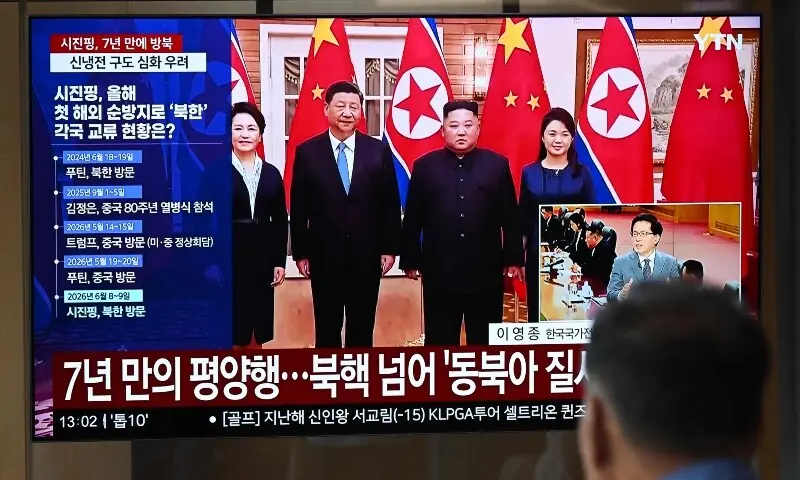

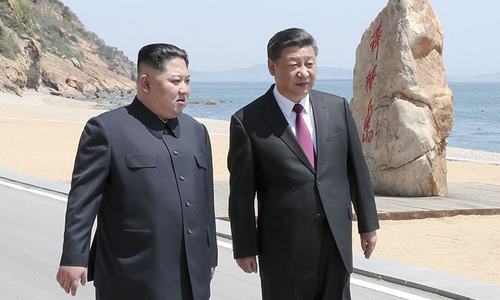
China’s President Xi Jinping hailed an “invincible friendship” with Pyongyang as he arrived in North Korea on Monday, his first trip abroad this year after hosting back-to-back summits in Beijing.
China, Washington’s chief geopolitical rival, has been North Korea’s main trading partner by far for decades and a key source of diplomatic and economic support for the country hit by multiple international sanctions.
Military officers lined a red carpet as an Air China plane carrying Xi arrived for his first visit since 2019, video from Xinhua showed.
A banner that read “We warmly welcome Comrade Xi Jinping” and hailing the two countries’ “unbreakable friendship” hung below Chinese and North Korean flags at the airport.
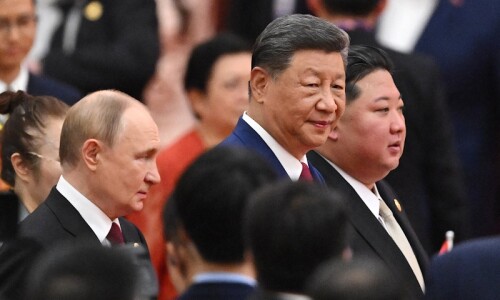
Xi made the trip after hosting US President Donald Trump and Russia’s Vladimir Putin separately in Beijing, and as North Korea’s nuclear talks with Washington remain deadlocked.
The White House said last month that Xi and Trump “confirmed their shared goal to denuclearise North Korea” during their summit in Beijing.
However, leader Kim Jong Un’s powerful sister said on the eve of Xi’s arrival that North Korea’s nuclear weapons programme was “the line of no retreat”.
Minseon Ku, a diplomacy professor at DePaul University, told AFP that “Beijing probably has accepted North Korea as a nuclear state” but Xi “will probably tell Kim that China wants stability more than anything”.
China has “always prioritised stability and is currently having to manage its relations and differences with the US”, Ku said.
Seong-Hyon Lee, a visiting scholar at the Harvard University Asia Centre, also said Beijing is shifting towards “underwriting regime durability” rather than seeking to coerce North Korea into denuclearisation.
“China’s broader regional strategy benefits from a stable, heavily armed, and aligned buffer state that absorbs US and allied military bandwidth,” he told AFP.
Elevated status
North Korea has repeatedly declared itself an “irreversible” nuclear state since Kim and Trump’s 2019 summit collapsed over the scope of denuclearisation and sanctions relief.
Kim has also been emboldened by the war in Ukraine, securing critical support from Moscow after sending troops to fight alongside Russian forces.
Some analysts say the summit could be Xi’s way of countering Russia’s growing influence over North Korea, but DePaul’s Ku stressed that “overall, Moscow is not a major power like China”.
“Moscow-Pyongyang power relations are more equal than Beijing-Pyongyang; Moscow needs Kim for their war in Ukraine as much as Kim needs technology sharing and food from Russia,” she said.
In an article published on the front page of North Korea’s Rodong Sinmun, Xi pledged closer cooperation.
“No matter how the times change or how the international situation evolves, the traditional friendship between China and North Korea is always invincible,” Xi wrote.
Xi last met Kim in September, when he invited the North Korean leader and Putin to a military parade in Beijing marking the 80th anniversary of the end of World War II.
Taiwan counterweight
Trump has made little progress on North Korea, especially on the nuclear front, despite his earlier high-profile summits with Kim.
North Korea is also the only country with an official, binding military alliance with China.
“America is currently engaged in offensive warfare potentially harmful to China’s key interests, such as energy supplies,” Vladimir Tikhonov, Korean Studies professor at the University of Oslo, told AFP.
“It appears Xi is trying to consolidate the alliance” with North Korea partly for that reason, he said.
Beijing claims self-ruled Taiwan as part of its territory, and North Korea could also serve as a useful counterweight to US partners in the region, including South Korea and Japan, analysts said.
Long-frosty China-Japan ties have deteriorated since Prime Minister Sanae Takaichi, a security hawk, suggested last year that Tokyo might intervene militarily in any Chinese attempt to take Taiwan.
“As China’s international standing rises, Beijing is likely seeking to draw Pyongyang more actively into its diplomatic orbit,” said Lim Eul-chul, a North Korea expert at Kyungnam University.