‘ADAB Aur Zindagi’, or literature and life, an article by Akhter Husain Raipuri published in 1935, was one of the earliest voices in Urdu literature advocating Marxist literary ideals. At that time he was just 23. The Progressive Writers’ Association (PWA) that took the subcontinent by storm was formed a year later. That is why he is considered among those who laid the philosophic foundations of Progressive Literary Movement and Marxist criticism in Urdu literature.
Sajjad Zaheer in his Raushnai, a book that narrates the PWA’s history, has acknowledged that Akhter Husain Raipuri’s article ‘Adab Aur Zindagi’ earned its writer a place in the pioneers of Progressive Literary Movement. Sajjad Zaheer also wrote that it was the first-ever article in Urdu logically deliberating the need for a new, progressive literature and condemning the “old literature” as well as the orthodox values (Maktab-i-Daniyaal, Karachi, p. 168). Sajjad Zaheer then taunts that Akhter Husain Raipuri was drifting away from the progressive movement because he was looking for some “worldly gains” (p. 171). Akhter Husain Raipuri in his autobiography Gard-i-Raah, while recalling what Sajjad Zaheer considered parting of ways, has given a clarification (page 109). Raipuri narrated how he had decided to go to Sorbonne University, Paris, to earn a doctorate. But, contrary to what Sajjad Zaheer felt, Akhter Husain Raipuri’s commitment to progressive ideals was a life-long affair and despite his migrating to Pakistan and joining the government echelons he remained intellectually associated with the progressives, albeit he had some ideological differences with progressives on certain issues.
Akhter Husain Raipuri was a researcher, critic, short story writer, translator and civil servant. He was born on June 12, 1912, in Raipur, the then Central Provinces, British India (Raipur is now a part of Indian state of Chhattisgarh). Akhter Husain Raipuri received his early education at Raipur and graduated from Aligarh University. He went to Paris in 1937 for doing PhD and wrote his dissertation on Sanskrit literature in French. He knew Sanskrit, Hindi, Bengali, Gujarati, Persian, French and English. He returned from Paris in 1940 and worked for M.A.O. College, Amritsar. He later on joined education department through public service commission. After the independence, he migrated to Pakistan and after a stint at education department worked for Unesco.
Akhter Husain Raipuri’s books include Zindagi Ka Mela (1940), short stories; Adab Aur Inqilaab (1943), critical essays; Sang-i-Meel (1949), critical essays; Muhabbat Aur Nafrat, short stories; Payaam-i-Shabaab, Urdu translations of Qazi Nazrul Islam’s Bengali poems; Habash Aur Italiya, history of Ethiopia and Italy; Gorki Ki Aap Beeti, Urdu translation of Maxim Gorky’s autobiography in three volumes; Shakuntala, Urdu translation of Kalidasa’s work from the original in Sanskrit; Pyari Zameen, Urdu translation of Pearl S. Buck’s novel The Good Earth; Raushan Meenar (1958), critical essays; Aag Aur Aansoo, a collection of his Hindi short stories; Gard-i-Raah (1984), his autobiography; and some others.
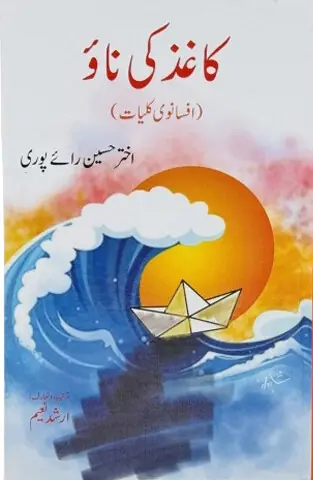
Arshad Naeem, a Lahore-based poet and writer, has recently collected Akhter Husain Raipuri’s Urdu short stories in a volume titled Kaghaz Ki Naao. In his intro, Arshad Naeem has taken exception to a statement made by a publisher who had published in 1989 Akhter’s 20 short stories in an anthology, claiming that he had published the entire collection of short stories by Akhter. Arshad, while recounting Akhter’s collections of short stories, says total number of short stories written by Akhter is 30 and the book he has compiled proffers 26 short stories, leaving out the four pieces that Akhter himself had discarded.
Published by Lahore’s Al-Hamd Publications, the 256-page book has some short stories that are really short. For instance, the total length of a short story titled ‘Samandar’, or the ocean, is just three pages. One of the reasons for this brevity is that Akhter’s art of storytelling is essentially a thrifty use of words. Using a minimalist style, Akhter believed in economy of language. As Dr Khalid Nadeem has put it in his blurb, Akhter’s short stories do not have any redundancies or unnecessary wordiness and that is why one cannot axe any paragraph, or even a sentence, from his short stories.
But unlike many progressive short story writers, Akhter’s short stories are not written in a style that favours stolid realism, turning creative pieces into bland and drab reports. Rather, his realistic short stories have a touch of Romanticism. He was never apologetic about this of trace of Romanticism as he believed romance, too, was a part of life.
Akhter Husain Raipuri died in Karachi on June 2, 1992.
Published in Dawn, June 1st, 2026