0
0

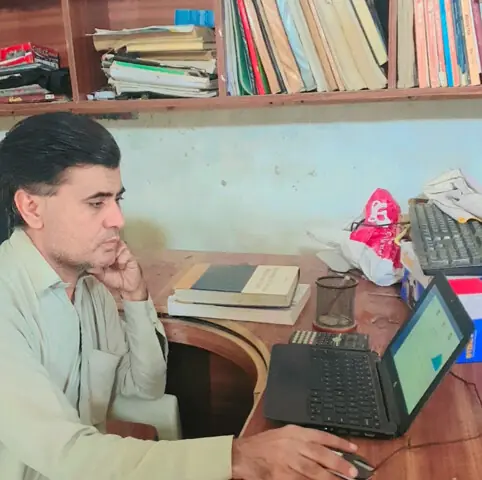
PESHAWAR: In the quiet sanctum of dusty archives, where time settles like fine mountain silt, a man of letters stumbled upon ghosts. Not the spectral kind that haunt folklore, but something far more poignant — faded photographs of Pashto music’s forgotten titans, their faces frozen in sepia, their voices long silenced by the march of decades.
Aurangzeb Qasmi from Mardan district, a translator, poet, researcher and teacher, has long lived in the embrace of the written word. Yet his soul has always answered to a deeper rhythm — the raw, heart-wrenching melodies of vintage Pashto music that once reverberated through the valleys of Khyber Pakhtunkhwa and the intimate hujras of tribal life.
“These were not mere singers,” he reflects, his voice carrying the quiet intensity of a man, who has crossed literary frontiers into uncharted technological territory. “They were the very breath of our cultural soul — Zar Khan, Muzaffar Khan, Enzar Gul, Khanzada, Kachay, Mehrunnissa, Chishti Chaman Jan, Sabz Ali Khan, Mir Ahmad Khan, and Abdullah Jan. Their songs carried the ache of love, the fire of resistance, and the melancholy of exile. And yet, their faces had almost vanished from living memory,” he says.
What began as an academic curiosity, gradually evolved into a profound personal mission. Confronted with these rare, unseen photographs, he felt the weight of responsibility. How does one return the face to the immortal voice? The answer lays in artificial intelligence.
Stepping far beyond poetry and prose, he embarked on a self-taught journey into AI. He hunted down fragile gramophone records, meticulously digitising their crackling audio, preserving every emotional fracture.
Then, with the patience of a craftsman and the vision of a poet, he used advanced AI tools to animate the photographs, breathing subtle life into still eyes and gentle movements into once-rigid shoulders, placing these resurrected artists back into the atmospheric settings of their era.
The result is magical realism made technical: vintage singers performing once more, their lips syncing to original recordings, their expressions carrying the same dignity and pathos that once moved entire communities.
So far, he has produced more than 300 such videos. Each one is a labour of love and cultural defiance — a bridge between the analogue soul of the past and the digital possibilities of the present.
“The response has been deeply moving,” he says, a note of genuine humility in his voice. “The Pakhtuns community has embraced these videos with an outpouring of emotion I could never have anticipated. People say they wept hearing their grandparents’ favourite songs again, seeing the singer’s face for the first time. It feels as though we have returned something sacred that was taken by time.”
In an age where cultural memory often dissolves in fleeting digital trends, his project stands as a rare act of preservation. It marries ancient Pakhtun traditions of storytelling and music with cutting-edge technology — not to modernise for modernity’s sake, but to honour what risks being lost.
For him, this endeavour transcends technical accomplishment. It represents the natural evolution of a literary life — one that has always sought to translate not just words, but entire worlds and emotions across time and space.
“As a translator and poet, I have always believed that our duty is to carry the fire from one generation to the next. These voices were fading embers. Now, through AI, we have fanned them back into flame, true to their original spirit,” he muses.
In the valleys where these songs were born, and in the hearts of a new generation discovering them, those flames are burning once more. Thanks to one man’s unlikely journey from the page to the pixel, the melodies of the past have found their voice again — richer, more alive and deeply remembered.
Published in Dawn, June 1st, 2026