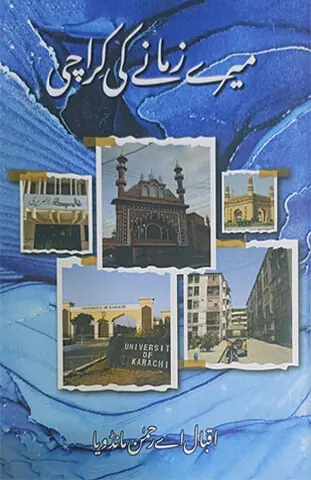
Mere Zamanay Ki Karachi
By Iqbal A. Rehman Mandvia
Fazlee
ISBN: 978-9694413549
351pp.
Do you fear asking an uncle about a particular place in Karachi because he might drag you back to pre-Partition days, wrapped in glorified memories that sound too good to be true? Or are you tired of scouring articles for authentic information, only to find fragments and contradictions?
Iqbal A. Rehman Mandvia’s Mere Zamanay Ki Karachi [The Karachi Of My Times] offers the perfect alternative. It spares you the long-winded monologue and endless searching, delivering instead something far richer, with carefully arranged chapters steeped in nostalgia, memory and quiet heartbreak.
This is not a conventional history of Karachi. It is a deeply relatable book, with memories tucked into every page, nostalgia woven into every line and a subtle sorrow that lingers long after the last chapter — reminding the reader of a Karachi that once lived not just on maps, but in hearts.
Mandvia, who authored Iss Dasht Mein Ek Shehr Tha [There Was A City In This Wilderness] a few years ago, returns with another work, now enriched with immense knowledge of neighbourhoods previously missing. He does not merely describe streets, markets or residential areas; he mourns them.
An Urdu book about Karachi contains a treasure of historical facts about the metropolis and has nostalgia woven into every line
Each chapter feels like a pause in time, allowing the city to stand still long enough for the reader to absorb what once was — and what has quietly slipped away. The Karachi of this book breathes through trams, evening walks, cinema queues and the unspoken trust between neighbours who shared little more than walls and goodwill.
The prose is unpretentious yet deeply affecting. Mandvia’s strength lies in restraint. He does not dramatise deliberately; the drama emerges naturally, carried by memory. There is warmth in his recollections, but also an unmistakable ache. Readers sense that this Karachi — orderly, courteous, culturally alive — exists now only in fragments, surviving in stories told with a sigh rather than certainty.
Filled with answers and fresh insights, this book offers new knowledge at every turn. Unlike Mandvia’s earlier 936-page work, this 351-page volume carries a quiet magic — concise yet rich, restrained yet deeply evocative — making every page feel purposeful and alive. Mere Zamanay Ki Karachi captures the Karachi of the good times, the way the city was planned to be the federal capital. The journey begins in Bahadurabad and concludes at Karachi University, like driving through familiar streets with an old friend by your side. The memory of the now defunct Drive-In Cinema — later acquired by Shan-i-Mughlia Restaurant — marks only the beginning of this nostalgic voyage.
There is no Karachiite who can honestly claim to have known everything contained in these pages. Just for a check, do you know why a locality is called Hussain D’Silva Town — a name that draws from two different faiths? Which stalwarts lie buried in the Sakhi Hasan graveyard, or how iconic shops, renowned hospitals, and residential colonies first came into being?
Hussain and D’Silva were, in fact, construction partners — Ashfaq R. Hussain and Jerome D’Silva — active in the 1940s. The graveyard of Sakhi Hasan holds the final resting places of poet Raees Amrohvi, playwright Khwaja Moinuddin, lyricist Fayyaz Hashmi, singers Mujeeb Alam and Ahmed Rushdi and the legendary painter Sadequain.
From iconic schools and their pupils to the origins of place names like Golimaar, Eesa Nagri, and Kati Pahaarri, the book offers a richly layered exploration of Karachi’s social, cultural and historical landscape — unearthing forgotten stories, tracing neighbourhood evolutions, and bringing the city’s past vividly to life through people, places and memories.
Who were the original inhabitants of Dhoraji Colony, Qasba Colony and Bandhani Colony? Why was a particular house known as ‘Cheel Wali Kothi’? Who were Dalmiya, Abbasi Shaheed and Haider Mehdi Hussaini, and who planned Gulshan-i-Iqbal? By the time one finishes the opening 48 pages, a vast and intricate portion of Karachi has quietly been added to the reader’s mental map.
Even if you know why Lalukhet was renamed Liaquatabad, the second chapter is indispensable. It reveals histories far beyond the limits of any single neighbourhood. What does “Hutti” in Teen Hutti mean? What distinguished a dada [gangster] from Lyari from a badmaash [scoundrel] in Lalukhet? Why was Lalukhet notoriously tough for law enforcement? And which events led to the razing of the Liaquatabad Meat Market?
If Numaish gave birth to the kebab paratha, then BBQ emerged from Liaquatabad. What began as a dhaba [roadside restaurant] became an icon of Karachi’s food culture. Similarly, traversing Shahrah-i-Pakistan, from Masjid-i-Shuhada to the Super Highway, becomes a journey through layers of the city previously unknown. The way Nazimabad and North Nazimabad are revisited takes you on a journey you’ll never want to end.
The writer’s connection of Humayun Road with Sharae Faisal through the famed Battle of Chausa is highly commendable. It is also intriguing to note that, while our roads are named after nearly all Mughal rulers, Babar is conspicuously absent — a point that invites reflection.
Mandvia’s account of the transformation of “chori dakaiti” [theft and burgling] into kidnappings for ransom and violent crimes reflects the profound shifts in Karachi’s demographics. The contrast between then and now is left to speak for itself, with silences as powerful as the words.
For someone like me, who has written articles and made documentaries exploring Nazimabad, Lyari, Bunder Road and Gulshan-i-Iqbal, I feel this book should have arrived years ago. It brings with it insights, anecdotes and perspectives that would have enriched my own journey through the city.
The book captures the city’s cinema culture beautifully as well, tracing its decline from bustling theatres to streets lined with ghostly, abandoned buildings. The onslaught of VCRs delivered the final blow to an industry already gasping for life. Prices of yesteryear — a 75 paisa cold drink or a 20 paisa roti [flat bread] — now feel surreal, echoes from a bygone era that almost seem like a joke.
From the hum of roadside stalls to the grandeur of iconic buildings, from open grounds to the winding lanes a result of ‘China-cutting’, and from the hidden stories behind every residential colony, the book offers far more than reference or history — it is a companion. It turns the places we have seen into places we truly know, breathing life into their streets, shops and corners through memory and imagination. For foodies, it is a feast; for history seekers, a trusted guide. The only thing missing in it are iconic photographs, which would have allowed readers to connect with the text even more instantly.
What makes Mere Zamanay Ki Karachi particularly moving is its portrayal of social harmony. Linguistic, ethnic and cultural differences appear not as fault lines, but as threads in a shared urban fabric. Reading these passages evokes quiet envy for a city that once seemed kinder to its inhabitants and more forgiving of human flaws.
The book is best read slowly, preferably when one is prepared to feel both comforted and unsettled. It will resonate deeply with those who remember the old city and haunt those who never knew it. In preserving Karachi’s past with such tenderness, Mandvia reminds us that cities, like people, can be wounded — and that remembering them is sometimes the only way to grieve.
The reviewer writes on old films and music and
loves reading books. X: @suhaybalavi
Published in Dawn, Books & Authors, May 24th, 2026