IMF highlights ‘Gulf exposure’ as biggest external risk for Pakistan


ISLAMABAD: Following the release of a $1.1 billion tranche for Pakistan, the International Monetary Fund (IMF) has identified Pakistan’s economic exposure to the Gulf Cooperation Council (GCC) as its most acute external vulnerability.
In its staff report, the lender warned that “the war weighs on the near-term outlook as Pakistan is highly exposed to energy imports and remittances from the Gulf countries as well as to global financial conditions”.
According to the report, 81 per cent of Pakistan’s fuel imports originate in the GCC region, while 55pc of remittances — equivalent to about nine percent of the GDP — flow from these economies.
The IMF noted: “A significant disruption to the GCC economies and/or return of migrant workers could weigh on these flows, a major source of financing for consumption and the balance of payments”.
According to the Fund, the Iran war’s impact has been formally embedded in Pakistan’s macroeconomic projections.
Under the IMF’s baseline scenario, GDP growth is expected to slow by 0.2 percentage points in FY26 and 0.6 points in FY27, while inflation is pushed up by approximately half a percentage point this year and one and a half points in FY27.
On Pakistan’s fiscal performance, the report found that programme targets were met, but flagged that the gains were driven by expenditure restraint rather than revenue growth.
“The consolidation progress so far has relied primarily on increasing revenue from the formal sector,” the report stated, noting that the Federal Board of Revenue (FBR) missed its end-December indicative target by 0.3pc of the GDP.
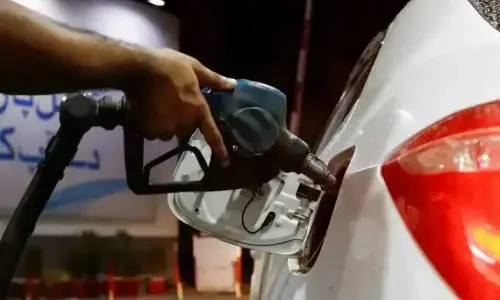
Energy pricing was listed among the prior actions required to complete the review. The government had temporarily delayed fuel price increases after the war began, providing a subsidy to oil marketing companies.
Additionally, the IMF has formally incorporated the country’s court-mandated transition to an interest-free banking system into its programme monitoring.
The report said the government’s financial sector strategy must provide “a detailed roadmap for the transition to a constitutionally mandated ‘riba’ (interest) free economy” and that “the strategy should establish, without ambiguity, the implementation trajectory for financial institutions and the approach to addressing outstanding conventional liabilities”.
The strategy is required as a structural benchmark by end-June 2026.
Published in Dawn, May 15th, 2026