0
0
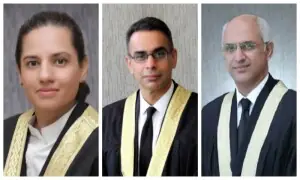
ISLAMABAD: Chief Justice Sardar Mohammad Sarfraz Dogar has issued a tough new policy requiring every judge of the Islamabad High Court to hear at least 30 cases per day, following the recent transfer of three judges to other provincial high courts.
Sources privy to the development told Dawn that the directive applies equally to single benches and two-member division benches, both of which must now dispose of a minimum of 30 cases daily.
The move is aimed at clearing the mounting backlog and ensuring swift disposal of cases pending before the court.
Previously, judges were hearing cases according to their own ease. In several instances, some judges instructed the IHC registrar office not to list more than a dozen cases before their respective single bench. Their staff justified this limitation by arguing that a large list could neither be heard in a single day, nor could a judge decide even a fewer number of cases expeditiously if burdened with excessive work.
The new policy stands in marked contrast to a stance taken last year by former Justice Babar Sattar. During a hearing of a case related to the Comsats Institute of Information Technology, Justice Sattar had warned the additional registrar and deputy registrar of consequences for burdening the courts.
In a written order passed in that case, Justice Sattar noted: “The office has fixed cases including ten RFAs [Regular First Appeals], which is beyond the number of cases that can be heard during the court hours.”
He further observed: “The Presiding Judge and the court’s administrative staff carefully manage the court calendar in view of the time available for hearing each day.”
The court had instructed the additional registrar judicial “not to populate the cause list without consultation with the court staff that maintain the court calendar”, adding that “due to failure to abide by such instruction and a complete lack of application of mind in fixing cases, a number of cases have to be adjourned due to paucity of time, which will cause inconvenience to the litigating parties and their learned counsel in addition to the cost incurred by such parties in appearing before the court on a day when their cases cannot be heard.”
Justice Sattar had warned the additional registrar and deputy registrar judicial of penal action “for wasting the time of litigant parties as well as the court by fixing cases that cannot be heard during the day.”
Meanwhile, the IHC registrar office has formed benches for hearing cases of various nature. According to the approved roster effective from May 4, 2026, four division benches have been constituted.
Division Bench-I comprises Chief Justice Sardar Mohammad Sarfraz Dogar and Mr Justice Mohammad Asif, and will hear all matters.
Division Bench-II comprises Mr Justice Sardar Ejaz Ishaq Khan and Mr Justice Arbab Mohammad Tahir, and will handle tax matters.
Division Bench-III comprises Mr Justice Khadim Hussain Soomro and Mr Justice Mohammad Asif, and will hear criminal matters.
Division Bench-IV comprises Mr Justice Mohammad Azam Khan and Mr Justice Inaam Ameen Minhas, and will hear all matters.
For single benches, all seven judges will hear cases individually. They include: Chief Justice Sardar Mohammad Sarfraz Dogar, Mr Justice Sardar Ejaz Ishaq Khan, Mr Justice Arbab Muhammad Tahir, Mr Justice Khadim Hussain Soomro, Mr. Justice Muhammad Azam Khan, Mr Justice Mohammad Asif, and Mr Justice Inaam Ameen Minhas.
The division benches will function from Monday to Thursday, while a special division bench or larger bench will be available on Thursday and any other day as directed by the Chief Justice.
Division Bench-III criminal matters, and Division Bench-IV all matters. Seven judges have also been listed for single bench hearings.
The division benches will function from Monday to Thursday, while a special division bench or larger bench will be available on Thursday and any other day as directed by the Chief Justice.
Published in Dawn, April 30th, 2026