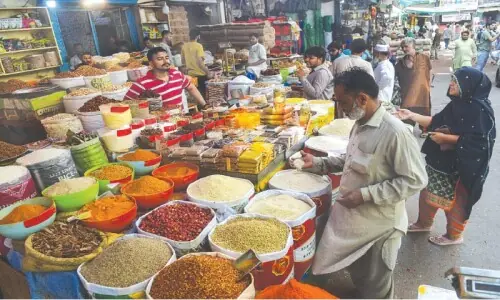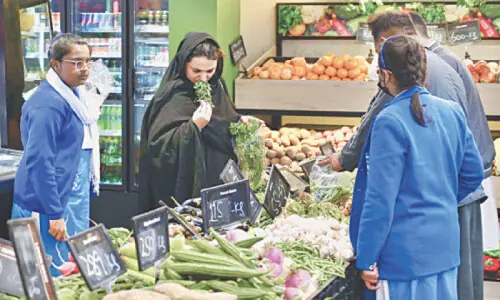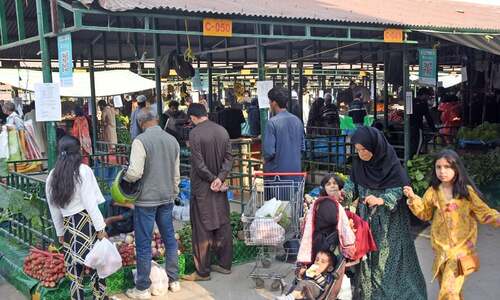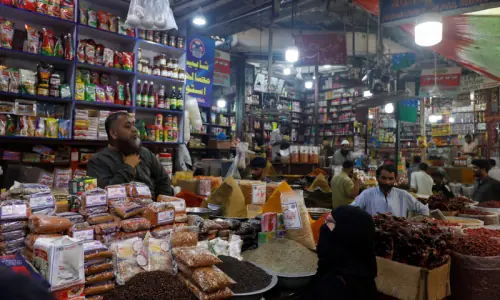
ISLAMABAD: Short-term inflation, measured by the Sensitive Price Index (SPI), rose 13.98 per cent year-on-year in the week ending April 23, driven by higher retail prices for petroleum products and perishable food items, the Pakistan Bureau of Statistics (PBS) data showed on Friday.
The increase in SPI was a broad-based cost shock rather than a narrow spike. This was mainly driven by unprecedented increases in electricity (54pc), LPG (51pc), petrol (44pc), and diesel (37pc).
This energy-led surge has spilled over into the prices of essential food items, both perishable and non-perishable, such as wheat flour (36pc), onions (32pc), tomatoes (23pc), and meat and milk, which are also rising.
Although petrol prices saw a slight reduction and diesel rates registered a sharp cut, overall fuel costs remain significantly elevated compared to pre-Middle East conflict levels. Prices of both food and non-food items showed no meaningful easing during the week under review.
Energy prices drive 37th straight weekly rise
The SPI increased for the 37th consecutive week. On a week-on-week basis, however, the index declined by 0.33pc.
According to PBS data, there has been some relief in the prices of potatoes, pulses, sugar and tea, but not enough to offset energy-led inflation.
According to analysts, this is cost-push inflation, which means energy has taken priority, followed by food. As a result, average households are under pressure because continued tension in the Middle East is driving up fuel prices.
The items whose prices increased the most over the previous week included potatoes (3.13pc), bread (0.91pc), washing soap (0.85pc), cooking oil-5 litre (0.69pc), long cloth (0.65pc), eggs (0.61pc), mutton (0.45pc), chicken (0.44pc), vegetable ghee-1 kg (0.30pc) and pulse masoor (0.27pc).
The items whose prices declined week-on-week included tomatoes, down 27.65pc, followed by onions (9.35pc), diesel (8.35pc), LPG (7.08pc), garlic (4.27pc), bananas (0.47pc), wheat flour (0.37pc), sugar (0.36pc) and mustard oil (0.22pc).
However, on an annual basis, the items whose prices increased the most were electricity charges for Q1 (54.02pc), LPG (50.68pc), petrol (44.10pc), diesel (36.76pc), wheat flour (36.06pc), onions (31.89pc), tomatoes (23.46pc), chilli powder (15.20pc), mutton (15.18pc), beef (13.27pc), powdered milk (10.41pc) and garlic (9.96pc).
In contrast, the prices of potatoes dropped by 47.38pc, followed by pulse gram (19.92pc), salt powder (13.22pc), sugar (11.74pc), pulse masoor (11.47pc), pulse moong (1.63pc), packet tea (1.14pc) and masoor pulse (11.47pc).
The index, comprising 51 items collected from 50 markets in 17 cities, is computed weekly to assess the prices of essential commodities and services at shorter intervals. Data showed that the prices of 19 items increased, 09 decreased, and 23 remained stable compared to the previous week.
The average price of Sona Urea stood at Rs4,566 per 50 kg bag, 0.57pc higher than last week’s price and 1.53pc higher than last year. Meanwhile, the average Cement price is at Rs1,536 per 50 kg bag, 0.6pc lower than the previous week and 8.97pc higher than last year.
Published in Dawn, April 25th, 2026