Every 1ºC of global warming avoided could halve number of world heritage sites exposed to major disruption: Unesco


 0
0


ISLAMABAD: The first global assessment examining all Unesco-designated World Heritage sites, Biosphere Reserves, and Global Geoparks reveals that every 1ºC of global warming avoided could halve the number of sites exposed to major disruption by the end of the century, it emerged on Thursday.
In its assessment, titled “People and nature in Unesco-designated sites: Global and local contributions”, Unesco said that by failing to act now, pressures will intensify and natural systems in more than one in four sites could reach critical tipping points by 2050, potentially undermining both ecosystems and the communities that depend on them.
Scaling up integrated management, restoration, inclusive governance, and targeted policies, alongside increased investment, was termed essential to sustain and expand these proven approaches and strengthen their resilience, Unesco said.
The report further stated that securing the future of Unesco-designated sites requires investment commensurate with their global significance.
Many sites operate with limited financial and technical capacity, while the demands of stewardship continue to increase — from climate adaptation and ecosystem restoration to monitoring, education, and community engagement.
In many regions, funding remains fragmented, short-term, or insufficient to support long-term resilience, the report noted.
Deepening understanding of how resilience is built and sustained across Unesco-designated sites should now be a priority, the report recommended.
It said that strengthening exchanges across sites and designations could help identify context-specific and transferable lessons, supporting more effective and integrated approaches to resilience within and beyond site boundaries.
The report recommended that investing in Unesco-designated sites was not only an investment in remarkable places, but also in approaches that have already demonstrated their value in sustaining both people and nature.
In a context of intensifying environmental and socio-economic pressures, reinforcing their protection, ensuring adequate and sustained resourcing, and strengthening their integration into broader policy frameworks is an urgent shared responsibility, as per the report.
This called for renewed commitment from member states, strengthened international cooperation, and strengthened alignment of action across sectors and scales, the report added.
It went on to further state that as pressures continue to grow, the role of Unesco-designated sites as anchors of resilience becomes increasingly significant, underscoring their importance as a foundation for advancing sustainability, equity, and long-term societal resilience for present and future generations.
These sites form a unique global network of more than 2260 sites across over 13 million square kilometres, Unesco said in its report.
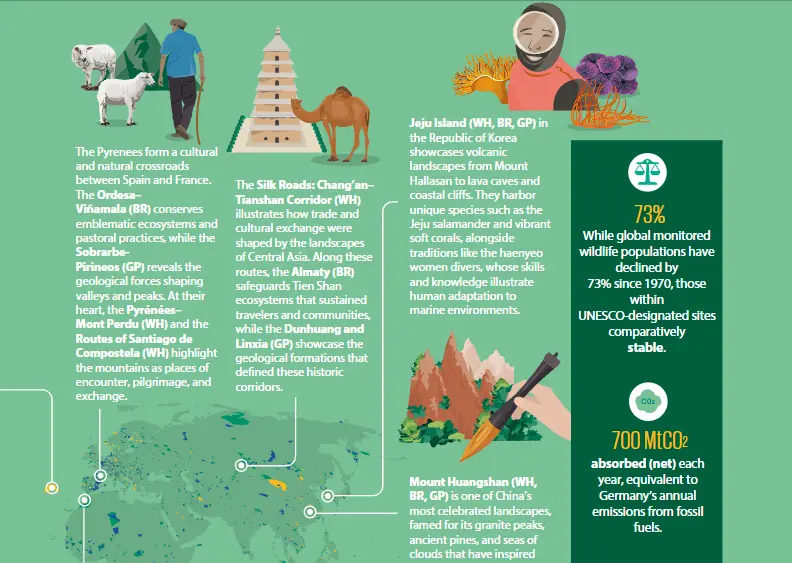
These living landscapes support the livelihoods of some 900m people worldwide — around 10 per cent of the global population, including many indigenous Peoples and local communities — while harbouring a significant share of global biodiversity and contributing to climate regulation.
The assessment highlights a central and encouraging finding that despite intensifying environmental pressures worldwide, Unesco-designated sites demonstrate a high level of resilience, forming a unique global network in which people and nature remain deeply interconnected.
According to the report, this resilience is reflected in their capacity to adapt to change while continuing to safeguard ecological integrity, cultural heritage, and community well-being, making them critical reference points for understanding how integrated social–ecological systems can endure and evolve under growing global pressures.
The assessment shows that Unesco-designated sites are delivering tangible results for both people and nature, even in the face of increasing pressures.
They represent a resilient model in which human well-being and environmental protection advance together, and offer practical, place-based responses to the intertwined challenges of climate change and biodiversity loss.
Within these landscapes, safeguarded over generations through local stewardship, monitored wildlife populations have remained stable on average, in stark contrast to the 73pc global decline in monitored species since 1970, as per the report.
The assessment examines how Unesco-designated sites are responding to growing pressures. Despite increasing environmental stress from human activities, including climate change, many of these sites continue to demonstrate resilience.
“The World Heritage Convention is unique in combining the protection of both cultural and natural heritage within a single international instrument, providing the highest level of global recognition and fostering scientific cooperation for the conservation and management of these exceptional places,” the report read.
Some areas of Unesco-designated sites are so unique that they are recognised through more than one Unesco designation, it added.
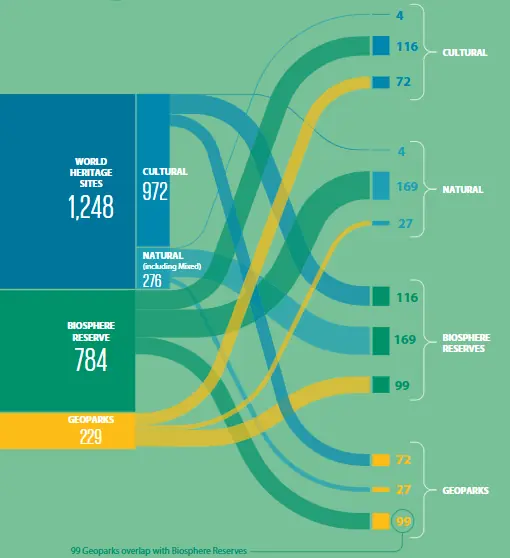
It continued: “Rather than duplicating eorts, these overlapping designations reflect complementary roles, allowing multiple dimensions of people–nature relationships to be recognised and managed together.”
“Cultural world heritage sites highlight how human societies developed in close response to their natural surroundings. Cities, infrastructures, and landscapes were shaped by deserts, rivers, land formations, climate, and natural resources,” the report said.
“From adaptive water systems and climate-responsive architecture to canals and industrial landscapes powered by nature, environmental conditions guided human creativity,” the report said.
It added Unesco-designated sites that translate global policy ambitions into concrete, place-based action.
Positioned at the intersection of climate, biodiversity, culture and development, the report said: “The sites provide platforms to integrate policies at local, national and international levels, delivering tangible benefits by serving as operational platforms supporting countries in navigating trade-offs and delivering on multiple international commitments simultaneously, as well as reference systems for tracking progress toward global targets”.