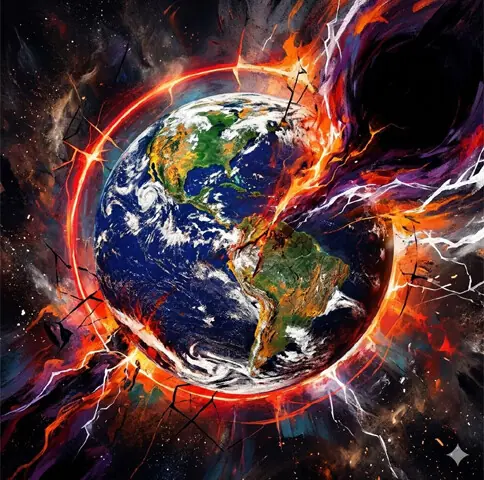
AS the world observes Earth Day today (April 22), it is a crucial reminder to all concerned — individuals, institutions and countries — that we need to take due action today more than ever. The Inter-governmental Panel on Climate Change (IPCC) has clearly warned that despite all the mitigating measures, the Earth’s temperature is still getting warmer and it might hit the critical benchmark of 1.5 degree Celsius above pre-industrial levels (1850-1900) between 2030 and 2035.
Greenhouse gas (GHG) and carbon dioxide (CO2) emissions have to be reduced by at least 43 per cent by 2030, and at least 60pc by 2035, relative to 2019 levels, in order to prevent the planet from exceeding this limit.
Human actions, in the meantime, are having devastating results, as is seen by faltering crops, increasing heatwaves and storms, growing diseases, and, most importantly, military conflicts. In its most recent Global Climate report, the World Meteorological Organisation (WMO) warned that the planet has a huge and growing energy imbalance that is warming the oceans, the land and the air to danger-ously high levels.
Between 2005 and 2025, the Earth’s energy imbalance grew by more than 11 zettajoules annually, or almost 18 times the amount of energy used by humans. The amount of work needed to generate one watt of electricity for one second is often expressed in joules, a fundamental unit of energy. Kilojoules, megajoules, gigajoules and terajoules were employed to capture ever-increasing quantities of energy.
Despite using a ‘billion trillion joule’ marker, the name ‘zettajoule’ has not yet been used often even though it is the core explanation of climate breakdown and the main unit of climate collapse, which is well and truly unfathomable, almost beyond comprehension, and really big.
Shockingly, the amount of heat being added to the oceans in 2020 was equal to around five Hiroshima bombs of energy each second. Seven Hiroshimas occurred per second by 2022. Moreover, the WMO data indicates that it was much closer to 11 Hiroshima bombs per second last year. The energy imbalance in the world’s oceans, which absorb over 90pc of solar radiation, unexpectedly reached a record 23 zettajoules last year, more than double the average for the preceding 20 years. This indicates that it was around 39 times the yearly global human energy use.
Given these terrible facts, the sustain-able narrative is not enough since the number is dreadful and headed for further disaster. In order to create a more sustainable economy that benefits both people and the environment, we must take action and prioritise life on Earth.
Fortunately, science is coming out with cutting-edge solutions for climate fix, such as carbon capture and storage technology, renewable energy technology, adoption of wind and solar energy, energy and material efficiency, climate-smart lives-tock and agricultural practices, green infrastructure, electric vehicles, efficient appliances, and fuel switching.
Restoring the Earth’s ecosystems and altering human behaviour to lower CO2 can help achieve the substantial emission reductions in order to ensure sustainability.
Dr Ainy Zehra
Islamabad
Published in Dawn, April 22nd, 2026