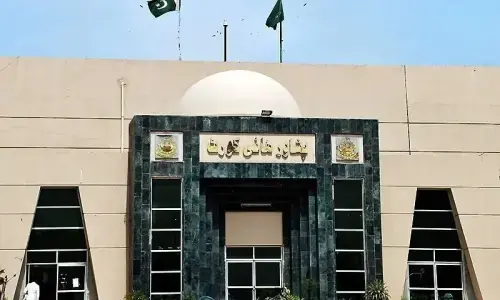
Peshawar High Court orders police not to include minor offences in clearance certificate



PESHAWAR: Peshawar High Court has ruled that there is distinction between petty nature offences and those involving moral turpitude and the former should not be reflected as adverse character entry in a police clearance certificate of an individual.
A bench consisting of Justice Syed Muddaser Ameer and Justice Aurangzeb, while allowing plea of a citizen, convicted in a minor nature case, ruled: “A minor conviction resulting only in the imposition of a nominal fine cannot be treated, nor ought it to be reflected, as an adverse character entry in a police clearance certificate in a manner that stigmatises the petitioner or impairs his lawful prospects.”
The bench directed respondents including police to issue a police clearance certificate (PCC) to the petitioner, Mohammad Raqeeb, after expunging the word “convicted” in relation to the said case, provided that the petitioner was not involved in any other criminal case.
“A police clearance certificate, when carrying adverse material, operates not merely as information but as a form of labelling. The Constitution does not permit perpetual stigma for minor and concluded matters and requires recognition of the individual’s capacity for rehabilitation,” the bench ruled in its 33-page detailed judgement.
Bench observes Constitution doesn’t permit perpetual stigma for minor matters
“The Islamic principles of dignity, honour and protection of reputation further reinforce this position, discouraging unnecessary stigmatisation and supporting reintegration rather than exclusion,” the bench observed.
“Inclusion of acquittals, minor offences, or matters resolved through a plea of guilt resulting in nominal penalties is neither lawful nor proportionate and results in undue prejudice,” it ruled.
Petitioner’s counsel Fatima Bibi said that her client was charged in an FIR registered under Section 21 of Khyber Pakhtunkhwa Arms Act at Saddar police station of Haripur district.
She stated that the petitioner pleaded guilty to the charge before a judicial magistrate, whereby he was convicted on June 27, 2016, and sentenced to imprisonment till the rising of the court coupled with a fine of Rs500.
The counsel said when the petitioner applied for the issuance of a PCC, police authorities refused to delete the remarks “convicted” and declined to issue the certificate without reflecting the said conviction. She contended that the impugned refusal infringed the fundamental rights of the petitioner and the same should be expunged from his certificate.
An additional advocate general requested for dismissal of the petition arguing that the criminal record, including details of involvement of an accused in any FIR, couldn’t be expunged or removed, even in cases where the accused was acquitted or discharged by a competent court, or where the matter pertained to a petty offence, or where the conviction was based on a plea of guilty.
In its judgement, authored by Justice Aurangzeb, the bench discussed threadbare different aspects of ‘plea of guilt’ as well as distinction between different nature of offences including minor as well as those involving moral turpitude.
“Although no comprehensive law on spent convictions exists, statutory recognition of rehabilitation is evident in Khyber Pakhtunkhwa Probation and Parole Act, 2021, particularly Section 13, which removes disqualifications upon successful completion of probation. This reflects a legislative intent against perpetual stigma,” the bench pointed out.
It observed: “Comparative jurisprudence similarly distinguishes between serious offences and minor concluded matters, emphasising that disclosure must be justified, proportionate, and limited to legitimate purposes. In consequence, while the state may retain comprehensive records for internal use, disclosure in police clearance certificates must be confined to relevant and final convictions of a serious nature.”
Referring to the judgements of superior courts, the bench observed that superior courts had consistently maintained a clear distinction between petty offences and those involving moral turpitude, recognising that both categories couldn’t be placed on the same legal footing.
The bench referred to a judgement of Lahore High Court, which provided an authoritative exposition on the concept of moral turpitude. That court underscored that all convictions were not alike in their nature, gravity or legal consequences.
“The court categorically held that a conviction, by itself, does not automatically amount to an offence involving moral turpitude; rather, the surrounding circumstances, nature of the allegation, intent of the accused and the societal impact of the act must be carefully evaluated before attaching such stigma,” the bench pointed out.
“Consequently, minor or technical infractions cannot be equated with offences that entail elements of depravity, dishonesty or moral delinquency, and therefore must not be treated alike for the purposes of adverse legal or administrative consequences,” the bench observed.
Published in Dawn, April 20th, 2026