



 0
0

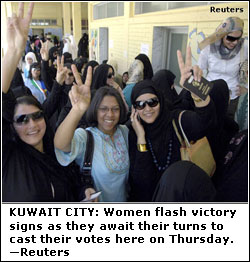 KUWAIT CITY: “I have waited a very long time for this historic day,” said Iqbal Moumtaz as she cast her vote in Kuwait’s first election open to women. “I thought I would die before voting at least once in my life.”
Moumtaz, in her seventies and unable to read or write, leaned on her cane and whispered her choice of candidates to the judge.
“I just wish I was able to fill my ballot paper by myself,” she told AFP in a trembling voice, adjusting the veil covering her face.
Clad in a traditional black robe covering her from head to toe, she walked to the polling station from her nearby house.
But she lifted her veil in front of the male judge to allow him to verify her identity.
“I am too old to attract a man with my wrinkles, but I cover because it’s a tradition,” she said, explaining why she had not asked one of the female personnel deployed at polling stations to check her identity.
Two women are running among 10 candidates for the two seats of this constituency outside Kuwait City.
In total, 28 women out of 249 candidates are competing in the legislative polls — the first since women were granted their full political rights in May 2005.
Dozens of abaya-clad women queued early morning outside a female-only polling centre in the Naffisa bint al-Hassan school in Sabah al-Salem district, 20 kilometers south of the capital.
Their number was soon in the hundreds despite the scorching heat.
This constituency of 31,000 voters, including 19,000 women, is the largest in the country and falls within the tribal zone.
Gathered voters formed a black mass, with several attaching the names of their candidates to their robes, while others protected themselves from the blazing sun with black parasols offered by candidates.
Two voters demonstrated their support for reformist candidates with bright orange scarves draped over their black abayas.
Janna al-Molla, who has just reached the voting age of 21, came to exercise her newly-acquired right.
“I’m so moved. I was determined to come. This is the first step on a new road,” said the student, the only woman not wearing a veil. Her friend Hoda Mohammad, not yet old enough to vote, accompanied her to soak up the atmosphere.
“Even if I miss the chance of voting, I could not be absent from such historic event,” she said.
Arriving in their Mercedes or Porsche four-wheelers, voters caused congestion around the Ghazzeya bint Jaber school in the tribal district of Riqqa, 35 kilometers south of the capital.
Outside the school, teenaged volunteers offered flowers to voters while carrying a candidate’s banner addressed to the assembled women: “My dear mother, my dear sister: Congratulations.”
“Our joy exceeds all limits. This day has an exceptional taste,” said 36-year-old Eqbal al-Mutairi.
But despite her pride at participating in this historic event, Mutairi said she is opposed to women standing as candidates — unlike her husband.
“My husband is determined to make me change my mind so that we can both run as candidates in the next elections,” she said.—AFP




























