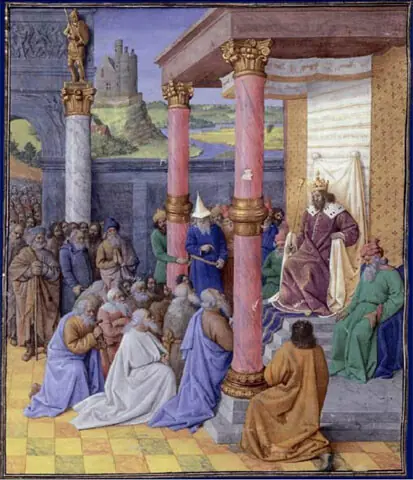
When Babylon fell to the armies of Cyrus the Great in 539 BCE, the world witnessed not just the collapse of an empire but the birth of a new vision of rule.
For the Jews exiled in Babylon, this Persian conqueror was no ordinary king. He was a liberator, remembered in scripture as “the Lord’s anointed” — the only non-Jew ever to be given the title of Messiah in the Hebrew Bible.
This remarkable episode — where a Persian monarch enabled the rebuilding of the Jewish Temple in Jerusalem — remains one of history’s most fascinating encounters between two ancient civilisations. It is a story of exile and return, of empire and faith, and of how tolerance can shape legacies that endure for millennia.
The Exile and the Promise of Return
The Jews had been living under the shadow of Babylonian captivity since 586 BCE, when King Nebuchadnezzar destroyed the First Temple [Solomon’s Temple] in Jerusalem and deported thousands to Babylon. For decades, their identity was tested in foreign lands, their rituals suppressed, their hopes dimmed.
When Cyrus the Great defeated Babylon, he handed the exiled Jews something they had not had in decades…
Then came Cyrus. In a sweeping campaign, he conquered Babylon and issued a decree that allowed displaced peoples — including the Jews — to return to their homelands. For the Jewish community, this was nothing short of miraculous. The Book of Ezra records his edict: “The Lord, the God of heaven, has given me all the kingdoms of the earth… and he has appointed me to build a temple for him at Jerusalem in Judah.”
A King Unlike Others
What made Cyrus different from other conquerors? Unlike rulers who sought to erase local traditions, Cyrus embraced diversity. His empire stretched across vast lands, yet he allowed subject peoples to worship freely and govern themselves in matters of faith.
The famous Cyrus Cylinder, an ancient clay cylinder inscribed in Akkadian cuneiform and discovered in Babylon, describes his policy of restoring temples and returning exiled communities — a vision of rule that resonates with modern ideas of human rights.
For the Jews, Cyrus was not just a political figure but a spiritual saviour. The prophet Isaiah even described him as chosen by God to deliver Israel. This intertwining of Persian statecraft and Jewish theology created a bond that shaped both traditions.
The Second Temple: A Symbol of Renewal
The return of the Jews to Jerusalem was more than a physical journey; it was a spiritual rebirth. By 516 BCE, the Jews had rebuilt the Second Temple, a structure that would stand for centuries as the heart of Jewish worship. This temple became a symbol of resilience, a reminder that exile could be overcome and faith restored.
Persian support for the project was crucial. By granting resources and protection, Cyrus ensured that the Jews could re-establish their religious life. In return, Jewish prayers even invoked blessings for the Persian kings — a rare acknowledgment of foreign rulers in Jewish liturgy.
Cultural Crossroads
The Persian-Jewish encounter was not only political but cultural. Scholars note that, during this period, Jewish thought absorbed influences from Persian religion, particularly Zoroastrianism. Concepts such as angels, demons and eschatology found echoes in Jewish writings. At the same time, Persian administration introduced systems of governance that shaped Jewish communal organisation.
This exchange highlights how civilisations, even when unequal in power, can enrich one another. The Jews preserved their identity, but they also adapted, integrating elements that would later define their theology.
Lessons for Today
Why does this ancient story matter now? Because it offers a model of leadership rooted in respect. Cyrus’ policies remind us that empires need not thrive on suppression; they can endure by embracing diversity. His vision stands in stark contrast to rulers who sought uniformity through force.
In a world still grappling with questions of coexistence, the Persian-Jewish relationship is a reminder that tolerance is not weakness — it is strength. It shows how faith and empire can coexist, how liberation can come from unexpected quarters and how respect can leave legacies that outlast conquest.
A Forgotten Chapter Worth Remembering
For readers in South Asia, this story resonates deeply. Our own histories are filled with exiles, migrations and encounters between civilisations. The tale of Cyrus and the Jews is not just about antiquity — it is about the timeless human quest for dignity and belonging.
Cyrus the Great remains a towering figure in both Persian and Jewish memory. To the Jews, he was the king who gave them back their temple. To the Persians, he was the founder of an empire built on vision and tolerance. To us today, he is a reminder that leadership, when tempered with humanity, can change the course of history.
The writer is a researcher with a focus on history and anthropology. He is also the founder of the Clifton Urban Forest, Karachi. X: @masoodlohar
Published in Dawn, EOS, April 12th, 2026