CS told to file report on enforcement of anti-defacement law in Sindh
KARACHI: The Sindh High Court (SHC) has directed the chief secretary to file a comprehensive report regarding the enforcement of a law prohibiting defacement of public properties across the province.
The SHC also sought a report about the constitution of the anti-property defacement task force and the enforcement of the anti-defacement programme.
A two-judge constitutional bench of the SHC, headed by Justice Adnan-ul-Karim Memon, further asked the chief secretary to inform it at the next hearing whether the rules have been framed or otherwise.
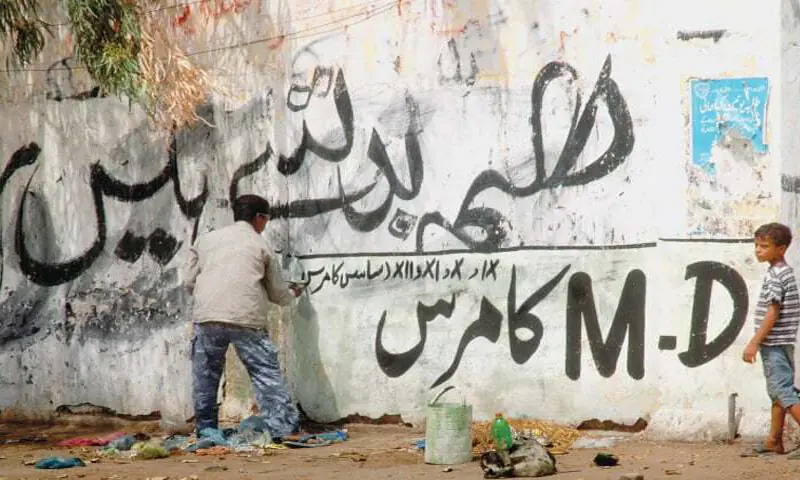
A petition was filed in December last year against the defacement of government buildings, parks, playgrounds, roads, utility service poles, etc., and the petitioner had submitted that the menace had been growing in the form of wall chalking, affixing posters, banners, hoardings and advertisements.
SHC rules local councils are bound to remove graffiti, posters, banners, advertisements or any other material from walls and properties within the province
Citing the chief secretary, local government secretary, Karachi mayor and commissioner, inspector general of police and prosecutor general as respondents, petitioner Tariq Mansoor argued that the Prevention of Defacement of Property Act (PDPA) was enacted in 2013, but it had not been implemented yet.
The bench in its order noted that the PDPA was legislated to prevent defacement of property and prohibit writing, affixing posters, banners, advertisements or any other material on walls and properties within the province.
It also observed that the defacement included writing, painting, chalking, affixing bills, placards and other material on any property without prior permission of the owner and that violation of the provisions of law was liable to punishment of up to six months’ imprisonment and fines.
It further said that under the law the government must constitute an anti-property defacement task force within 15 days of the promulgation of the act to assess the nature and extent of defacement, recommend measures to improve enforcement, review practices of other jurisdictions and propose a comprehensive anti-defacement programme.
The task force must consist of a chairperson and members from law, civil society, education, media, business community and engineering or architecture sectors, while the act also mandated every local council to remove all existing defacement within its jurisdiction and recover the cost from the person responsible for the same, it added.
The bench observed that that PDPA was enacted in 2013 and came into force in March 2014, and the government was under a statutory obligation to implement the same in its letter and spirit.
It also said that the law imposed mandatory duties upon the government and local authorities to prohibit defacement of property, remove existing defacement, constitute an anti-property defacement task force, prepare a comprehensive anti-defacement programme and frame rules for effective implementation of the act.
“However, despite lapse of considerable time, the said statutory obligations have not been fully implemented, which amounts to failure on the part of the public functionaries to perform their statutory duties”, it added.
The bench further said that the non-enforcement of the law not only defeats the very purpose of the legislation but also adversely affects the fundamental rights of citizens, particularly the right to life, dignity and the right to a clean and healthy environment, which falls within the ambit of Article 9 of the Constitution.
It noted that, being the guardian of fundamental rights, the high court was empowered to direct authorities to perform their statutory obligations in accordance with law, and since the matter in question related to the enforcement of law and protection of fundamental rights of the public at large, the petition was maintainable as a public interest litigation.
The bench in its order said, “The chief secretary is directed to submit a comprehensive report with regard to the enforcement of the Prevention of Defacement of Property Act, 2013 throughout the province of Sindh, including Karachi Division. He shall also submit his report with regard to constitute the anti-property defacement task force in terms of Section 4 of the Act and implement a comprehensive anti-defacement program”.
It also stated that the local council and authorities concerned are required to remove all existing defacement within their respective jurisdictions in terms of Section 5 of the Act.
Adjourning the hearing for a date to be fixed after three weeks, it further asked the chief secretary to inform it whether rules under Section 6 of the Act have been framed or otherwise.
Published in Dawn, April 9th, 2026