Scientists find evidence for theorised gargantuan star explosions
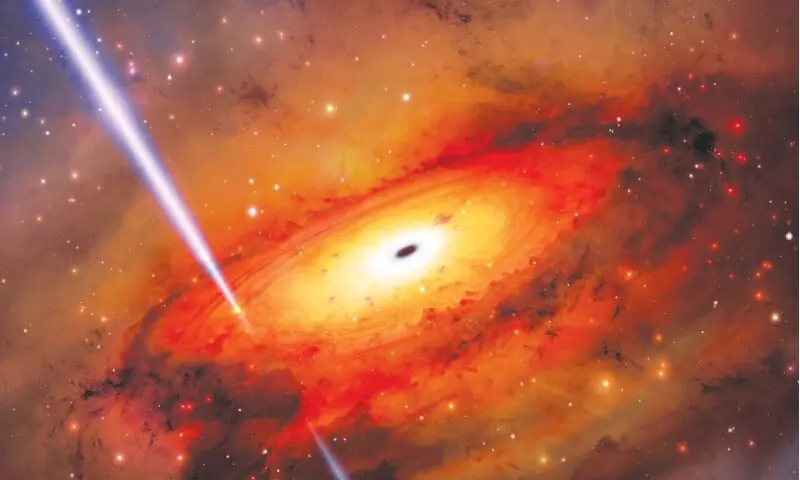
WASHINGTON: A supernova — the explosive death of a star — is always violent, blasting material into space while typically leaving behind a compact stellar remnant like a neutron star or black hole. But some supernovas involving the largest stars in the cosmos may be so immensely powerful they leave absolutely nothing behind.
Scientists since the 1960s have theorised the existence of these ultra-powerful supernovas, and have now come up with evidence for them — albeit indirect — in research involving black holes and ripples in spacetime called gravitational waves.
Such supernovas are predicted to occur in the most enormous stars — those with a mass around 140 to 260 times greater than the sun, according to Hui Tong, a doctoral student in astrophysics at Monash University in Australia and lead author of the study published on Wednesday in the journal Nature.
“Despite their enormous mass, they live relatively short lives, about a few million years. For comparison, the sun will live for about 10 billion years, so these stars burn out roughly a thousand times faster — like a massive firework that burns intensely and briefly before exploding,” Tong said.
The explosion of large stars of a certain mass leaves behind a neutron star, a compact collapsed stellar core. Some stars that are even larger, when they explode, leave behind a black hole, an exceptionally dense object with gravity so strong not even light can escape. The black hole retains a portion of the original star’s mass, with the rest blown into space.
In this study, the researchers combed through data on 153 pairs of black holes, knowing their mass based on gravitational waves they emitted, and then separated out black holes that had formed through the earlier mergers of two smaller black holes.
What the researchers then detected was an absence of black holes between about 44 and 116 times the mass of the sun, what they called a “forbidden range.” That absence, they said, may best be explained if the largest stars, which might be expected to leave behind black holes in that mass range, instead were obliterated at the end of their lifespan in a rare type of explosion called a pair-instability supernova, leaving no traces.
“A pair-instability supernova is one of the most violently explosive types of stellar deaths,” said astrophysicist and study co-author Maya Fishbach of the University of Toronto’s Canadian Institute for Theoretical Astrophysics.
“For the most part, massive stars make black holes. The more massive the star, the heavier the black hole,” Fishbach said, until stars reach a certain mass threshold beyond which the physics of their explosive demise dictates that there is no stellar remnant left behind.
These huge stars evolve in a similar way to other massive stars at first, burning hydrogen and helium and building up a large core made mostly of carbon and oxygen. For the core to remain stable, there needs to be a balance between the inward pressure of gravity and the outward release of energy — in the case of these stars high-energy photons, the particles that make up light.
But at the extreme temperatures present inside these stars, some of the photons convert into pairs of subatomic particles called electrons and positrons, thus weakening the outward pressure that was helping to maintain the core’s stability.
Published in Dawn, April 4th, 2026