Bangladeshi farmers test solar irrigation as fuel costs bite


 0
0
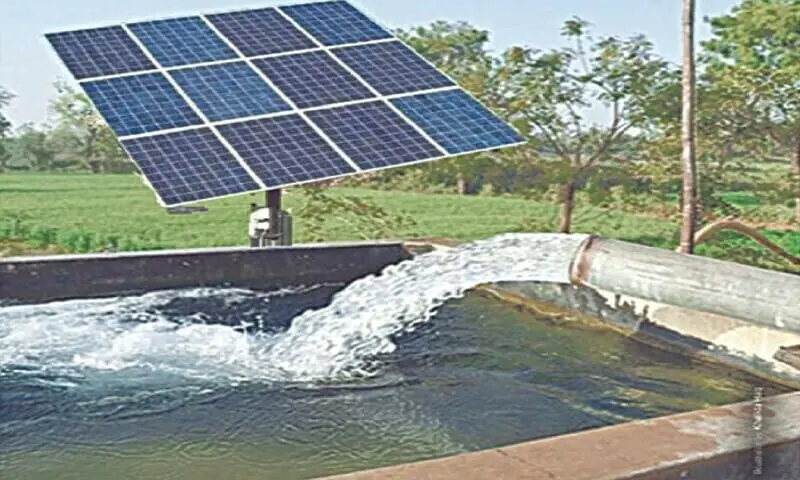

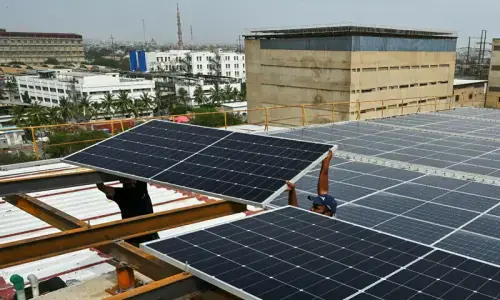
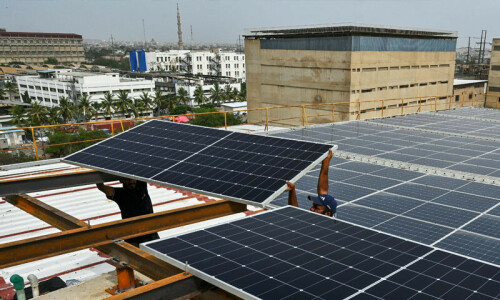
CHUADANGA: In Bangladesh’s farm belt, solar-powered irrigation pumps are promoted as a way to cut diesel use, lower irrigation costs and, when pumps are idle, generate extra income for farmers who can sell surplus electricity to the grid.
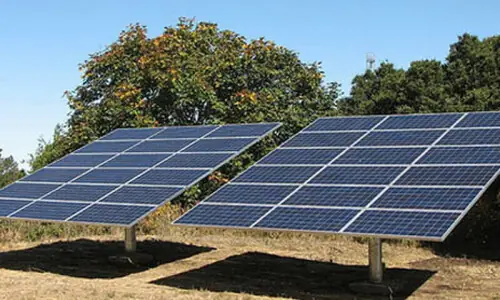
Solar panels installed in or beside crop fields to power groundwater irrigation pumps can be a better alternative to paying for rising cost of fuel for traditional generators, experts say.
But the technology still has limited uptake. The Bangladesh Agricultural Development Corporation’s latest irrigation survey found about 71 per cent of power-operated irrigation equipment was diesel-run and 29pc electric, while only 4,058 solar-powered units were identified nationwide.
But that could change due to the Iran war and the resulting sharp rise in energy prices. Bangladesh has started rationing fuel while trying to secure sufficient diesel for its farmers and industry owners.
The country’s latest climate plan, submitted under the Paris Agreement, aims to install 45,000 solar irrigation pumps by 2035. But progress has been slow, held back by high upfront costs, licensing hurdles and uncertainty over how operators would sell their surplus power to the grid to improve returns.
For Mohammad Anisur Rahman, a 50-year-old farmer in southwestern Bangladesh’s Jhenaidah district, the switch to solar irrigation has reduced his costs and dependence on diesel.
“The diesel crunch and power outages have already hit farmers and who knows if the problem may get worse,” Rahman said. Last year, he set up solar panels over part of his maize fields and linked them to a submersible solar irrigation pump.
Solar irrigation is cheaper, he said.
In southwestern Bangladesh, irrigation with solar energy can cost between $87 and $99 an acre, compared to $125 to $150 using diesel pumps, according to field estimates shared by farmers and pump operators.
Developers and researchers say one way to improve the business case is to connect more solar irrigation pumps to the grid so operators can sell unused electricity outside the main irrigation season.
Wave Foundation, an NGO working on solar irrigation in the country’s west, said it had already connected three solar pumps to the grid, and plans to set up 39 more.
But while operators may export surplus electricity to the grid, they still face restrictions or uncertainty around drawing power from it for irrigation when solar falls short.
“This barrier to get power from the grid weakens the economics of solar irrigation,” said Ketab Ali, a risk management expert at the Wave Foundation.
Shafiqul Alam, lead analyst for Bangladesh energy at the Institute for Energy Economics and Financial Analysis, said wider grid connection for solar irrigation could also help Bangladesh reduce fossil fuel generation during periods when irrigation demand is low.
Water risks
However, some researchers and water experts warn that cheaper solar irrigation could increase pressure on groundwater in regions already facing declining water tables.
In northwest Bangladesh in particular, groundwater depletion has long been a concern because of intensive dry-season cultivation and heavy dependence on groundwater irrigation.
But Mohammad Faiz Alam, a senior regional researcher at the International Water Management Institute, said research suggests farmers using solar do not necessarily extract more water than diesel users.
He said that because many systems are supervised by NGOs or local organisations with farmers paying a fee for the irrigation, there is often some built-in discipline in how water is delivered and charged for.
Still, he said, scaling solar irrigation in water-stressed areas would likely require stronger groundwater regulation, more recharge efforts, more use of surface water where feasible, and region-specific planning rather than a one-size-fits-all approach.
Published in Dawn, April 3rd, 2026