International Finance Corporation briefs Aurangzeb on ‘growing portfolio’ in Pakistan


 0
0
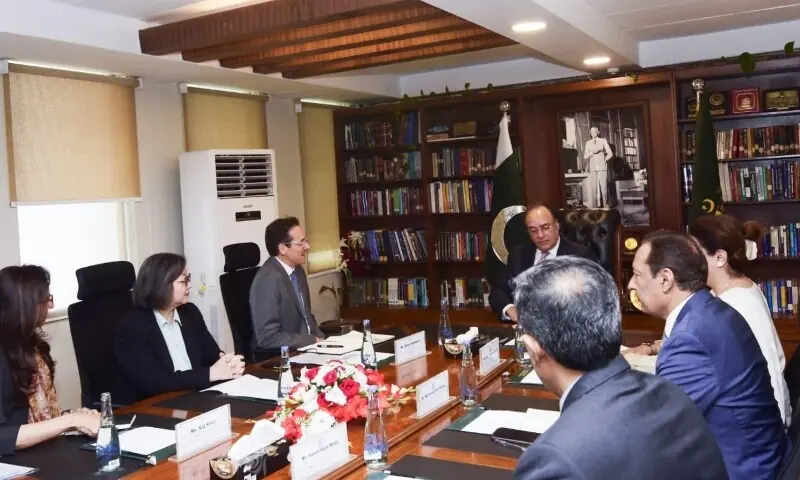

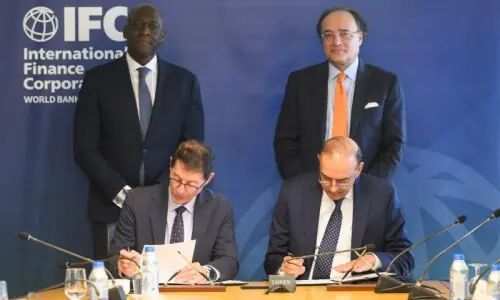
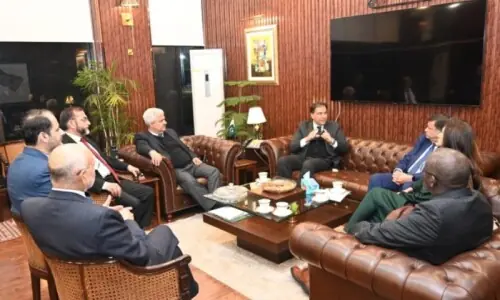
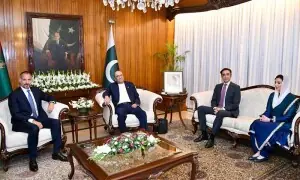
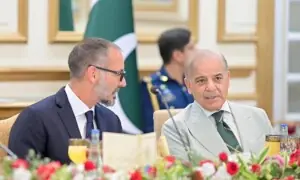
A delegation from the International Finance Corporation (IFC) called on Finance Minister Muhammad Aurangzeb and discussed its “growing portfolio in Pakistan, which now exceeds $2 billion annually and approximately $2.7bn committed this year”, according to the finance ministry.
IFC is the private sector arm of the World Bank Group.
According to the ministry, the IFC delegation comprised IFC Divisional Director for Pakistan, Afghanistan and Central Asia Simon Andrews, World Bank Country Director for Pakistan Bolormaa Amgaabazar and IFC Country Manager Naz Khan.
Key areas of engagement included financial sector support through risk-sharing and guarantee facilities to promote trade and small and medium-sized enterprises (SME) financing; expansion of local currency financing to mitigate foreign exchange risks; and upcoming initiatives such as a diversified payment rights facility and a green bond issuance with a leading local bank, the ministry said.
“Discussions focused on further scaling private sector investment, particularly in infrastructure and public-private partnerships,” it said.
The ministry added: “While progress had been made in areas such as urban water management and distribution efficiency projects, both sides acknowledged the need to develop a stronger pipeline of projects and enhance coordination to unlock larger-scale private investment in sectors including energy, transport, and logistics.”
The minister emphasised the importance of adopting a client-centric approach to financing solutions, particularly in facilitating local currency lending to support private sector growth and reduce exchange rate vulnerabilities, it said, adding that Aurangzeb underscored that “such initiatives complement, rather than substitute, foreign currency inflows and are essential for sustainable economic expansion”.
“The meeting also covered collaboration on job creation, entrepreneurship, and innovation, including proposals for developing a venture capital ecosystem and strengthening private sector engagement in policy formulation,” the ministry stated.
During the meeting, both sides discussed mechanisms to further institutionalise dialogue between government and business stakeholders to support effective and responsive policymaking.
The broader discussions addressed regional economic connectivity, particularly with Central Asian countries, and the importance of leveraging emerging opportunities in agri-business, infrastructure, and trade linkages, it added.
Aurangzeb briefed the delegation on the government’s ongoing efforts to maintain macroeconomic stability amid global uncertainties, including proactive management of energy supply chains, fiscal discipline, and targeted subsidy frameworks.
The ministry stated that both sides reaffirmed their commitment to deepening collaboration, accelerating implementation of priority initiatives, and leveraging the full suite of World Bank Group instruments to support Pakistan’s reform agenda, private sector development, and sustainable, inclusive economic growth.
Aurangzeb welcomed Andrews on his recent appointment and appreciated the IFC’s enhanced engagement in Pakistan over the past few years, particularly in investment, trade finance, and advisory support.
He acknowledged the positive impact of IFC’s on-ground leadership and responsiveness, noting that increased senior-level presence has significantly strengthened collaboration and delivery, the statement said.