After Ali Larijani, what comes next?
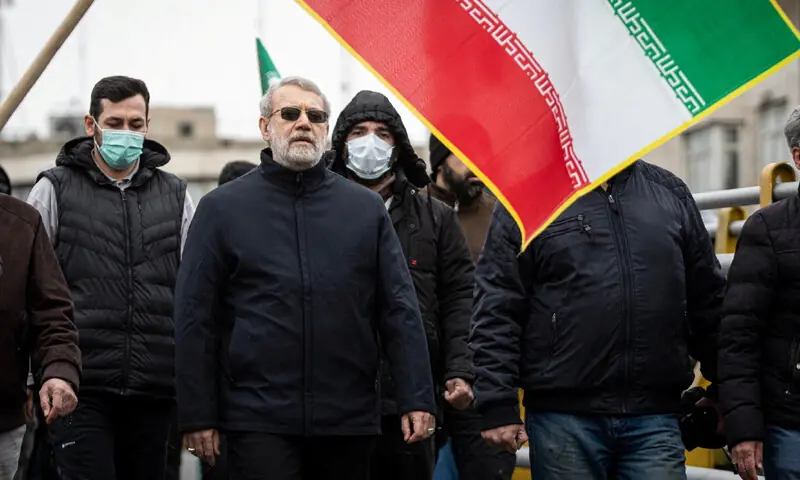

DURING the Al Quds Day rally in Tehran on Friday, as bombs fell around them, a number of top Iranian leaders took to the streets. Shortly thereafter, CNN broadcast a Pentagon briefing by Pete Hegseth, who boasted that the US-Israeli onslaught had forced Iran’s leadership to cower underground, ‘like rats’.
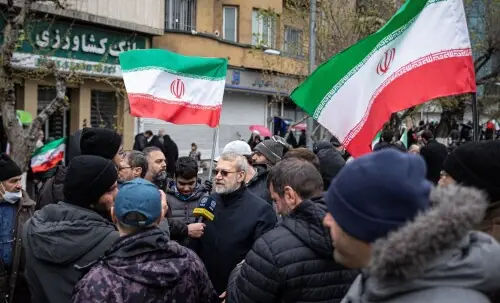
Any impact these words could have, however, evaporated when the broadcaster used a picture-in-picture overlay and showed visuals of President Masoud Pezeshkian, Foreign Minister Abbas Araghchi and other senior officials mingling with people on the streets of Iran’s capital.
Among the crowd, one man stood out from the rest. Clad in a zipped-up black jacket, he mingled freely with participants of the rally, exchanged greetings with senior citizens, and walked around with general nonchalance.
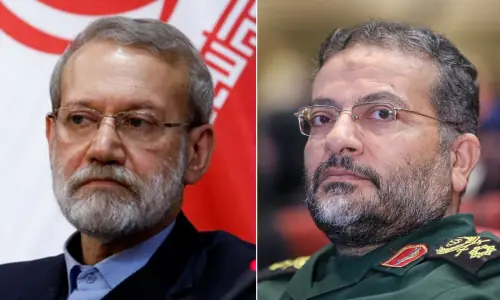
This was Ali Larijani, secretary of the Supreme National Security Council and a close confidant of Iran’s former supreme leader, Ayatollah Ali Khamenei.
The political and military veteran was seen as one of few who could have built consensus for an eventual de-escalation
On Tuesday, Israeli PM Benjamin Netanyahu appeared on television to announce his death. Iran’s Fars news agency and Larijani’s own X account also confirmed the development in the early hours of Wednesday.
According to Sky News International Affairs Editor Dominic Waghorn, who is currently reporting from Tehran, massive explosions rocked his hotel in the early hours of Tuesday, which he thought were “possibly the bombs that killed Larijani”.
Philosophy and pragmatism
Born in Najaf, Iraq in 1957 to a prominent Shia family close to the Islamic republic’s founder Ayatollah Ruhollah Khomeini, Larijani’s family has been influential within Iran’s political system for decades.
He earned a PhD in Western philosophy from the University of Tehran, and was considered a leading scholar on the works of Emmanuel Kant.
Bespectacled and known for his measured tone, the 68-year-old was believed to enjoy the confidence of the late Khamenei after a long career in the military, media and legislature.
A veteran of the Islamic Revolutionary Guard Corps (IRGC) during the Iran-Iraq war, Larijani also headed state broadcaster IRIB for a decade from 1994 before serving as parliamentary speaker from 2008 to 2020.
He also led Iran’s nuclear policy and strategic diplomacy. In 1996, he was appointed Khamenei’s representative to the Supreme National Security Council (SNSC). He later became secretary of the SNSC and chief nuclear negotiator, leading talks with Britain, France, Germany and Russia between 2005 and 2007.
He then ran in the 2005 presidential elections, losing to populist candidate Mahmoud Ahmadinejad.
Larijani also supported the landmark 2015 nuclear deal with world powers that unravelled three years later after President Donald Trump withdrew US support for the agreement.
In June 2025, after Iran’s 12-day war with Israel and the US, he was re-appointed head of Iran’s top security body, two decades after his first stint, coordinating defence strategies and overseeing nuclear policy.
What now?
The scenarios following Larijani’s assassination do not bode well for hopes of de-escalation. According to noted Middle East scholar Vali Nasr, Larijani’s replacement will be appointed by IRGC.
“With every assassination US and Israel engineering greater radicalisation of Iran’s leadership. It will make for a bleak future for Iran, Iranians, the region and ultimately makes it far more difficult for US to disentangle itself from endless conflict in the region,” the scholar, who has previously advised the White House, wrote on X.
Another noted Iranian analyst, Trita Parsi of Quincy Institute, tried to grapple with why Larijani was targeted.
“Israel is trying to literally kill off Trump’s off ramps: Larijani was not only a key figure within the regime who had emerged as the chief consensus builder, but… literally someone who favoured talks with the US and who could build consensus within the system for an Iranian off ramp at some point. He also favored de-escalation with the GCC states and supported Pezeshkian’s message on that point,” he noted as one possiblity.
Published in Dawn, March 18th, 2026