In today’s digital world, many of us don’t get to hold a pen for days.
All our fingers do is tap screens and punch keyboards faster than lightning. While the focus on handwriting seems to have shifted, there is an art form that is making a revival — calligraphy.
Yes, calligraphy, the art of decorative or ornamental handwriting, is finding its way back, offering a therapeutic and relaxing escape from the fast-paced world of notifications and glowing screens. This art of artistic lettering lets you be creative by forming something unique with your
fingers. It shows you that beautiful things take time and patience to create. And it is a superb way to reclaim your steady focus and quiet concentration that often gets lost in the whirlpool of fast-paced stimulation and the endless stream of information coming from our screens.
Calligraphy is thriving in contemporary designs, especially those used for wedding invitations, logo design, paintings and even street art, which is aptly termed ‘calligraffiti’.
Calligraphy is more than just beautiful writing. For centuries, it has been a means of historical, cultural and religious expression and record, transforming language into art
Calligraphy literally means “beautiful writing” and has its roots in the Greek words ‘kallos’, meaning beauty, and ‘graphein’, meaning to write. Calligraphy is an ancient art form, probably as old as writing itself, practised for centuries with different styles and techniques that developed in ancient cultures around the world. As language and writing evolved, so did calligraphy.
Let us learn more about the origin, styles, tools and techniques of this art form. Since it is not possible to address all aspects of these in the short space here, we will only give an introduction, and leave you to discover more about it on your own.
HISTORY AND STYLES
When writing emerged as a form of communication, there were distinctly two styles of writing. There was the functional writing that was more basic, while scribes and artists used a more formal style for inscriptions, clearly meant for posterity.
Egyptian
Egyptian hieroglyphics, dating back to around 3000 BCE, represent one of the earliest calligraphic script forms. The Egyptians used pictorial symbols to represent words and ideas. It was decorative, symbolic and monumental, done on stone and papyrus.
Chinese
Historical traces suggest that China was the first place where calligraphy was widely practised, around 1600–1100 BCE. It started during the Shang Dynasty, when characters were carved into animal bones and turtle shells. It evolved during the Han Dynasty (206 BCE–220 CE), moving from rigid carvings to fluid brush-and-ink work on silk and paper.
By then, calligraphy had acquired the status of an elite art form, and with time it branched into seal script, clerical script and running script. The characters in Chinese calligraphy focus more on symbolising the idea of a thing rather than transcribing its pronunciation.
Japanese calligraphy (Shodo) developed later, around the 6th century, and was heavily influenced by Chinese traditions brought over with Buddhism.
Roman
The development of the Latin alphabet started around 600 BCE. Early inscriptions were varied in direction and form, as they adapted from Greek and Etruscan influences. It was much later that it took a more formal artistic form, with writing styles like Imperial Capitals and, later, monastic scripts like Uncial.
European
During the medieval ages, calligraphy flourished in Europe through monks, who used it mainly for copying religious texts. Scripts such as Carolingian minuscule, Gothic script and later Italic script emerged as a result.
Arabic
Arabic calligraphy is one of the most celebrated and characteristic forms of visual expression in Islam. Through this art, a calligrapher transmits the verses of the Holy Quran in an artistic form.
The Arabic script evolved from the Nabataean script of the Arabian Peninsula around the 4th century CE. With the arrival of Islam in the 7th century, Arabic calligraphy flourished as an art form and was widely used to scribe copies of the Holy Quran and its verses.
With the spread of Islam, Arabic calligraphic styles also developed, with each style representing the various historical periods of Islamic rule and the cultural influences of different regions. These Arabic calligraphic styles include Kufi, Thuluth (Sulus), Naskh, Deewani, Riqa,Nasta’liq and Ta’liq.
Thuluth (Sulus), with its flowing lines, is popular for adorning architecture such as mosques. Thuluth means “a third” in Arabic, because in this style one-third of each letter slopes, and it also refers to the width of the pen used to write the script.
The word Naskh means “copy” in Arabic and it is thus the preferred style for manuscripts and everyday writing. This style is graceful, rounded, effortlessly readable and easy to write, making it suitable for longer texts.
Kufic is the oldest calligraphic form of the Arabic script and was used to transcribe early copies of the Quran. Its style is highly angular and rectilinear, giving the text a block-like appearance. Today, it is used in architectural decoration, logos and modern geometric art. One of the early Kufic inscriptions can be seen inside the Dome of the Rock in Jerusalem.
Diwani script was popular during the Ottoman Empire and was used in courts to write official documents. It reached the height of its popularity in the sixteenth century.
Ta’liq, which literally means “hanging”, is a cursive script developed by the Persians in the 10th century, primarily for administrative, royal and literary documents. The letters in this script are more rounded and contain many elegant curves.
A more elegant variation of the Ta’liq script is the Nasta’liq, developed in 14th-century Iran, and characterised by its slanted, cursive and cascading appearance.
Riqa evolved from Naskh and Thuluth. Riqa means “a small sheet”, and has clipped letters composed of short, straight lines and simple curves. It is one of the most common handwriting styles.
WHAT CALLIGRAPHERS WRITE WITH
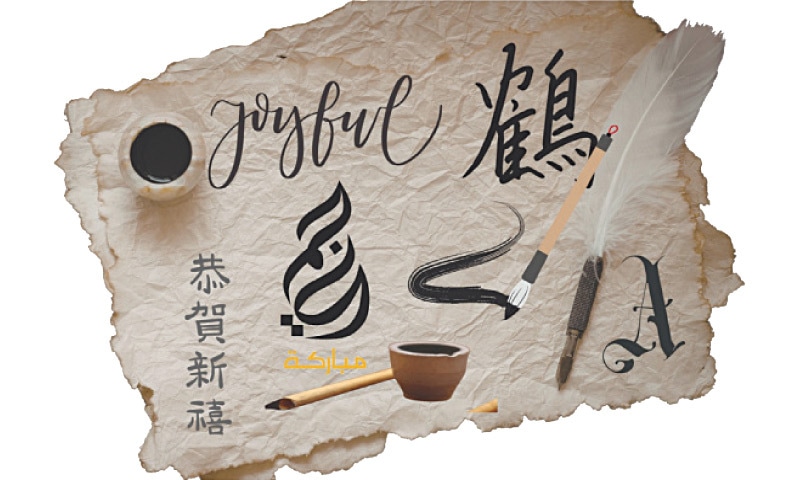
Calligraphers require a variety of tools to create their pieces of art, with the tools differing according to the calligraphic style of each region. Here is a summary of the different tools used by calligraphers of various traditions.
Chinese calligraphy
Pen: It favours the use of a flexible animal-hair brush, since it is more suitable for creating a wide range of line thicknesses through varying pressure and speed.
Inkstick and ink stone: Ink is solid; the artist grinds it with water on an ink stone to obtain the desired ink density and viscosity.
Paper: Xuan, or rice paper, is the traditional paper prized for its strength, absorbency and longevity. Maobian paper, or grass paper, is less refined but more affordable, and made from wheat straw or bamboo fibres. It is traditionally used for practice or drafts. However, it is less durable than Xuan paper.
Western calligraphy
Pen: Metal nibs, quills or felt-tip markers are used to create consistent, often angled lines of the Latin alphabet. Felt-tip markers and brush pens are popular in modern, less traditional styles.
Ink: This ink is generally less viscous than Arabic ink, allowing for a steady flow from metal reservoirs.
Paper: It has evolved from animal skins to specialised plant-based papers that offer smoothness and ink resistance, preventing the metal nib from snagging or the ink from bleeding.
Arabic calligraphy
A rigid, chiselled reed or bamboo pen is used to produce sharp, angled and precise lines, connecting letters in a cursive style.
Pen (Qalam): Traditionally, the calligraphy pen is made from a reed or bamboo and then cut at an angle to create different strokes. The quality of the pen’s material and cut determines the precision and style of the calligraphy.
Ink (Miqta): Calligraphers use special ink made from natural materials. The ink’s consistency and colour can influence the final appearance of the calligraphy.
Paper: Smooth and glossy paper is preferred, as it allows the pen to glide smoothly over the surface. However, modern calligraphers use all kinds of materials, such as canvas, wood or fabric. The choice of surface affects the texture and finish of the calligraphy.
Calligraphy is not only about shaping the letters of a script, it also moulds the calligrapher in many different ways. As we learn and practise this art, we also learn to focus and pay attention to the smallest details. It teaches us patience and mindfulness as we concentrate on the flow of the pen. Our fine motor skills and dexterity also improve through calligraphy, since the slightest turn of the finger or change in pressure can impact the task. Our hand–eye coordination and muscle memory are also fine-tuned in the process.
Calligraphy is not only a creative expression, it also fosters personal growth in many ways. As a calligrapher’s skill improves, so do his mental and emotional well-being and his overall skill set.
Published in Dawn, Young World, March 14th, 2026