PARIS: The Middle East war “is creating the largest supply disruption in the history of the global oil market”, as Iran’s chokehold on regional supplies forces Gulf producers to slash production, the International Energy Agency said on Thursday.
In its latest market report, the IEA said crude production was currently down by at least 8.0 million barrels per day.
The conflict, triggered on February 28 by American-Israeli attacks on Iran, is hampering the global economy’s supply of oil and weakening production capacity.
The war has seen Iran tighten its chokehold on the Strait of Hormuz, through which a fifth of global crude passes, effectively all but shutting it down. IEA said current flows through the strait were moving at less than 10 percent of pre-crisis levels, which in 2025 were around 15 million barrels per day — with “no signs of a de-escalation in hostilities or a clear timeline for a recovery in flows through the Strait.” It stressed that a resumption of flows would be key in minimising the war’s impact on global markets.
Against that backdrop, major European stock markets were off more than half of one percent in early morning trading before recovering slightly. In Asia, Japan’s Nikkei had shed one percent at the close while Hong Kong closed off 0.7pc.
A threat from Tehran to bring down the global economy overshadowed an impending record release of strategic crude by the IEA. On Wednesday it said its 32 members had agreed to unlock 400 million barrels of oil from reserves — their largest release ever.
‘Stop-gap measure’
“The co-ordinated emergency stock release provides a significant and welcome buffer, but in the absence of a swift resolution to the conflict, it remains a stop-gap measure,” the IEA warned.
The United States has proposed partially lifting sanctions against Russia in an attempt to offset the fallout from the Hormuz squeeze, but Group of Seven nations Wednesday rejected the idea.
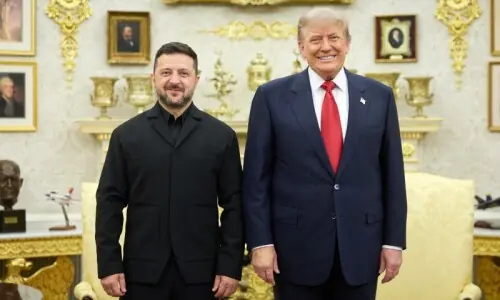
Coming out of the first talks between Moscow and Washington since the start of the war Russian President Vladimir Putin’s envoy Kirill Dmitriev overnight hailed a “productive meeting” with US negotiators in Florida after US President Donald Trump had indicated Putin wanted to be “helpful” regarding the Iran conflict’s energy fallout.
After his Miami meeting Dmitriev said on Telegram both sides had “discussed promising projects that could contribute to the restoration of Russian-American relations and the current crisis on global energy markets.” He added Washington was beginning to understand better “the key, systemic role of Russian oil and gas in ensuring the stability of the global economy.”
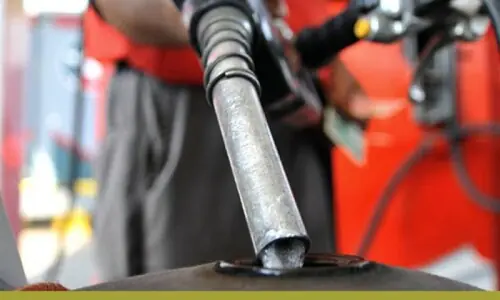
Oil prices have gyrated since the crisis began, rising more than 30pc to around $120 a barrel only to drop back.
Prices briefly topped $100 Thursday but then fell again to around $92 a barrel albeit analysts predicted elevated prices for the forseeable future amid reports of more Iranian attacks on vessels, notably off the coast of Iraq.
The IEA said in its report the shortfall could be partially addressed with alternative routes such as transit through the Bab-el-Mandeb Strait from the Red Sea.
However, this route has in recent years “carried a risk of Houthi (rebel) attacks.” Despite efforts to stave off the disruption via emergency stockpiles, the IEA forecast March global oil supplies would drop 8 million bpd to 98.8 million bpd for their lowest level in four years.
“For forecasting purposes, we have assumed only minimal flows through the Strait of Hormuz in March,” it stated.
The IEA added supply curtailments in the Middle East are being partly offset by higher output from non-OPEC+ producers, Kazakhstan and Russia.
Citing the “geopolitical alarm” in the region, Stephen Innes of SPI Asset Management said that “in brokerage jargon, the IEA’s decision (to release emergency supplies) is equivalent to using a garden hose to put out a refinery fire.” Kathleen Brooks, director of research at XTB, observed that “the conflict has intensified this week, and the longer the oil price remains elevated, the more damaging and long-lasting the inflation shock will be for the global economy.”
The IEA concluded that even if the conflict intensity recedes to the extent oil flows can resume “it will take several days to weeks” for the backlog of tankers on both sides of the Strait to clear. And it warned that shut-in upstream production would take weeks if not months to return to pre-crisis levels.
Published in Dawn, March 13th, 2026