KARACHI: The Pakistan Navy has launched Operation Muhafizul Bahr to counter “multidimensional threats to national shipping and maritime trade”.
Statements issued by Inter-Services Public Relations (ISPR) and the Pakistan Navy said the decision came in light of the “evolving regional maritime security environment and potential disruptions to critical sea lanes”.
It added that the initiative had been undertaken to ensure the uninterrupted flow of national energy supplies and the security of sea lines of communication.
“Pakistan Navy escort operations are being conducted in close coordination with Pakistan National Shipping Corporation,” the statement said.
‘Operation Muhafizul Bahr’ to ensure uninterrupted flow of national energy supplies, security of sea lines of communication
“Pakistan Navy is fully cognisant of the prevailing maritime situation and is actively monitoring and controlling the movement of merchant vessels to ensure their safe and secure transit,” it added.
It further said that with approximately 90 per cent of Pakistan’s trade conducted via sea, the operation aimed to ensure that vital sea routes remained safe, secure, and uninterrupted.
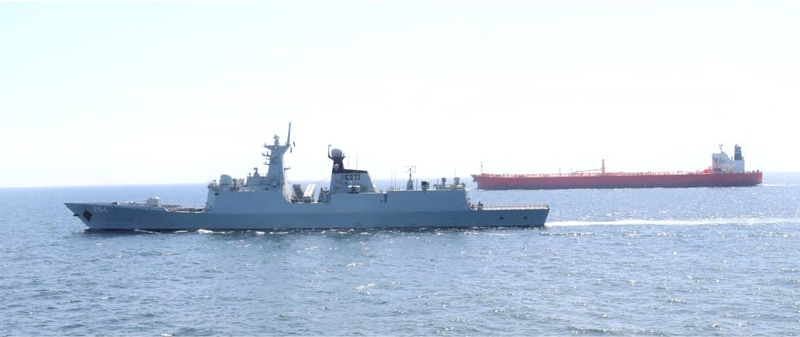
It noted that currently, Pakistan Navy ships were escorting two merchant vessels.
“Pakistan Navy remains fully prepared to respond to emerging maritime security challenges and is committed to ensuring the safety of national shipping and regional maritime security,” the statement concluded.
Pakistan felt the first direct economic impacts of the US-Israel war on Iran in a big way on Friday, as the government announced a Rs55 per litre increase in petrol and high-speed diesel prices.
Escalating military conflict in the Middle East and the closure of the Strait of Hormuz have forced global shipping companies to adopt precautionary measures for the movement of goods by sea as well as for their staff and crew, while some firms have indicated the imposition of war-risk and contingency surcharges on cargo.
The Strait of Hormuz is a strategic maritime corridor through which nearly 25 per cent of the world’s oil passes. Its closure has taken an estimated 20 million barrels per day (mbd) cumulative off global oil markets in what is being called “the largest oil supply disruption in history”.
Published in Dawn, March 10th, 2026