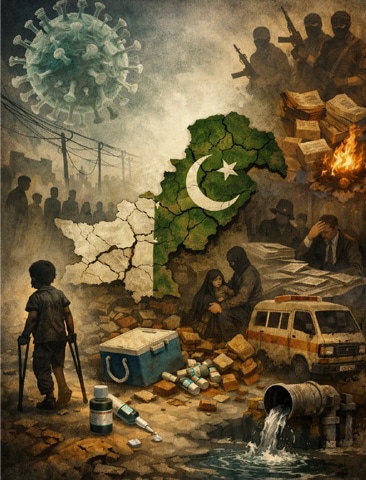
THIS is with reference to the editorial ‘Erasing polio’ (Feb 3) which raised questions about the government’s resolve to makePakistan polio-free. The fact is that polio has survived in Pakistan not because vaccines do not work. It has survived because systems do not work. This is a governance, trust and inequality crisis repeatedly veiled as ‘public resis-tance’. Countries poorer, more remote and more unstable than Pakistan have eliminated polio. The virus remains active here because accountability is weak.
Pakistan treated polio as a campaign, not a system. Polio eradication has been handled through repetitive emergency drives rather than permanent primary healthcare. Door-to-door drops cannot replace clean water, functioning clinics, routine immunisation and trusted health workers. Parents are asked to believe in one vaccine, while every other basic health need is ignored. This contradiction destroys credibility. People do not reject polio drops; they reject selective care.
Presenting vaccine hesitancy as a matter of ignorance or extremism is like the state blaming its own people instead of fixing governmental failures. This is convenient and dishonest. In many areas, refusal is a rational response to broken promises. When families lack safe drinking water, maternal care, or treatment for common illnesses, polio teams appear as outsiders with a single obsession. Trust cannot grow where dignity is missing. Resistance is merely a symptom.
Also, frontline workers are exploited, not empowered. Polio workers, mostly women, remain underpaid, overworked and poorly trained, and are sent to unsafe environments without protection. Some have come under attack, and most have no hope of ever getting permanent health roles. A system that treats its own workers as disposables cannot expect people to value its mission. Sustainable eradication of polio requires a respected, local and permanent staff, not temporary labour.
Further, in some of the regions, polio has become associated with surveillance, coercion and force. Checkpoints, police escorts and pressure tactics have turned a health intervention into a security operation. Globally, evidence shows that militarising health destroys trust. People do not accept medicine at gunpoint. Fear spreads faster than viruses.
As for relevant data, it is collected, but is not used honestly. Pakistan has generated massive polio data, yet local realities repeatedly get ignored. Missed children, fake finger marking, and inflated coverage reports are often tolerated to meet targets. When numbers matter more than children, failure becomes institutionalised. Polio persists because, to our policymakers, the truth is inconvenient.
The politicisation of religion is also a key factor. Religious leaders have been over and over approached late, symbolically or selectively. In areas where clergy was genuinely involved as a partner, explaining, questioning and endorsing, public acceptance improved. Where religious entities were bypassed or manipulated, suspicion intensified. Culture has to be engaged with respect, which we failed to.
Finally, inequality has never really been addressed sincerely. Polio remains concentrated in areas with poverty, dis-placement, conflict and neglect. The virus follows inequality. Until sanitation, nutrition, education and basic healthcare improve, polio eradication will remain fragile. Vaccines cannot compensate for structural abandonment.
Polio eradication in Pakistan will only succeed when the government stops treating it as a technical problem, and confronts it as a political and ethical one. This means strong primary healthcare, sincere governance, community trust, worker protection, and dignity for the neg-lected. Polio is not stubborn. Systems are. Until systems change, the virus will stay.
Muhammad Shahjahan Memon
Islamabad
Published in Dawn, March 3rd, 2026