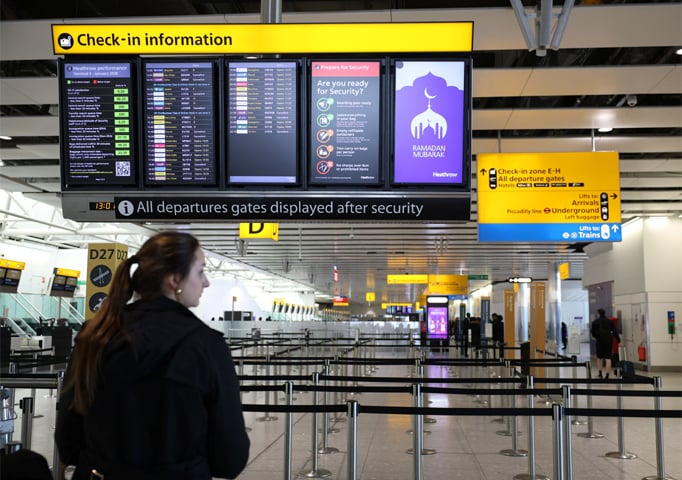
DUBAI: For decades, Dubai’s sales pitch featured gleaming skylines, tax-free salaries, ease of doing business and something far more intangible: the unspoken promise that whatever was happening elsewhere in the Middle East, this city was different. The conflicts that destabilised the region would somehow stop at Dubai’s borders.
On Saturday, that all changed. Iran’s retaliatory strikes across the Gulf hit across Dubai’s key sectors, landing on airports, hotels and ports. They also hit the psychological foundations of a city that had spent four decades constructing that identity as one of the world’s most reliable places to do business in an unreliable neighbourhood.
“It is hard to overstate the peril for Dubai’s economic model,” said Jim Krane, a fellow at Rice University’s Baker Institute.
“The physical damage may be slight, and most of the pain thus far is psychological. But Dubai’s status as a safe-haven for expatriates and their businesses is in increasing doubt. The longer the war continues, the more intense the search will be for alternative locations. Dubai needs this war to wrap up now. International capital is highly mobile.”
In a sign of the ongoing strains, the UAE’s stock markets were closed on Monday and Tuesday, while tech outages following a hit to Amazon’s cloud computing facilities were affecting some banking operations, according to a person familiar with the situation. Tens of thousands remained stranded in the UAE as airspace remained largely closed.
Dubai’s transformation from a modest pearling and fishing port into a global financial centre was a decades-long project. The launch of Emirates airline in 1985, the opening of the Burj Al Arab in 1999 and laws in the early 2000s allowing foreigners to own property for the first time were the pillars of Brand Dubai.
Dubai’s economy is almost fully powered by non-oil sectors, with oil now accounting for less than 2pc of GDP. A mix of trade, tourism, high-end real estate and financial services, built on a regulatory framework that mirrored London and New York, has replaced it. Neighbouring Abu Dhabi, which holds more than 90% of the UAE’s oil reserves, remains more reliant on oil revenue for growth.
Beirut had been the region’s international financial capital until its civil war in the 1970s shattered that image. Bahrain stepped into the vacuum until Dubai’s rise rendered it a more modest player. Each succession was built on the same promise: a stable, open alternative to wherever the region’s last crisis struck. Dubai executed that promise more completely than any of its predecessors.
Dubai’s rise was itself partly built on the instability of others. With Syrians displaced by civil conflict, wealthy families rattled by the Arab Spring, and more recently Russians fleeing because of the Ukraine war, new residents all poured capital and talent into the emirate. The population across the UAE ballooned, from about 1 million in 1980 to 11 million in 2024.
Last year, the UAE was on track to attract a record 9,800 relocating millionaires, more than any other country on earth, according to Henley & Partners. Money has poured into real estate, propelling Dubai’s developer Emaar Properties to a record high on February 25, valuing the company at about 149 billion dirhams ($40.6 billion).
Published in Dawn, March 3rd, 2026