Farazeh Syed’s exhibition ‘All the Women in Me’ at Karachi’s Canvas Gallery prosecutes the colonial archive: its camera, its titles, its voracious gaze, while nurturing — patiently and insistently — the lives of women crushed by that record.
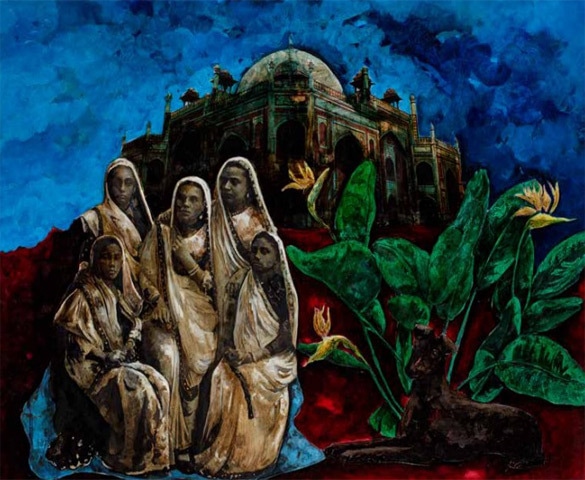
The exhibition brings together paintings on canvas and wasli that rework found colonial photographs of South Asian women, set in conversation with intimate personal images drawn from the artist’s familial past. Syed uses photographs of her legendary grandmother, the singer Malika Pukhraj, who spent her later years in Lahore. Syed spent several formative years closely attached to her and says that the photographs “represent a South Asian woman from the same era who was fierce and formidable in her strength and vulnerable and fallible in her humanness. They, thus, serve as a contrast to the denial of individuality, autonomy and agency in the colonial images.”
Syed reads violence in these images — violence through detached reflection, through distortion and erasure, through a gaze that spoke for women while denying them voice. In her paintings, that violence is neither sensationalised nor aestheticised — it is held in tension with a repaired register.
The works on wasli are the most evident attempt to undo this damage. By reimagining it through a South Asian female gaze, Syed loosens the archival grip that once fixed these women in place. Faces gain expression rather than vacancy and bodies shed their performative submission. The women are no longer captives to a controlling eye but conversers within a visual language that recognises them as individuals.
Farazeh Syed’s recent exhibition takes visual documentation of South Asian women by British colonialists and upends their ways of looking
Syed’s long engagement with the female body — shaped by years of rigorous training under the artist Iqbal Hussain who passed away recently, and informed by her immersion in music — rolls here with quiet confidence. The bodies in ‘All the Women in Me’ are not arranged to please. They occupy space with weight and purpose. Even when seated or motionless, they seem internally active, absorbed in private thought or reminiscence. The women are not there to be seen, they are there to be.
Colour and rhythm do much of the work. Flora and fauna appear as carriers of memory. These elements recall the orchards and animals of her grandmother’s Lahore home, and they also function symbolically, suggesting growth, interdependence and the non-human witnesses to women’s lives that archives ignore. While this exhibition is unmistakably political, the paintings do not lecture. The exhibition trusts viewers to feel their way into its arguments, to recognise the unease of the colonial image and the relief of its undoing.
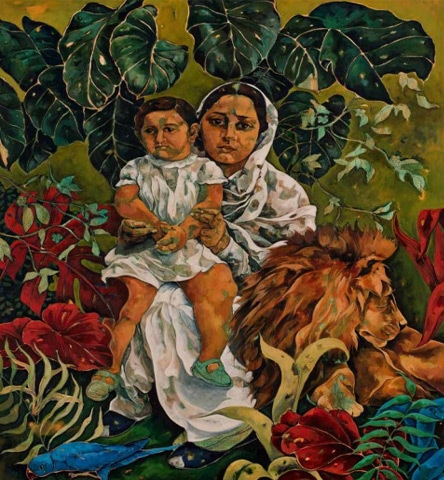
Syed’s interdisciplinary practice, her scholarship, her teaching, her deep relationship to music, all quietly underwrite the exhibition. One feels the discipline of years spent drawing the human form, the patience of research and the lyricism borrowed from raga and rhythm. I imagine that the “me” of the title is not autobiographical but instead expands outwards, encompassing mothers and daughters, known women and unnamed ones, those photographed and those who escaped the lens.
In a wasli painting derived from a colonial ethnographic photograph of a seated woman, the artist pares the scene down to its essentials. The Victorian paraphernalia that once framed the subject, such as long curtains, furniture, architectural prompts, has been stripped away. What remains is the woman, rendered with a gravity that counterattacks submission. Her eyes no longer slip past the viewer in rehearsed vacancy and instead hold a quiet, inward resolve.
The canvases based on photographs of Syed’s grandmother operate as a different chronicle altogether. Her figure fills the frames with unrepentant presence. The brushwork is emphatic but not forceful. Here, distinctiveness emphasises itself through various specifics: the tilt of the head, the compactness of the torso, the unapologetic weight of age and experience. This is not a metaphorical woman but a person whose authority derives from having lived.
Across the exhibition, moments like these accrue importance. The women are no longer frozen in time and are instead allowed to exist within it. In doing so, Syed offers more than a critique of the archive. She models an alternative archival practice that is grounded in empathy, composition and the determination that women’s bodies are not sites of display, but storehouses of lived knowledge.
‘All the Women in Me’ was on display at Canvas Gallery, Karachi from January 20-29, 2026
Rumana Husain is a writer, artist and educator. She is the author of two coffee-table books on Karachi, and has authored and illustrated 90 children’s books
Published in Dawn, EOS, March 1st, 2026