UAVs banned countrywide after Afghan drones downed in parts of KP
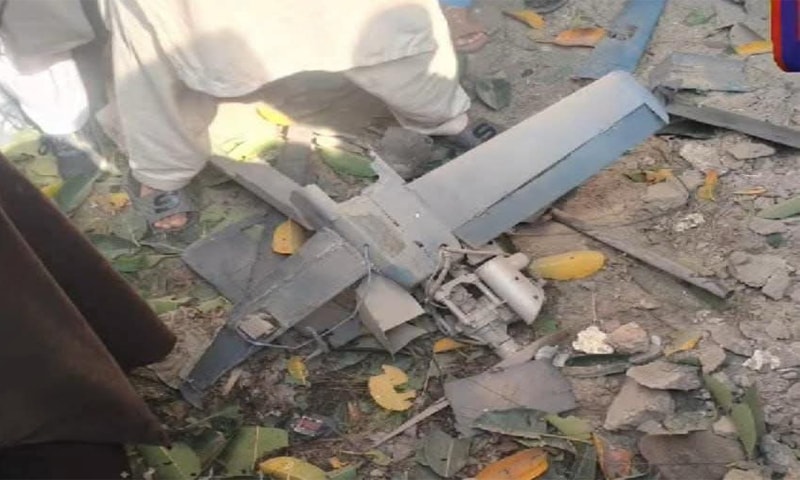
ISLAMABAD: After Afghan Taliban forces used “rudimentary drones” to target various parts of the country, a ban was imposed on flying unmanned aerial vehicles (UAVs) of any kind across the country.
On Friday, a number of ‘drone attacks’ were reported from across part of Khyber Pakhtunkhwa. During his press briefing, Inter-Services Public Relations (ISPR) chief Lt Gen Ahmed Sharif Chaudhry mentioned that Afghan forces tried to use some rudimentary sort of drones to attack areas like Swabi and Abbottabad.
“However, the anti-drone system over there and the effective deployment took them out,” he said.
According to local reports, at least six people were injured in three drone attacks in Bannu, Swabi and Abbotabad.
In Bannu, a mosque in the Mirbaz Barkazai area was targeted by a quadcopter around Iftar, leaving five worshippers injured.
The attack occurred in the evening, while people were inside the mosque breaking their fast. According to reports, a quadcopter drone approached from an unknown direction and dropped explosive material into the mosque roof, triggering a loud blast that injured several individuals.
The incident in Swabi, which occurred near a girls school, was one of the first reported incidents of a drone attack in the area. According to ASP Muhammad Numan, at least one schoolgirl was injured, while other children narrowly escaped.
The incident occurred in Pabbini, a village located in the mountainous region of Gadoon Amazai, when children were playing near a government girls higher secondary school. The school had closed early on account of Friday, and the injured girl, identified as Amna, had just stepped out when the drone struck.
ASP Numan said that the injured girl was taken to hospital for treatment, while residents of the village gathered in large numbers at the site of the attack.
“It was a self-made drone that also contained explosives,” he told Dawn.
Meanwhile in Abbotabad, no loss of life or property was reported when a drone flying over the cantonment area was brought down by forces around 1pm on Friday, the local DPO confirmed.
Ban on drone flying
In view of drones being used, ostensibly by Afghan Taliban forces, to stage attacks inside Pakistani territory, drone-flying has been banned in nearly all parts of the country.
The administrations of Islamabad, Khyber Pakhtunkhwa, Gilgit-Baltistan and Sindh notified a comprehensive ban on flying UAVs of any sort, for different periods of time.
The Islamabad administration has banned the use of drones, phantoms and camcopters in the federal capital for two months under Section 144 of the Code of Criminal Procedure, which can be extended for another two months. The ban applies on everyone, except law enforcement agencies and the Islamabad Administration.
A spokesperson for Gilgit-Baltistan police told Dawn flying drones has been banned in all districts of Gilgit-Baltistan for an indefinite period.
The region witnessed demonstrations in favour of the Pakistan Army, and security checks were also heightened in the region following the skirmishes between Pakistan and Afghanistan.
A Gilgit-Baltistan police spokesperson said the decision to impose ban on flying drones in all districts of the region had been taken on instructions of the federal interior ministry.
In Khyber Pakhtunkhwa, the Home and Tribal Affairs Department issued a notification banning the use of drones, quadcopters and UAVs for one month, classifying it as a “direct or indirect threat and… potential risk to the lives and properties of citizens as well as infrastructure of the government”.
In a separate notification, the additional chief secretary of Sindh also imposed a similar restriction on the use of helicams, drones, UAVs and quadcopters for two months. The ban, however, would not apply to law enforcement or intelligence agencies, and would be enforced by local police.
A similar notification from the Balochistan home department imposed a complete ban on the use, possession, and operation of remote-controlled aerial devices in the province, due to concerns over surveillance, espionage, transportation of prohibited items and explosives, spreading fear, and disrupting law and order. The ban will remain in place indefinitely. Punjab had already banned the flying of drones and UAVs in its jurisdiction for 30 days, starting on Wednesday.
Syed Irfan Raza in Islamabad, Jamil Nagri in Gilgit, Manzoor Ali in Peshawar, Saleem Shahid in Quetta, Rashid Javed in Abbotabad, Muqaddam Ali Khan in Swabi and Muhammad Waseem Khan in Bannu also contributed to this report
Published in Dawn, February 28th, 2026