0
0

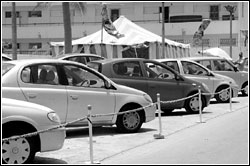 THE budget 2006-2007 has opened the over-heated car market for new comers with incentives— questionable black cab import programme and additional incentives for import of used cars.
The local car assemblers have been protesting for the last one and a half years against the liberal imports. Its outcome is visible on the roads in which second hand cars now run side by side with locally assembled cars.
The government opened the Japanese dominated car market for the Europeans in order to bridge the shrinking demand and supply gap.
With demand outstripping the supply, before the 2006-2007 budget, new entrants were allowed to import 100 per cent completely knocked down kits (CKD) and components at statuary customs duty rate applicable to the import of components, not manufactured locally, for a period of three years from the start of production.
Also the import of 300 black cabs in CBU conditions have been exempted from all taxes. However, five per cent duty on CKD and 20 per cent on CBU beyond the initial 300 vehicle have been levied.
In the new budget, importers of used cars have been provided a relief by allowing five year old car under transfer of residence scheme. A European company plans to bring Rs1 billion investment in setting up a plant in Punjab while another plans to roll out cars in one of the existing car assembly plants at Port Qasim.
The local assemblers are not happy over the government’s move of allowing new entrants saying that the local industry has made tremendous investment in raising capacity and upgrading products.
The industry claims that it has recorded an average 30 per cent growth per annum for the last four to five years. Its target is to raise its output from the current 215,000 units per annum to half a million by 2011-2012.
The Indus Motors sees its production capacity rising to 100,000 by 2011 from the current 44,000 units while Suzuki is targeting 250,000 units per annum from the current 90,000 units while Honda plans to roll out 100,000 cars by 2011 from the current 30,000 and Dewan intends assembling 48,000 units from the current 20,000.
However, all the four assemblers want a “level playing field” between the current and new players.
They feel threatened by the rising imports of used cars whose numbers, they believe may touch 100,000 units by 2006-2007 (about 40 per cent of total car market) from the existing 36,000 units of 2005-2006, if the trend continues unchecked.
They allege that the facility provided to overseas Pakistanis for used car import is being misused by the second hand car dealers, while the auto assemblers were facing a growing competition from the second-hand car dealers. Moreover, it was a drain on foreign exchange reserves and widens the trade deficit.
The assemblers claim that they are feeling the pinch of used car imports in some categories of vehicles whose daily booking, they say, has fallen sharply besides their delivery periods have been shortened to just one month from three months. The budget has remained neutral but for the announcement introducing tariff-based system (TBS) on cars from July 1, 2006.
The customs duty at 50 per cent on A-max parts (localised parts) has been levied. These are the parts that have been localised by one original equipment manufacturer (OEM) and not by others. This unequal localisation by different OEMs occurs because under the scheme of Industry Specific Deletion Programme (ISDP) each OEM had the option to select parts from a basket of parts. A part chosen to be localised by one assembler may not have been chosen by other car maker.
As per ISDP — OEMs were required to develop the parts in the given timeline. Now due to the immediate imposition of 50 per cent customs duty, there will be an increase in import costs till the parts are localised.
To offset this increase in costs, the industry was expecting that the duty on CKD kits would be reduced to 32.5 per cent from 35 per cent in budget 2006-2007 but it did not happen. Now, the cost of all the manufacturers will increase, says a company executive.
The Vendor Industry (Pakistan Association of Automotive Parts and Accessories Manufacturers) is concerned over the rising import of used cars under various schemes. One of the PAAPAM officials says that 3,000-4,000 used cars are arriving every month. Now vehicles, five-years old against the previous three-years old, have been allowed in the new budget.
He says that the vending industry has invested Rs125 billion in the past five years and over Rs20 billion spending is in the pipeline. Import of used cars should be stopped otherwise the vendors will suffer.
He adds that indigenisation level in cars up to 800cc has reached over 73 per cent as compared to 67 per cent in 1999 while deletion level in cars up to 1,200cc has touched over 65 per cent from 49 per cent in 1999. Deletion in cars above 1,200cc has crossed 62 per cent from 44 per cent in 1999.
Car sales during July-May 2005-2006 surged by 23 per cent to 140,072 units from 113,640 units in the same period of 2004—2005.
The influx of used cars has reduced in premiums being charged on some of the locally assembled cars. The delivery period has also been reduced but it still ranges from two to five months for cars in big demand.
This demand has surged, artificially triggered by the auto leasing that accounts for over 70 per cent market shares. Besides, huge inflow of remittances has also played a pivotal role in boosting the car demand.