



 0
0

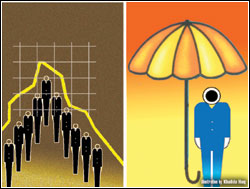 A civilised society should provide old age security to all citizens. Pakistan’s Constitution states this as a non-mandatory directive principle. The need for a basic subsistence pension covering the whole labour force is widely accepted. This is the first pillar of old age security.
Pension schemes for employees of the federal and provincial governments, and Defence Services, are well known. But EOBI is the only pension scheme which provides pensions for ordinary working persons.
EOBI stands for “Employees’ Old Age Benefits Institution”, established in 1976. EOBI provides pensions to insured persons, commencing at age 60. It also provides pensions to spouses on the death of insured persons, whether death occurs before or after the age of 60.
EOBI pensions are modest, aimed at subsistence. The pension at age 60, if contributions are made for 40 years, would be 80 per cent of the minimum wage in force at the time of attaining age 60.
At the minimum wage of Rs3,000 per month, the pension after 40 years’ contributions would be Rs2,400 per month. In practice, the average contribution period would probably be around 20 years, and the pension would be about Rs1,200 per month, at the minimum wage of Rs3,000 per month. But there is a minimum pension, at present Rs1,000 per month.
The cost of EOBI pensions does not fall on the government. The cost is met from the EOBI Fund. This is built up by contributions from employers and employees. At present, employers contribute six per cent of the minimum wage, i.e. Rs180 per month, and employees contribute one per cent, i.e. Rs30 per month, total seven per cent i.e. Rs210 per month. These contributions, plus investment income on the fund, pay for the pensions.
As of today, there are about 225,000 EOBI pensioners, including about 25,000 widows.
Pakistan’s labour force was estimated at 42 million on January 1, 2004. Their average income was Rs4,088 per month. Most Pakistanis live from hand to mouth. Their capacity to save is limited or zero. When they can no longer work, they depend on children, or other family members or on charity. Many live in abject poverty. They desperately need a basic subsistence pension, like that provided by EOBI.
Unfortunately, only 1.5 million active working persons aged under 60 are insured by EOBI, which is about four per cent of the total. They stand to get pensions at age 60. But 96 per cent of Pakistan’s Labour Force will get no pensions. Restrictions on the scope of EOBI are the cause for this low coverage. A very important restriction is that there must be at least 10 employees for an establishment to join the scheme. This number has remained fixed since July 1, 1976.
Suppose a person works in an establishment with only five persons. What sin has he committed that he is deprived of a pension? Similarly, take a person is on daily wages. What sin has he committed that he will not get a pension?
A conference was held in January 1993, attended by representatives of federal and provincial governments, employers and workers. The undersigned presented a phased programme to extend EOBI to the entire labour force stretched over 20 years. This was warmly received. A leading employer said “why wait for 20 years, let’s do it faster”.
A commission was set up later in 1993 and two task forces were set up in 1994 and 1996, to study the issue. All of them advocated expansion of EOBI to cover the entire labour force. The task forces thought 20 years was too long, and recommended phased programmes of seven or 10 years respectively. If their reports had been implemented, the entire labour force would have been entitled to pensions by now. However, the political will was absent, and these reports have gathered dust.
Unfortunately, the Finance Bill, 2006, goes in the opposite direction, to cut down pension coverage, instead of expanding it. The Bill proposes that industries and establishments set up from July 1, 2006 will join the EOBI scheme only if there are at least 20 employees, compared with the present minimum of 10. This would exclude about 10 per cent of employees engaged by industries and establishments set up in future. As the economy grows, it would deprive tens of thousands of poor persons of pensions. Their widows would be deprived of pensions after the worker dies.
It would raise the level of poverty among old persons and widows. It is directly contrary to the direct principles of the Constitution and contrary to the poverty reduction programme. Employers would gain what their employees would lose: a straight transfer from the poor to the rich, a zero sum game favouring the rich.
Perhaps these implications were not fully understood when the proposal was framed.
The Finance Act, 2005, made commendable changes in the EOBI scheme. Contributions and benefits were linked to the minimum wage. The minimum wage was raised from Rs2,500 to Rs3,000 per month. This made EOBI easier to administer, and to expand it. The minimum pension was raised to Rs1,000 per month.
The Finance Bill, 2006, also proposes some good changes. The minimum wage is proposed to be raised to Rs4,000 pm. If contributions are made for 40 years, the pension would be Rs3,200 pm on the basis of this proposed minimum wage. If the average contribution period is 20 years, the pension would be Rs1,600 per month. The minimum pension is proposed to be raised to Rs1,300 per month.
These positive changes should not be negated by excluding tens of thousands of poor persons, by raising the EOBI thresh-hold to 20 persons. This proposal should be decisively rejected.
The voluntary pension scheme introduced in 2005 may have some merit for income tax payers, whose number was just over one million. The average income tax paid by individuals was Rs51,000. This is an elite, a totally different proposition from the labour force of 45 million, with an average income of around Rs5,000 per month.. Experience in developed countries is that about 40 per cent taxpayers ultimately join voluntary schemes. So VPS coverage will at best reach perhaps 200,000 to 400,000 persons, after many years.
For the vast majority of the labour force of over 45 million, VPS and other schemes set up under the Income Tax Ordinance, 2001 are mirages. They distract us from delivering subsistence pensions to the entire labour force.
Expansion of the EOBI scheme as recommended by the commissions and task forces is the only practical vehicle. Of course, EOBI is not perfect. Its operations need to be greatly improved. But this does not mean that the scheme should be damaged or cut down.
The writer is a consulting actuary and a former chairman of the State Life






























