



 0
0

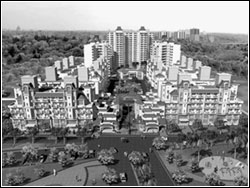 THE property sector in leading Indian cities – including Mumbai, Delhi, and Bangalore – has been experiencing a boom over the past one year, with prices galloping by almost a 100 per cent in many select areas.
The soaring fortunes of the information technology and other high-tech sectors are fuelling demand for both residential and commercial properties in these three cities, driving the industry. The Indian government has also liberalised the investment rules, allowing 100 per cent foreign direct investment (FDI) in the sector.
Billions of rupees are being channelled into the sector, and analysts expect growth to continue for a few more years. The finance ministry is also eager to enhance the flow of funds into the real estate sector, and had recently directed the Securities and Exchange Board of India (SEBI), the country’s capital market regulator, to draw guidelines for real estate mutual funds.
India does not have an overall regulator for the real estate sector, and individual state governments – or their urban development departments – and municipal corporations are supposed to regulate the industry. However, corruption is rife in most states and cities, and many unscrupulous builders are able to flout regulations by bribing officials.
The entry of foreign and institutional funding is expected to clean up the mess in the sector. Last week, M. Damodaran, chairman, SEBI – who had earlier helped in overhauling the country’s mutual fund sector – announced that the regulator would shortly be coming out with guidelines for real estate mutual funds (REMFs).
India does not have any formal REMFs or Real Estate Investment Trusts (REITs) – as they are known in countries like the US. Some leading financial institutions had in recent months taken tentative steps in setting up real estate funds. But only high net-worth individuals and institutions have participated in these funds.
SEBI has given the green signal to some 20 venture capital funds to invest in the buoyant real estate trade. But retail investors have been deprived of an opportunity to partake in the buoyancy in the Indian real estate sector. REITs are expected to be established in India by next year, and mutual funds too could emerge as major players in the sector.
A.P. Kurian, chairman, Association of Mutual Funds in India (AMFI), points out that investments in real estate funds would easily exceed those from the capital markets, and thousands of ordinary investors would want to channelise part of their savings in these funds.
Deutsche Bank, which recently came out with a report on the Indian real estate sector, points out that introduction of REITs would provide global investors a familiar investment vehicle. These trusts would also bring about much-needed transparency and reduce liquidity risks.
The bank notes that India’s institutional real estate market is under-developed, with professional real estate firms accounting for a negligible share of the market. Traditionally, real estate developers – who do not have access to bank funding – have had to depend on ‘investors’ or ‘speculators,’ who would invest in a few apartments or office units, and dispose them once the project is ready.
REITs and REMFs can access funds from the public and invest them in real estate projects. If the properties are sold after being developed, the REMF would be treated as an equity fund, but if it were to earn income out of renting the properties, it would be considered a debt fund by SEBI.
INTERESTINGLY, one of the biggest IPOs (Initial Public Offerings) to hit the Indian market later this month, or in early July, is from a real estate developer. The DLF group, controlled by K P Singh, a billionaire developer of Delhi, and his family members, is one of the largest property developers in the country.
Very few developers in India have gone in for listings on the stock markets, depriving them of money. DLF’s proposed IPO – the company plans to raise a whopping $3 billion through the issue – has already resulted in a slew of other issues by smaller real estate developers, some with terrible credentials.
The DLF group, which owns properties in over 200 million sq ft of land in about three-score cities in India, will be launching its ambitious IPO shortly. The group owns over 4,000 acres of land, worth an estimated Rs800 billion. However, the recent volatility in the stock markets has dampened sentiments, and the bankers managing the issue are likely to scale down the size of the issue.
DLF, together with a handful of other Delhi-based developers, have been engaged in a bidding war in recent months, offering fantastic sums at auctions by government agencies. Last week, DLF’s Delhi rival, Parsvnath Developers won a deal to develop a 130-acre plot of land in Chandigarh, for a whopping Rs8.21 billion.
This was the third largest land deal in India, and DLF has been involved in bidding in all the major deals. Late last month, another Delhi-based developer, Unitech, won the biggest land deal in the country, when it bid an amazing Rs15.82 billion to develop a 300-acre plot in Noida on the outskirts of the national capital. DLF was the second highest bidder (Rs14.01 billion).
DLF succeeded in its bid for acquiring mill-land owned by state-controlled National Textile Corporation (NTC), a few months ago, paying Rs7.02 billion for a 16.5-acre plot in central Mumbai.
*****
SEVERAL major international property developers and financiers have made a beeline to India after the government allowed 100 per cent FDI in the sector. Dubai-based Emaar Properties, for instance, has tied up with a Delhi-based developer, and has been participating in the recent auctions in north India.
Emaar has had a head start among the international players, having won the contract to develop a sprawling project on the outskirts of Hyderabad, where it is putting up a golf course, luxury hotel and convention centre on a 100-acre plot of land. Emaar is also keen on promoting a software park in Kochi in Kerala, and is busy acquiring land in other major Indian cities.
The Dubai company has ambitious plans to develop $4 billion worth of projects in India, including residential townships, office complexes, hotels and shopping malls. After the opening up of the sector, about $500 million in FDI has entered India, and dozens of leading firms are toying with the idea of setting up a presence.
Leading American property developer, Tishman Speyer Properties, has been one of the first international majors to take advantage of the new policy. It has set up TSI Venture Ltd, together with ICICI Venture Funds Management Co, to develop projects in India. Tishman Speyer plans to invest about a billion dollars in the sector over the next three years.
Other American institutions have also started investing in the sector. GE Commercial Finance Real Estate – part of GE – has invested over $60 million in a fund, while the California Public Employees’ Retirement System has injected about a $100 million. Morgan Stanley has invested about $70 million, while General Motors is expected to bring in a large amount shortly, especially to develop special economic zones.
Similarly, several Singapore-based developers – including Ascendas, CapitaL and Keppel Land – have also taken up projects, especially around Bangalore. The Trinity Capital Fund raised about $450 million recently and listed on the London Stock Exchange, and the proceeds will be invested in the Indian real estate sector.
Prominent NRI groups, including the Chatterjee Group, and the Royal Indian Raj International Corporation of Canada, are also investing a few hundred million dollars into the sector. The Indian government has received about 100 applications from international companies eager to invest..
For an industry that had always been starved off funds, and had to depend on unreliable financiers for decades, the skies have suddenly opened up, as foreign investors rush in with much-needed cash.






























