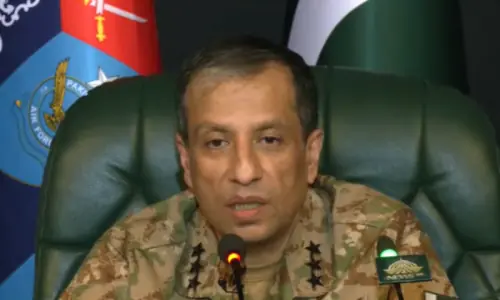
KARACHI: At least 27 riverine (katcha) area bandits have been killed, 82 wounded and 77 arrested in 113 encounters since the launch of Operation Nijaat-i-Mehran in January 2026, Sindh Inspector General of Police (IGP) Javed Alam Odho said on Friday.
Briefing the media at the Central Police Office, the he said the operation was launched on the directives of the Sindh government to eliminate criminal gangs operating in the katcha areas. He added that 123 bandits had surrendered before law-enforcement agencies as part of the government’s policy.
Flanked by Additional IGP Sindh Iqbal Dara, Mr Odho said that 15 abductees had been safely recovered during the operation, adding that some of the victims had remained in captivity for up to three years under inhuman conditions.
In an oblique reference to previous operations against riverine dacoits that failed to achieve lasting results, the IG said that a comprehensive strategy had been formulated which incorporates socio-economic measures alongside enforcement actions.
Says operation will continue till ‘total annihilation of crime’, permanent ‘riverine police unit’ will be set up
He vowed to continue the operation until the “complete elimination” of crime from the katcha areas. The plan, he said, included de-weaponisation of riverine zones where even military-grade arms were found.
Mr Odho said that longstanding tribal feuds, which had served as breeding grounds for criminals by providing manpower and weapons, would be addressed. He attributed these conflicts to egos, attempts to occupy state land and petty disputes. While some tribal elders had cooperated with law enforcers, he warned that headstrong chiefs would be dealt with strictly.
He further announced that a permanent police presence would be established in the cleared areas to prevent the re-emergence of criminal groups. He said that difficult-to-access localities such as Bagarji and Ranwati had recently been cleared, and notorious gangs operating there had been eliminated.
The IG said that a socio-economic development plan had also been prepared for the riverine belt. He expressed hope that the proposed Ghotki-Kandhkot bridge over the Indus would improve access for law enforcers and help curb criminal activity, similar to the impact of the Dadu-Moro bridge in the past. Roads, dispensaries and schools would be established, he added. He also shared that several Karachi-based NGOs had pledged support for setting up educational institutions in the area.
Recalling earlier initiatives, Mr Odho said that socio-economic uplift projects launched in Ghotki district in 2003 with the support of oil and gas companies had benefited local communities and helped eliminate criminal elements.
He also announced the establishment of a dedicated riverine police unit to ensure a sustained law-enforcement presence in the katcha areas.
The IG said that the riverine belt extended over about 450 kilometres in Sindh, of which 50-60kms were currently disturbed. He identified two major challenges: the difficult terrain comprising waterways, fertile lands and islands, and the proximity of these areas to bordering regions of other provinces, particularly Punjab.
Responding to a question about alleged political patronage of riverine bandits, the IG said that while some individuals might support criminals due to caste ties or land-related interests, the government had given police a free hand and there was no pressure on law enforcers.
On the issue of arms inflow, he said that recent security operations in Balochistan were expected to improve the situation and reduce the supply of sophisticated weapons to riverine areas. Any remaining loopholes would be addressed with the help of the federal government.
Mr Odho said that around 150,000 people lived in bandit-infested katcha areas and that the Sindh government had decided to rehabilitate them. If required, they would be allotted state land to earn their livelihoods through lawful means.
Street crime in Karachi
The IG said that besides riverine banditry, street crime in Karachi remained a major challenge for the police. Recalling past conditions, he said the metropolis once suffered from organised crime and terrorism and there were several no-go areas inaccessible even to police.
He said that peace was restored after the sacrifice of more than 1,100 police personnel. “Crime has not been eliminated in Karachi,” he said but added that there had been a noticeable decline.
He vowed to further improve the law-and-order situation in the provincial capital.
Published in Dawn, February 7th, 2026